The piston in the cylinder head of locomotive has a stroke of $6\,m$ (which is twice the amplitude). If the piston executing simple harmonic motion with an angular frequency of $200\, rad\, min^{-1}$, its maximum speed is .... $ms^{-1}$
Medium
Download our app for free and get started
Amplitude $=\frac{6}{2}=3 \mathrm{m}$
$\mathrm{V}_{\max }=\mathrm{A} \omega=3 \times \frac{200}{60}=10 \mathrm{ms}^{-1}$

Download our appand get started for free
Experience the future of education. Simply download our apps or reach out to us for more information. Let's shape the future of learning together!No signup needed.*
Similar Questions
- 1The length of a spring is $l$ and its force constant is $k$. When a weight $W$ is suspended from it, its length increases by $x$. If the spring is cut into two equal parts and put in parallel and the same weight $W$ is suspended from them, then the extension will beView Solution
- 2The force-deformation equation for a nonlinear spring fixed at one end is $F =4x^{1/ 2}$ , where $F$ is the force (expressed in newtons) applied at the other end and $x$ is the deformation expressed in metersView Solution
- 3Two identical pendulums oscillate with a constant phase difference $\frac{\pi}{4}$ and same amplitude. If the maximum velocity of one is $v$, the maximum velocity of the other will be ........View Solution
- 4The scale of a spring balance reading from $0$ to $10 \,kg$ is $0.25\, m$ long. A body suspended from the balance oscillates vertically with a period of $\pi /10$ second. The mass suspended is ..... $kg$ (neglect the mass of the spring)View Solution
- 5A particle executes $S.H.M.$ and its position varies with time as $x=A$ sin $\omega t$. Its average speed during its motion from mean position to mid-point of mean and extreme position isView Solution
- 6The equation of motion of a particle is $\frac{{{d^2}y}}{{d{t^2}}} + Ky = 0$, where $K$ is positive constant. The time period of the motion is given byView Solution
- 7A pendulum has time period $T$. If it is taken on to another planet having acceleration due to gravity half and mass $ 9 $ times that of the earth then its time period on the other planet will beView Solution
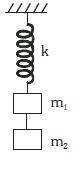
- 8Two masses $m_1$ and $m_2$ are supended together by a massless spring of constant $k$. When the masses are in equilibrium, $m_1$ is removed without disturbing the system; the amplitude of vibration isView Solution
- 9The displacement time equation of a particle executing $SHM$ is : $x = A \,sin\,(\omega t + \phi )$. At time $t = 0$ position of the particle is $x = A/2$ and it is moving along negative $x-$ direction. Then the angle $\phi $ can beView Solution
- 10Two bodies performing $SHM$ have same amplitude and frequency. Their phases at a certain instant are as shown in the figure. The phase difference between them isView Solution