The scale of a spring balance reading from $0$ to $10 \,kg$ is $0.25\, m$ long. A body suspended from the balance oscillates vertically with a period of $\pi /10$ second. The mass suspended is ..... $kg$ (neglect the mass of the spring)
Medium
Download our app for free and get started
(b) Using $F = kx$
$ \Rightarrow 10g = k \times 0.25$
$\Rightarrow k = \frac{{10g}}{{0.25}} = 98 \times 4$
Now $T = 2\pi \sqrt {\frac{m}{k}}$
$\Rightarrow m = \frac{{{T^2}}}{{4{\pi ^2}}}k$
$ \Rightarrow m = \frac{{{\pi ^2}}}{{100}} \times \frac{1}{{4{\pi ^2}}} \times 98 \times 4 = 0.98\;kg$

Download our appand get started for free
Experience the future of education. Simply download our apps or reach out to us for more information. Let's shape the future of learning together!No signup needed.*
Similar Questions
- 1Abody performs simple harmonic oscillations along the straight line $ABCDE$ with $C$ as the midpoint of $AE.$ Its kinetic energies at $B$ and $D$ are each one fourth of its maximum value. If $AE = 2R,$ the distance between $B$ and $D$ isView Solution

- 2For a body executing $S.H.M. :$View Solution
$(a)$ Potential energy is always equal to its $K.E.$
$(b)$ Average potential and kinetic energy over any given time interval are always equal.
$(c)$ Sum of the kinetic and potential energy at any point of time is constant.
$(d)$ Average $K.E.$ in one time period is equal to average potential energy in one time period.
Choose the most appropriate option from the options given below:
- 3A spring having a spring constant $‘K’$ is loaded with a mass $‘m’$. The spring is cut into two equal parts and one of these is loaded again with the same mass. The new spring constant isView Solution
- 4A large horizontal surface moves up and down in $SHM$ with an amplitude of $1 \,cm$. If a mass of $10\, kg$ (which is placed on the surface) is to remain continually in contact with it, the maximum frequency of $S.H.M.$ will be ... $Hz$View Solution
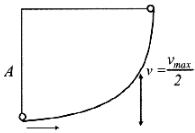
- 5A particle starts with $S.H.M.$ from the mean position as shown in the figure. Its amplitude is $A$ and its time period is $T$. At one time, its speed is half that of the maximum speed. What is this displacement?View Solution
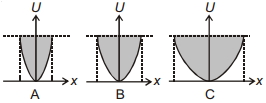
- 6The variations of potential energy $(U)$ with position $x$ for three simple harmonic oscillators $A, B$ and $C$ are shown in figure. The oscillators have same mass. The time period of oscillation is greatest forView Solution
- 7A particle moves with simple harmonic motion in a straight line. In first $\tau \,s$, after starting from rest, it travels a distance $a$, and in next $\tau \,s$, it travels $2a$ in same direction thenView Solution
- 8Amplitude of a wave is represented by $A = \frac{c}{{a + b - c}}$ Then resonance will occur whenView Solution
- 9Column $I$ gives a list of possible set of parameters measured in some experiments. The variations of the parameters in the form of graphs are shown in Column $II$. Match the set of parameters given in Column $I$ with the graph given in Column $II$. Indicate your answer by darkening the appropriate bubbles of the $4 \times 4$ matrix given in the $ORS$.View Solution
Column $I$ Column $II$ $(A)$ Potential energy of a simple pendulum (y axis) as a function of displacement ( $\mathrm{x}$ axis) $Image$ $(B)$ Displacement (y axis) as a function of time (x axis) for a one dimensional motion at zero or constant acceleration when the body is moving along the positive $\mathrm{x}$-direction $Image$ $(C)$ Range of a projectile (y axis) as a function of its velocity ( $\mathrm{x}$ axis) when projected at a fixed angle $Image$ $(D)$ The square of the time period (y axis) of a simple pendulum as a function of its length ( $\mathrm{x}$ axis) $Image$ 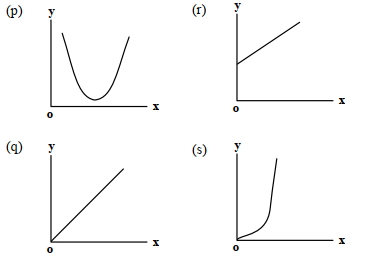
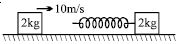
- 10A $2\, Kg$ block moving with $10\, m/s$ strikes a spring of constant $\pi ^2 N/m$ attached to $2\, Kg$ block at rest kept on a smooth floor, the velocity of the rear $2\, kg$ block after it separates from the spring will be ..... $m/s$View Solution