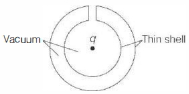
A positive charge $q$ is placed at the centre of a neutral hollow cylindrical conducting shell with its cross-section as shown in the figure below. Which one of the following figures correctly indicates the induced charge distribution on the conductor? (Ignore edge effects)
KVPY 2017, Advanced
Download our app for free and get started
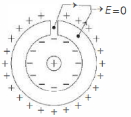
$(a)$ As no ficld exists inside the shell body or in the cavity, correct charge distribution is as shown below in the figure,

Download our appand get started for free
Experience the future of education. Simply download our apps or reach out to us for more information. Let's shape the future of learning together!No signup needed.*
Similar Questions
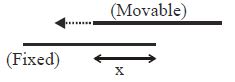
- 1A parallel-plate capacitor consists of a fixed plate and a movable plate that is allowed to slide in the direction parallel to the plates. Let $x$ be the distance of overlap, as shown in the figure. The separation between the plates is fixed. Assume that the plates are electrically isolated, so that their charges $±Q$ are constant. Force on the movable plate is proportional toView Solution
- 2Two charged spherical conductors of radius $R_{1}$ and $\mathrm{R}_{2}$ are connected by a wire. Then the ratio of surface charge densities of the spheres $\left(\sigma_{1} / \sigma_{2}\right)$ is :View Solution
- 3If the charge on a capacitor is increased by $2$ coulomb, the energy stored in it increases by $21\%$. The original charge on the capacitor is....$C$View Solution
- 4View SolutionA parallel plate capacitor after charging is kept connected to a battery and the plates are pulled apart with the help of insulating handles. Now which of the following quantities will decrease?
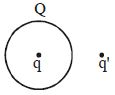
- 5A thin metallic spherical shell contains a charge $Q$ on it. A point charge $+q$ is placed at the centre of the shell and another charge $q'$ is placed outside it as shown in fig. All the three charges are positive. The force on the central charge due to the shell is :-View Solution
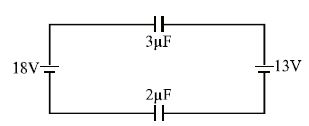
- 6Two batteries and two condensers are connected as shown in the figure. The charge on $2\,\mu F$ capacitor is.....$\mu F$View Solution
- 7Two identical positive charges are placed at $x =\, -a$ and $x = a$ . The correct variation of potential $V$ along the $x-$ axis is given byView Solution
- 8After the switch shown in figure $A$ is closed, there is current $i$ through resistance $R$. Figure $B$ indicates current variation curves $a, b, c$ and $d$ for four sets of values of $R$ and capacitance $C$:View Solution
$(i)$ $R_0$ and $C_0$, $(ii)$ $2R_0$ and $C_0$,
$(iii)$ $R_0$ and $2C_0$, $(iv)$ $2R_0$ and $2C_0$.
Which set goes with which curve?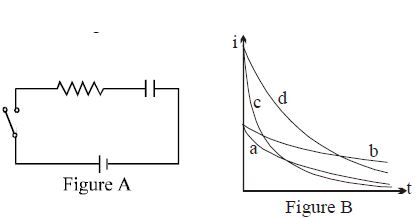
- 9Two metallic spheres of radii $1\,cm$ and $2\,cm$ are given charges ${10^{ - 2}}\,C$ and $5 \times {10^{ - 2}}\,C$ respectively. If they are connected by a conducting wire, the final charge on the smaller sphere isView Solution
- 10Two point dipoles of dipole moment ${\vec P_1}$ and ${\vec P_2}$ are at a distance $x$ from each other and ${\vec P_1}$ || ${\vec P_2}$. The force between the dipoles isView Solution