The plates of a parallel plate condenser are pulled apart with a velocity $v$. If at any instant their mutual distance of separation is $d$, then the magnitude of the time of rate of change of capacity depends on $d$ as follows
Diffcult


Download our appand get started for free
Experience the future of education. Simply download our apps or reach out to us for more information. Let's shape the future of learning together!No signup needed.*
Similar Questions
- 1With the rise in temperature, the dielectric constant $K$ of a liquidView Solution
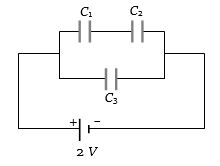
- 2Two capacitors ${C_1} = 2\,\mu \,F$ and ${C_2}\, = \,6\,\mu \,F$ in series, are connected in parallel to a third capacitor ${C_3} = \,4\,\mu \,F$. This arrangement is then connected to a battery of $e.m.f.$ $=$ $2V$, as shown in the figure. How much energy is lost by the battery in charging the capacitorsView Solution
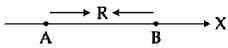
- 3Two electric dipoles $A, B$ with respective dipole moments $\overrightarrow {{d_A}} = - 4\,qa\,\hat i$ and $\overrightarrow {{d_B}} = 2\,qa\,\hat i$ are placed on the $x-$ axis with a separation $R$, as shown in the figure. The distance from $A$ at which both of them produce the same potential isView Solution
- 4Two charges $ + 3.2 \times {10^{ - 19}}\,C$ and $ - 3.2 \times {10^{ - 19}}\,C$ kept $2.4\, \mathop A\limits^o $ apart forms a dipole. If it is kept in uniform electric field of intensity $4 \times {10^5}\,volt/m$ then what will be its electrical energy in equilibriumView Solution
- 5Two identical capacitors, have the same capacitance $C$. One of them is charged to potential $V_1$ and the other to $V_2$. The negative ends of the capacitors are connected together. When the positive ends are also connected, the decrease in energy of the combined system isView Solution
- 6The work done to take an electron from rest where potential is $-60\, V$ to another point where potential is $-20\, V$ is given by.....$eV$View Solution
- 7View SolutionVariation in electric potential is maximum if one goes
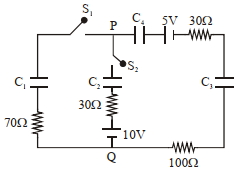
- 8In the circuit shown, initially there is no charge on capacitors and keys $S _1$ and $S _2$ are open. The values of the capacitors are $C _1=10 \mu F , C _2=30 \mu F$ and $C _3= C _4=80 \mu F$.View Solution
Which of the statement($s$) is/are correct ?
$(1)$ The keys $S _1$ is kept closed for long time such that capacitors are fully charged. Now key $S _2$ is closed, at this time, the instantaneous current across $30 \Omega$ resistor (between points $P$ and $Q$ ) will be $0.2 A$
$(2)$ If key $S _1$ is kept closed for long time such that capacitors are fully charged, the voltage difference between points $P$ and $Q$ will be $10 V$.
$(3)$ At time $t =0$, the key $S _1$ is closed, the instantaneous current in the closed circuit will be $25 mA$.
$(4)$ If key $S _1$ is kept closed for long time such that capacitors are fully charged, the voltage across the capacitors $C _1$ will be $4 V$.
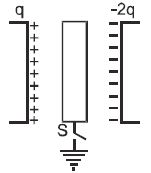
- 9The metal plate on the left in figure carries a charge $+q$. The metal plate on the right has a charge of $-2q$. What charge will flow through $S$ when it is closed, if central plate is initially neutralView Solution
- 10A capacitor is discharging through a resistor $R$. Consider in time $t _{1}$, the energy stored in the capacitor reduces to half of its initial value and in time $t_{2}$, the charge stored reduces to one eighth of its initial value. The ratio $t_{1} / t_{2}$ will be ................View Solution