Question
The position of a particle is given by $\vec{\text{r}}=9\text{t}\hat{\text{i}}+6\text{t}^2\hat{\text{j}}+8\hat{\text{k}},$ where $t$ is in seconds and the coefficients have the proper units for $\vec{\text{r}}$ to be in metres.
  1. Find velocity $\vec{\text{v}}(\text{t})$ of particle and $\vec{\text{a}}(\text{t})$ acceleration of the particle.
  2. Find the magnitude and direction of $\vec{\text{v}}(\text{t})$ at $t = 2sec.$
Answer

$\vec{\text{r}}=9\text{t}\hat{\text{i}}+6\text{t}^2\hat{\text{j}}+8\hat{\text{k}}$ $\vec{\text{v}}(\text{t})=\frac{\vec{\text{dr}}}{\text{dt}}=9\hat{\text{i}}+12\text{t}\hat{\text{j}}$ $\vec{\text{a}}(\text{t})=\frac{\vec{\text{dv}}}{\text{dt}}=12\hat{\text{j}} = 12m/ s$ along $y-$axis At $t = 2 \vec{\text{v}}=9\hat{\text{i}}+12(2)\hat{\text{j}}$
or, $\vec{\text{v}}=9\hat{\text{i}}+24\hat{\text{j}}$
magnitude, $|\vec{\text{v}}|=\sqrt{(9)^2+(24)^2}=25\text{ m/s}$ direction $\theta=\tan^{-1}\Big(\frac{25}{9}\Big)$ with $x-$axis

Need a full question paper?

Generate a complete, print-ready paper with questions like this in minutes — across 16+ boards, with answer keys.

Start Generating Free

Similar questions

If the Earth were to suddenly contract to $\frac{1}{\text{n}}^{\text{th}}$ of its present radius, without any change in its mass, then what will be the effect on the duration of the day?
Calculate the temperature which has same numeral value on celsius and Fahrenheit scale.
State and explain Work-Energy theorem.
If the horizontal force needed for the turn in the previous problem is to be supplied by the normal force by the road, what should be the proper angle of banking?
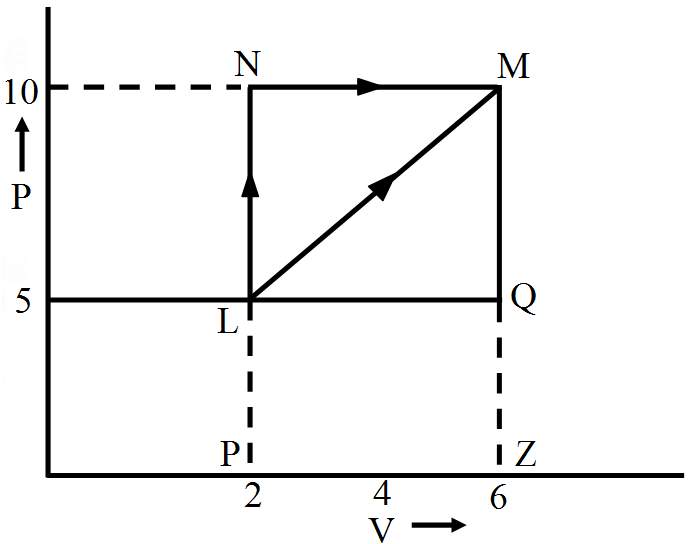
An ideal gas changes its state from $L$ to $M$ by two path $\text{LNM}$ and $LM$.
  1. Is the work done same for two paths?
  2. The internal energy of gas at $L$ is $20J$ and the amount of heat needed to change its state through $LM$ is $400J$. What is the internal energy of gas at $M$?
A trolley of mass $300kg$ carrying a sandbag of $25kg$ is moving uniformly with a speed of $27km/h$ on a frictionless track. After a while, sand starts leaking out of a hole on the floor of the trolley at the rate of $0.05 kgs^{-1}$. What is the speed of the trolley after the entire sand bag is empty?
Derive an expression for the acceleration of a body of mass 'm' moving with a uniform speed 'v' in a circular path of radius ‘r'.
A train approaching a platform at a speed of 54km/h sounds a whistle. An observer on the platform finds its frequency to be 1620Hz. The train passes the platform keeping the whistle on and without slowing down. What frequency will the observer hear after the train has crossed the platfrom? The speed of sound in air = 332m/s.
Just as precise measurements are necessary in science, it is equally important to be able to make rough estimates of quantities using rudimentary ideas and common observations. Think of ways by which you can estimate the following (where an estimate is difficult to obtain, try to get an upper bound on the quantity): The number of air molecules in your classroom.
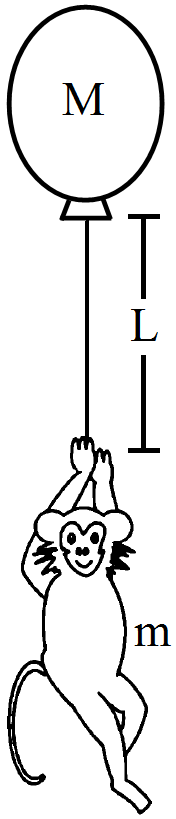
The balloon, the light rope and the monkey shown in figure are at rest in the air. If the monkey reaches the top of the rope, by what distance does the balloon descend ? Mass of the balloon = M, mass of the monkey = m and the length of the rope ascended by the monkey = L.