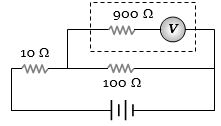
The potential difference across the $100\,\Omega$ resistance in the following circuit is measured by a voltmeter of $900 \,\Omega$ resistance. The percentage error made in reading the potential difference is
Diffcult
Download our app for free and get started
(c) Before connecting the voltmeter, potential difference across $100\,\Omega $ resistance
${V_i} = \frac{{100}}{{(100 + 10)}} \times V = \frac{{10}}{{11}}\,V$
Finally after connecting voltmeter across $100\,\Omega $ Equivalent resistance $\frac{{100 \times 900}}{{(100 + 900)}} = 90\,\Omega $
Final potential difference
${V_f} = \frac{{90}}{{(90 + 10)}} \times V = \frac{9}{{10}}\,V$
$\%$ error = $\frac{{{V_i} - {V_f}}}{{{V_i}}} \times 100$
$ = \frac{{\frac{{10}}{{11}}\,V - \frac{9}{{10}}\,V}}{{\frac{{10}}{{11}}\,V}} \times 100 = 1.0.$
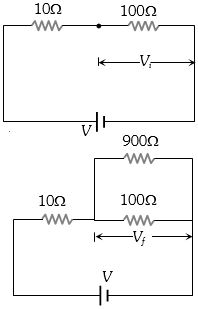
${V_i} = \frac{{100}}{{(100 + 10)}} \times V = \frac{{10}}{{11}}\,V$
Finally after connecting voltmeter across $100\,\Omega $ Equivalent resistance $\frac{{100 \times 900}}{{(100 + 900)}} = 90\,\Omega $
Final potential difference
${V_f} = \frac{{90}}{{(90 + 10)}} \times V = \frac{9}{{10}}\,V$
$\%$ error = $\frac{{{V_i} - {V_f}}}{{{V_i}}} \times 100$
$ = \frac{{\frac{{10}}{{11}}\,V - \frac{9}{{10}}\,V}}{{\frac{{10}}{{11}}\,V}} \times 100 = 1.0.$

Download our appand get started for free
Experience the future of education. Simply download our apps or reach out to us for more information. Let's shape the future of learning together!No signup needed.*
Similar Questions
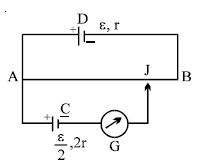
- 1In the figure, the potentiometer wire $AB$ of length $L$ and resistance $9r$ is joined to the cell $D$ of $\mathrm{emf}$ $\varepsilon$ and internal resistance $r$. The cell $C’s$ $\mathrm{emf}$ is $\varepsilon /2$ and its internal resistance is $2r$. The galvanometer $G$ will show no deflection when the length $AJ$ isView Solution
- 2Match the List $I$ with the List $II$ from the combination shown. In the left side (List $I$) there are four different conditions and in the right side (List $II$), there are ratios of heat produced in each resistance for each condition :View Solution
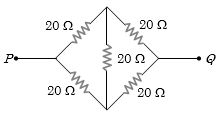
List $I$ List $II$ $(I)$ Two wires of same resistance are connected in series and same current is passed through them $(A)$ $1:2$ $(II)$ Two wires of resistance $R$ and $2R$ $ohm$ are connected in series and same $P . D .$ is applied across them $(B)$ $4:1$ $(III)$ Two wires of same resistance are connected in parallel and same current is flowing through them $(C)$ $1:1$ $(IV)$ Two wires of resistances in the ratio $1: 2$ are connected in parallel and same $P . D .$ is applied across the $(D)$ $2:1$ - 3The effective resistance between points $P$ and $Q$ of the electrical circuit shown in the figure isView Solution
- 4In the circuit shown, the reading of the ammeter (ideal) is the same with both switches open as with both closed find the value of resistance $R$ in $ohm$ . ................ $\Omega$View Solution
- 5When a potential difference $V$ is applied across a wire of resistance $R$, it dissipates energy at a rate $W$. If the wire is cut into two halves and these halves are connected mutually parallel across the same supply, the same supply, the energy dissipation rate will become:View Solution
- 6The current density is a solid cylindrical wire of radius $R ,$ as a function of radial distance $r$ is given by $J ( r )= J _{0}\left(1-\frac{ r }{ R }\right) .$ The total current in the radial region $r =0$ to $r =\frac{ R }{4}$ will beView Solution
- 7An electric kettle takes $4\, A$ current at $220\,V.$ How much time will it take to boil $1\,\, kg$ of water circuits are consequences of from temperature $20\,^o C\, ?$ The temperature of $(a)$ conservation of energy and electric charge boiling water is $100\,^o C.$ ............... $min$View Solution
- 8View SolutionAn energy source will supply a constant current into the load if its internal resistance is
- 9The total power dissipated (in $watt$ ) in the circuit shown isView Solution
- 10The equivalent resistance between $P$ and $Q$ in the given figure, is ............... $\Omega$View Solution