MCQ
The potential energy function for a particle executing linear simple harmonic motion is given by $U(x)=\frac{1}{2} k x^2$, where k is the force constant of the osicllator. For $k =0.5 Nm ^{-1}$, the graph U (x) versus x is shown in the figure given below.
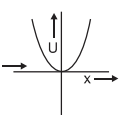
Image
Find out position of a particle carrying total energy 1 J moving under this potential at which it must turn back to its orignal position.
  • A
    $\pm 0.5 m$
  • B
    $\pm 1 m$
  • $\pm 2 m$
  • D
    $\pm 3 m$

Answer

Correct option: C.
$\pm 2 m$
(C) $\pm 2 m$
Since paticle is at turning point, K = 0 therefore E = 1 = U = (1/2)k x2
putting $k=0.05$, we get $x^2=4$ and $x=+2$ and $x=-2$.

Need a full question paper?

Generate a complete, print-ready paper with questions like this in minutes — across 16+ boards, with answer keys.

Start Generating Free

Similar questions

An unpolarized beam of intensity $2a^2$ passes through a thin polaroid. Assuming zero absorption in the polaroid, the intensity of emergent plane polarised light is
A magnetic needle is placed on a cork floating in a still lake in the northern hemisphere. Does the needle together with the cork move towards the north of the lake
If in the experiment of Wheatstone's bridge, the positions of cells and galvanometer are interchanged, then balance points will
If $T$ is the surface tension of soap solution, the amount of work done in blowing a soap bubble from a diameter $D$ to $2D$ is
A proton is moves on circular path with its constant angular speed then correct relation between its magnetic moment and angular momentum 
A stone thrown upward with a speed $u$ from the top of the tower reaches the ground with a velocity $3u$. The height of the tower is
Fusion reaction takes place at high temperature because
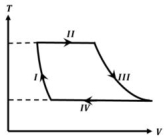
One mole of a monatomic ideal gas undergoes a cyclic process as shown in the figure (where $V$ is the volume and $T$ is the temperature). Which of the statements below is (are) true?

(image)

$(A)$ Process $I$ is an isochoric process   $(B)$ In process $II$, gas absorbs heat

$(C)$ In process $IV$, gas releases heat   $(D)$ Processes $I$ and $III$ are $not$ isobaric

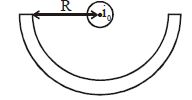
Adjoining figure shows a very long semicylindrical conducting shell of radius $R$ and carrying a current $i$. An infinitely long straight current carrying conductor is lying along the axis of the semi-cylinder. If the current flowing through the straight wire be $i_0$, then the force per unit length on the conducting wire is
A body of mass ${M}$ moving at speed ${V}_{0}$ collides elastically with a mass $'m'$ at rest. After the collision, the two masses move at angles $\theta_{1}$ and $\theta_{2}$ with respect to the initial direction of motion of the body of mass ${M}$. The largest possible value of the ratio ${M} / {m}$, for which the angles $\theta_{1}$ and $\theta_{2}$ will be equal, is :