The potential $V$ is varying with $x$ and $y$ as $V\, = \,\frac{1}{2}\,\left( {{y^2} - 4x} \right)\,volt.$ The field at ($1\,m, 1\,m$ ) is
Easy


Download our appand get started for free
Experience the future of education. Simply download our apps or reach out to us for more information. Let's shape the future of learning together!No signup needed.*
Similar Questions
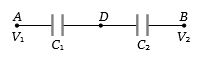
- 1Two condensers ${C_1}$and ${C_2}$ in a circuit are joined as shown in figure. The potential of point $A$ is ${V_1}$ and that of $B$ is ${V_2}$. The potential of point $D$ will beView Solution
- 2The capacity of a parallel plate condenser is $10\,\mu \,F$, when the distance between its plates is $8 \,cm$. If the distance between the plates is reduced to $4\, cm$, then the capacity of this parallel plate condenser will be.........$\mu \,F$View Solution
- 3$A$ $2$ $\mu F$ capacitor is charged to a potential $=$ $10\,V$. Another $4$ $\mu F$ capacitor is charged to a potential $=$ $20\,V$. The two capacitors are then connected in a single loop, with the positive plate of one connected with negative plate of the other. What heat is evolved in the circuit?......$\mu J$View Solution
- 4View SolutionConsidering a group of positive charges, which of the following statements is correct?
- 5If an electron moves from rest from a point at which potential is $50\, volt$ to another point at which potential is $70\, volt$, then its kinetic energy in the final state will beView Solution
- 6Electric potential is given byView Solution
$V = 6x - 8x{y^2} - 8y + 6yz - 4{z^2}$
Then electric force acting on $2\,C$ point charge placed on origin will be......$N$
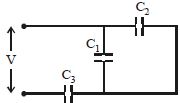
- 7Three capacitors $C_1,\,C_2$ and $C_3$ are connected as shown in the figure to a battery of $V\,volt$. If the capacitor $C_3$ breaks down electrically the change in total charge on the combination of capacitors isView Solution
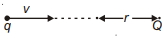
- 8The charge $q$ is fired towards another charged particle $Q$ which is fixed, with a speed $v$. It approaches $Q$ upto a closest distance $r$ and then returns. If $q$ were given a speed $2 v$, the closest distance of approach would beView Solution
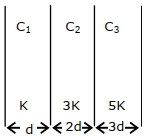
- 9In the reported figure, a capacitor is formed by placing a compound dielectric between the plates of parallel plate capacitor. The expression for the capacity of the said capacitor will be (Given area of plate $=A$ )View Solution
- 10Three capacitors each of $4\,\,\mu F$ are to be connected in such a way that the effective capacitance is $6\,\,\mu F.$ This can be done by connecting thernView Solution