The pressure applied from all directions on a cube is $P$. How much its temperature should be raised to maintain the original volume $?$ The volume elasticity of the cube is $\beta $ and the coefficient of volume expansion is $\alpha $
Diffcult


Download our appand get started for free
Experience the future of education. Simply download our apps or reach out to us for more information. Let's shape the future of learning together!No signup needed.*
Similar Questions
- 1Two exactly similar wires of steel and copper are stretched by equal forces. If the total elongation is $2 \ cm$, then how much is the elongation in steel and copper wire respectively? Given, $Y_{\text {steel }}=20 \times 10^{11} dyne / \ cm ^2, Y_{\text {copper }}=12 \times 10^{11} dyne / \ cm ^2$View Solution
- 2The mean distance between the atoms of iron is $3 \times {10^{ - 10}}m$ and interatomic force constant for iron is $7\,N\,/m$The Young’s modulus of elasticity for iron isView Solution
- 3View SolutionTwo identical wires of rubber and iron are stretched by the same weight, then the number of atoms in the iron wire will be
- 4To double the length of a iron wire having $0.5\,c{m^2}$ area of cross-section, the required force will be $(Y = {10^{12}}\,dyne/c{m^2})$View Solution
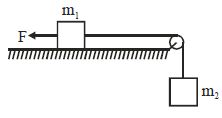
- 5Consider the situation shown in figure. The force $F$ is equal to the $m_2g/2.$ If the area of cross-section of the string is $A$ and its Young's modulus $Y$, find the strain developed in it. The string is light and there is no friction anywhereView Solution
- 6The depth below the surface of sea to which a rubber ball be taken so as to decrease its volume by $0.02 \%$ is______ $\mathrm{m}$.View Solution
(Take density of sea water $=10^3 \mathrm{kgm}^{-3}$, Bulk modulus of rubber $=9 \times 10^8 \mathrm{Nm}^{-2}$, and $\mathrm{g}=10 \mathrm{~ms}^{-2}$ )
- 7A metal rod of cross-sectional area $10^{-4} \,m ^{2}$ is hanging in a chamber kept at $20^{\circ} C$ with a weight attached to its free end. The coefficient of thermal expansion of the rod is $2.5 \times 10^{-6} \,K ^{-1}$ and its Young's modulus is $4 \times 10^{12} \,N / m ^{2}$. When the temperature of the chamber is lowered to $T$, then a weight of $5000 \,N$ needs to be attached to the rod, so that its length is unchanged. Then, $T$ is ............ $^{\circ} C$View Solution
- 8A brass rod of length $2\,m$ and cross-sectional area $2.0\,cm^2$ is attached end to end to a steel rod of length $L$ and cross-sectional area $1.0\,cm^2$ . The compound rod is subjected to equal and opposite pulls of magnitude $5 \times 10^4\,N$ at its ends. If the elongations of the two rods are equal, then length of the steel rod $(L)$ is ........... $m$ $(Y_{Brass}=1.0\times 10^{11}\,N/m^2$ and $Y_{Steel} = 2.0 \times 10^{11}\,N/m^2)$View Solution
- 9A rubber ball is taken to a $100\, m$ deep lake and its volume changes by $0.1\%$. The bulk modulus of rubber is nearlyView Solution
- 10A force $F$ is applied on the wire of radius $r$ and length $L$ and change in the length of wire is $l.$ If the same force $F$ is applied on the wire of the same material and radius $2r$ and length $2L,$ Then the change in length of the other wire isView Solution