The ratio of densities of nitrogen and oxygen is $14:16.$ The temperature at which the speed of sound in nitrogen will be same at that in oxygen at $55^oC$ is ..... $^oC$
Medium


Download our appand get started for free
Experience the future of education. Simply download our apps or reach out to us for more information. Let's shape the future of learning together!No signup needed.*
Similar Questions
- 1A wire of $10^{-2} kgm^{-1}$ passes over a frictionless light pulley fixed on the top of a frictionless inclined plane which makes an angle of $30^o$ with the horizontal. Masses $m$ and $M$ are tied at two ends of wire such that m rests on the plane and $M$ hangs freely vertically downwards. The entire system is in equilibrium and a transverse wave propagates along the wire with a velocity of $100 ms^{^{-1}}$.View Solution
- 2View SolutionA pulse or a wave train travels along a stretched string and reaches the fixed end of the string. It will be reflected back with
- 3The ends of stretched wire of length $L$ are fixed at $x\, = 0$ and $x \,= L$. In one experiment, the displacement of the wire is ${y_1} = A\sin\, \left( {\pi x/L} \right)\sin \,\omega t$ and energy is $E_1$. and in another experiment its displacement is ${y_2} = A\sin \,\left( {2\pi x/L} \right)\sin 2\omega t$ and energy is $E_2$, ThenView Solution
- 4View SolutionThe ratio of speed of sound in hydrogen gas to the speed of sound in oxygen gas at the same temperature is
- 5Two identical piano wires, kept under the same tension $T$ have a fundamental frequency of $600\,\, Hz.$ The fractional increase in the tension of one of the wires which will lead to occurrence of $6\,\, beats/s$ when both the wires oscillate together would beView Solution
- 6View SolutionTwo waves having sinusoidal waveforms have different wavelengths and different amplitude. They will be having
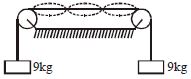
- 7The length of the wire shown in figure between the pulleys is $1.5\, m$ and its mass is $12.0\,g$. The frequency of vibration with which the wire vibrates in three loops forming antinode at the mid point of the wire is $(g = 9.8 \,m/s^2)$View Solution
- 8A source of sound of frequency $500 Hz$ is moving towards an observer with velocity $30 m/s$. The speed of sound is $330 m/s$. the frequency heard by the observer will be .... $Hz$View Solution
- 9A metal wire of linear mass density of $9.8\, g/m$ is stretched with a tension of $10 kg$ weight between two rigid supports $1$ metre apart. The wire passes at its middle point between the poles of a permanent magnet, and it vibrates in resonance when carrying an alternating current of frequency $n.$ The frequency $n$ of the alternating source is ..... $Hz$View Solution
- 10Length of a string tied to two rigid supports is $40 cm$. Maximum length (wavelength in $cm$) of a stationary wave produced on it is ... $cm$View Solution