The ratio of the magnetic field at the centre of a current carrying coil of the radius $a$ and at a distance ‘$a$’ from centre of the coil and perpendicular to the axis of coil is
Medium
Download our app for free and get started
(d) $\frac{{{B_c}}}{{{B_a}}} = {\left( {1 + \frac{{{x^2}}}{{{a^2}}}} \right)^{3/2}} = {\left( {1 + \frac{{{a^2}}}{{{a^2}}}} \right)^{3/2}} = {\left( {1 + 1} \right)^{3/2}} = 2\sqrt 2 $

Download our appand get started for free
Experience the future of education. Simply download our apps or reach out to us for more information. Let's shape the future of learning together!No signup needed.*
Similar Questions
- 1The sensitivity of a Galvenometer of resistance $171\,\Omega $ becomes $20\,times$ when we used shunt of $x \,\Omega .$ Find $x$ ................. $\Omega$View Solution
- 2In the productView Solution
$\overrightarrow{\mathrm{F}} =\mathrm{q}(\vec{v} \times \overrightarrow{\mathrm{B}})$
$=\mathrm{q} \vec{v} \times\left(\mathrm{B} \hat{i}+\mathrm{B} \hat{j}+\mathrm{B}_{0} \hat{k}\right)$
For $\mathrm{q}=1$ and $\vec{v}=2 \hat{i}+4 \hat{j}+6 \hat{k}$ and
$\overrightarrow{\mathrm{F}}=4 \hat{i}-20 \hat{j}+12 \hat{k}$
What will be the complete expression for $\vec{B}$ ?
- 3An electron having mass $m$ and kinetic energy $K$ enter in uniform magnetic field $B$ perpendicularly, then its frequency will beView Solution
- 4A particle is moving with velocity $\overrightarrow{ v }=\hat{ i }+3 \hat{ j }$ and it produces an electric field at a point given by $\overrightarrow{ E }=2 \hat{ k }$. It will produce magnetic field at that point equal to (all quantities are in SI units)View Solution
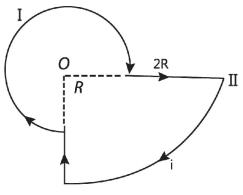
- 5Consider the circular loop having current $i$ and with central point $O$. The magnetic field at the central point $O$ isView Solution
- 6A charge particle of charge $q$ and mass $m$ is accelerated through a potential diff. $V\, volts$. It enters a region of orthogonal magnetic field $B$. Then radius of its circular path will beView Solution
- 7A moving coil galvanometer has a coil with $175\, turns$ and area $1\, cm^2$ It uses a torsion band of torsion constant $10^{-6}\, N\, -m/rad$. The coil is placed in a magnetic field $B$ parallel to its plane. The coil deflects by $10$ for a current of $1\, mA$. The value of $B$ (in Tesla) is approximatelyView Solution
- 8Given below are two statements: One is labelled as Assertion $A$ and the other is labelled as Reason $R$.View Solution
Assertion $A:$ For measuring the potential difference across a resistance of $600\,\Omega$, the voltmeter with resistance $1000\,\Omega$ will be preferred over voltmeter with resistance $4000\,\Omega$.
Reason $R:$ Voltmeter with higher resistance will draw smaller current than voltmeter with lower resistance.
In the light of the above statements, choose the most appropriate answer from the options given below.
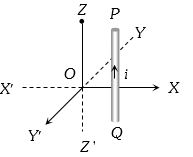
- 9A vertical wire kept in $Z-X$ plane carries a current from $Q$ to $P$ (see figure). The magnetic field due to current will have the direction at the origin $O$ alongView Solution
- 10The earth’s magnetic field at a given point is $0.5 \times {10^{ - 5}}\,Wb{\rm{ - }}{m^{ - 2}}$. This field is to be annulled by magnetic induction at the center of a circular conducting loop of radius $5.0\,cm$. The current required to be flown in the loop is nearly......$A$View Solution