The ratio of the speed of sound in nitrogen gas to that in helium gas, at $300 K$ is
IIT 1999, Medium


Download our appand get started for free
Experience the future of education. Simply download our apps or reach out to us for more information. Let's shape the future of learning together!No signup needed.*
Similar Questions
- 1The fundamental frequency of a sonometer wire is increases by $6\, Hz$ if its tension is increased by $44\%$, keeping the length constant. The frequency of the wire is ...... $Hz$View Solution
- 2At standard temperature and pressure the density of a gas is $1.3$ $kg/{m^3}$ and the speed of the sound in gas is $330\, m/sec.$ Then the degree of freedom of the gas will beView Solution
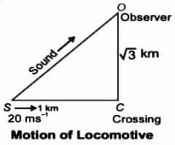
- 3A locomotive approaching a crossing at a speed of $20 \,ms ^{-1}$ sounds a whistle of frequency $640 \,Hz$ when $1 \,km$ from the crossing. There is no wind and the speed of sound in air is $330 \,ms ^{-1}$. What frequency is heard by an observer $\sqrt{3} \,km$ on the straight road from the crossing at right angle ......... $Hz$View Solution
- 4A string is clamed at both the ends and it is vibrating in its $4^{th}$ harmonic. The equation of the stationary wave is $Y =0.3\,sin\,(0.157\,x) \,cos\,(200\pi t)$. The length of the string is ..... $m$ (all quantities are in $SI$ units)View Solution
- 5The equation of a stationary wave is $y = 0.8\cos \,\left( {\frac{{\pi x}}{{20}}} \right)\sin 200\,\pi t$, where $x$ is in $cm$ and $t$ is in sec. The separation between consecutive nodes will be..... $cm$View Solution
- 6Beats are produced with the help of two sound waves of amplitudes $3$ and $5$ units. The ratio of maximum to minimum intensity in the beats isView Solution
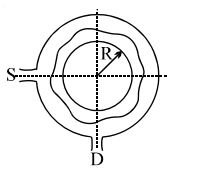
- 7A narrow tube is bent in the form of a circle of radius $R,$ as shown in the figure. Two small holes $S$ and $D$ are made in the tube at the positions right angle to each other. A source placed at $S$ generated a wave of intensity $I_0$ which is equally divided into two parts : One part travels along the longer path, while the other travels along the shorter path. Both the part waves meet at the point $D$ where a detector is placed The maximum intensity produced at $D$ is given byView Solution
- 8A travelling harmonic wave is represented by the equation $y(x, t) = 10^{-3}\,sin\,(50t + 2x)$, where $x$ and $y$ are in meter and $t$ is in seconds. Which of the following is a correct statement about the wave?View Solution
- 9If two waves represented by $y_1 = 4\, \sin\, \omega t$ and ${y_2} = 3\sin \,\left( {\omega t + \frac{\pi }{3}} \right)$ interfere at a point, then amplitude of the resulting wave will be aboutView Solution
- 10Two monoatomic ideal gases $1$ and $2$ of molecular masses $m_1$ and $m_2$ respectively are enclosed in separate containers kept at the same temperature. The ratio of the speed of sound in gas $1$ to that in gas $2$ is given byView Solution