The refractive indices of glass and water with respect to air are 3/2 and 4/3 respectively. If speed of light in glass is 2×10⁸ m/s, find the speed of light in water.
CBSE OUTSIDE DELHI - SET 3 2016
Download our app for free and get started
$\text{Refractive index of a medium} = \frac{\text{Speed of light in air}}{\text{Speed of light in the medium}}$$\frac{3}{2} = \frac{\text{Speed of light in air}}{\frac{2 \times 10^{8} \text{m/s}}{\text{Speed of light in air = 3} {\times 10^{8} \text{m/s}}}}$
$\text{Speed of light in water} = \frac{3 \times 10^{8} \text{m/s}}{4/3} 2.25 \times 10^{8} \text{m/s}$
$\text{Speed of light in water} = \frac{3 \times 10^{8} \text{m/s}}{4/3} 2.25 \times 10^{8} \text{m/s}$

Download our appand get started for free
Experience the future of education. Simply download our apps or reach out to us for more information. Let's shape the future of learning together!No signup needed.*
Similar Questions
- 1View SolutionDefine:
- Principal focus of a concave mirror.
- Focal length of a concave mirror.
- 2View SolutionWhich type of mirror is used in a solar furnace? Support your answer with reason.
- 3View SolutionGive two uses of a convex mirror. Explain why you would choose convex mirror for these uses.
- 4View SolutionDescribe the nature of image formed when the object is placed at a distance of 20cm from a concave mirror of focal length 10cm.
- 5View SolutionAn object is placed at a distance of 6cm from a convex mirror of focal length 12cm. Find the position and nature of the image.
- 6View SolutionIdentify the device used as a spherical mirror or lens in following cases, when the image formed is virtual and erect in each case.Object is placed between the focus and device, image formed is enlarged and on the same side as that of the object.
- 7View SolutionAn object is placed just outside the principal focus of concave mirror. Draw a ray diagram to show how the image is formed, and describe its size, position and nature.
- 8View SolutionA boy with a mouth 5cm wide stands 2m away from a plane mirror. Where is his image and how wide is the image of his mouth?
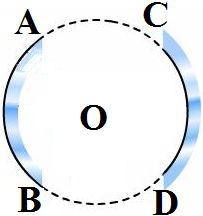
- 9AB and CD, two spherical mirrors, form parts of a hollow spherical ball with its centre at O as shown in the diagram. If arc $\text{AB}=\frac{1}{2}$ arc CD, what is the ratio of their focal lengths? State which of the two mirrors will always form virtual image of an object placed in front of it and why.View Solution
- 10View SolutionState two factors on which the lateral displacement of the emergent ray depends.