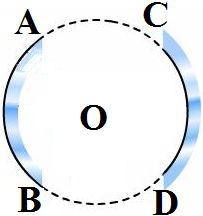
AB and CD, two spherical mirrors, form parts of a hollow spherical ball with its centre at O as shown in the diagram. If arc $\text{AB}=\frac{1}{2}$ arc CD, what is the ratio of their focal lengths? State which of the two mirrors will always form virtual image of an object placed in front of it and why.
Download our app for free and get started
The ratio of the focal lengths of mirrors AB and CD will be equal to one as both the mirrors are part of same spherical ball. Hence, their radius of curvature and focal length will be same. The mirror AB will always form a virtual image when object is placed infront of it because mirror AB is a conex mirror.

Download our appand get started for free
Experience the future of education. Simply download our apps or reach out to us for more information. Let's shape the future of learning together!No signup needed.*
Similar Questions
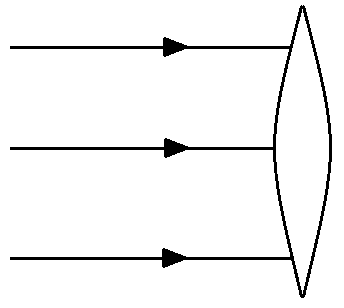
- 1View SolutionYour eye contains a convex lens. Why is it unwise to look at the sun?
- 2View SolutionIdentify the device used as a spherical mirror or lens in following cases, when the image formed is virtual and erect in each case.Object is placed between infinity and device, image formed is diminished and between pole and focus, behind it.
- 3View SolutionDraw ray diagrams showing the image formation by a convex mirror when an object is placed:
At infinity. - 4View SolutionDraw a ray diagram to show the formation of a real magnified image by a convex lens. (In your sketch the position of object and image with respect to the principal focus of lens should be shown clearly).
- 5View SolutionExplain with the help of a diagram, why the concave lens is also called a diverging lens.
- 6View SolutionDoes the incident and emergent ray coincide in the process of refraction through glass slab? Give reason.
- 7View SolutionWhen a light ray passes from air into glass, what happens to its speed? Draw a diagram to show which way the ray of light bends.
- 8The refractive index of water with respect to vacuum is $\frac{4}{3}$ and refractive index of vacuum with respect to glass is $\frac{2}{3}$ If the speed the speed of light in glass is $2 \times 10^8 ms^{-1}$, find the speed of light in (i) vacuum, (ii) water.View Solution
- 9View SolutionDraw ray diagrams showing the image formation by a convex mirror when an object is placed:
At finite distance from the mirror. - 10View SolutionHow could you find the focal length of a convex lens rapidly but approximately?