MCQ
The $r.m.s.$ speed of a certain gas is v at $400\,K.$ The temperature at which the $r.m.s.$ speed becomes two times, will be ...... $K$
  • A
    $800$
  • $1600 $
  • C
    $1200$
  • D
    None of these

Answer

Correct option: B.
$1600 $
b
${v_{rms}} \propto \sqrt T $

$\Rightarrow$ $\frac{{{T_2}}}{{{T_1}}} = \frac{{v_2^2}}{{v_1^2}} = \frac{{4{v^2}}}{{{v^2}}} = 4$

$\Rightarrow$  ${T_2} = 4{T_1} = 4 \times 400 = 1600\,K$

Need a full question paper?

Generate a complete, print-ready paper with questions like this in minutes — across 16+ boards, with answer keys.

Start Generating Free

Similar questions

Error in the measurement of radius of a sphere is $0.2\%$. The error in the calculated value of its volume is  ......... $\%$
A stationary sound source $'s'$ of frequency $334\,\, Hz$ and a stationary observer $'O'$ are placed near a reflecting surface moving away from the source with velocity $2\,\, m/sec$ as shown in the figure. If the velocity of the sound waves is air is $V = 330\,\, m/sec$, the apparent frequency of the echo is ... $Hz$
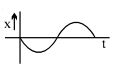
If position time graph of a particle is sine curve as shown, what will be its velocity-time graph.
For inelastic collision between two spherical rigid bodies
In the Newton's cooling experiment the graph drawn between the rate of cooling of object and temperature excess with environment :
If $A$ is the area of cross-section of a spring $L$ is its length $E$ is the Young's modulus of the material of the spring then time period and force constant of the spring will be respectively
A small object of uniform density rolls up a curved surface with an initial velocity $v$. It reaches upto a maximum height of $3v^2/4g$ with respect to the initial position. The object is
A normal eye is not able to see objects closer than 25cm because:
A source of sound $S$ of frequency $500 Hz$ situated between a stationary observer $O$ and a wall $W$, moves towards the wall with a speed of $2 m/s$. If the velocity of sound is $332 m/s$, then the number of beats per second heard by the observer is (approximately)
A particle of mass $m$ moving eastward with a speed $v$ collides with another particle of the same mass moving northwards with same speed $v$. The two particles coalesce on collision. The new particle of mass $2 \,m$ will move with velocity