Question
Read the passage given below and answer the following questions from 1 to 5.
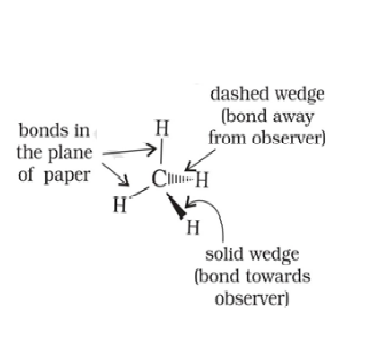
The three-dimensional (3-D) structure of organic molecules can be represented on paper by using certain conventions. For example, by using solid ( ) and dashed ( ) wedge formula, the 3-D image of a molecule from a two-dimensional picture can be perceived. In these formulas the solid-wedge is used to indicate a bond projecting out of the plane of paper, towards the observer. The dashed-wedge is used to depict the bond projecting out of the plane of the paper and away from the observer. Wedges are shown in such a way that the broad end of the wedge is towards the observer. The bonds lying in plane of the paper are depicted by using a normal line (—). 3-D representation of methane molecule on paper has been shown in Figure.
A cyclic or open chain componds these compounds are also called as aliphatic componds and consist of staright or branched chain componds for example:
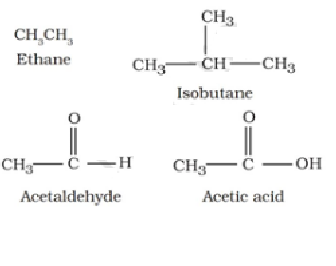
Cyclic or closed chain or ring compounds
a) Alicyclic compounds Alicyclic (aliphatic cyclic) compounds contain carbon atoms joined in the form of a ring (homocyclic).
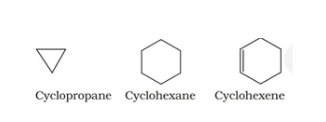
Someetimes atoms other than carbon are also present in the ring (heterocylic). Tetrahydrofuran given below is an example of this types of compound:
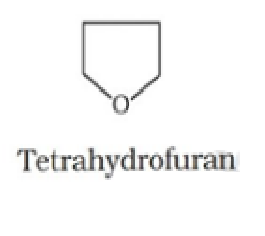
These exhibit some of the properties similar to those of aliphatic compounds.
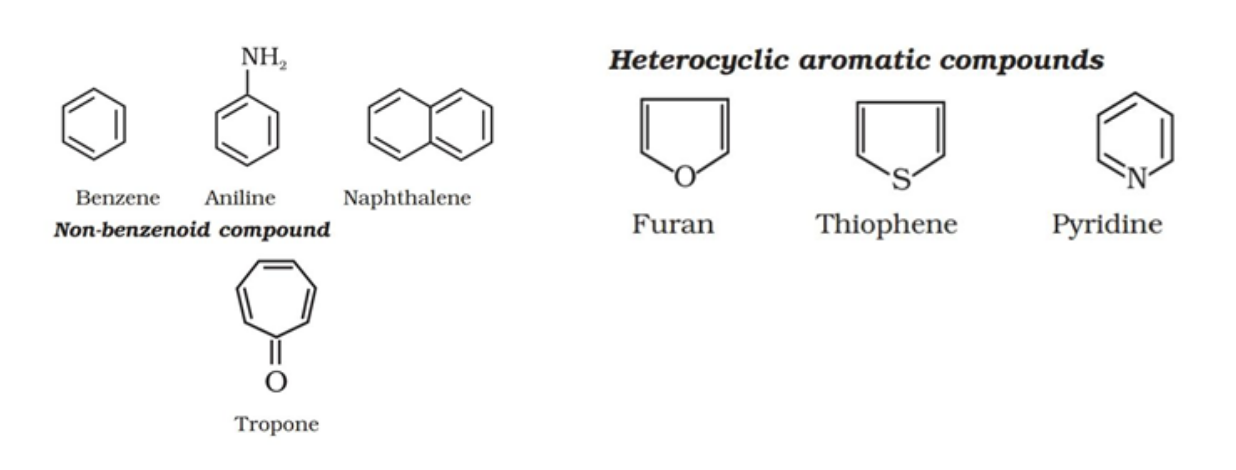
b) Aromatic compounds Aromatic compounds are special types of compounds. These include benzene and other related ring compounds (benzenoid). Like alicyclic compounds, aromatic comounds may also have hetero atom in the ring. Such compounds are called hetrocyclic aromatic compounds. Some of the examples of various types of aromatic compounds are:
Benzenoid aromatic compounds .
Organic compounds can also be classified on the basis of functional groups, into families or homologous series.
Functional Group The functional group is an atom or a group of atoms joined to the carbon chain which is responsible for the characteristic chemical properties of the organic compounds. The examples are hydroxyl group (–OH), aldehyde group (–CHO) and carboxylic acid group (–COOH) etc.
Homologous Series A group or a series of organic compounds each containing a characteristic functional group forms a homologous series and the members of the series are called homologues. The members of a homologous series can be represented by general molecular formula and the successive members differ from each other in molecular formula by a $–CH^2$ unit. There are a number of homologous series of organic compounds. Some of these are alkanes, alkenes, alkynes, haloalkanes, alkanols, alkanals, alkanones, alkanoic acids, amines etc. It is also possible that a compound contains two or more identical or different functional groups. This gives rise to polyfunctional compounds.
A systematic name of an organic compound is generally derived by identifying the parent hydrocarbon and the functional group(s) attached to it. See the example given below.
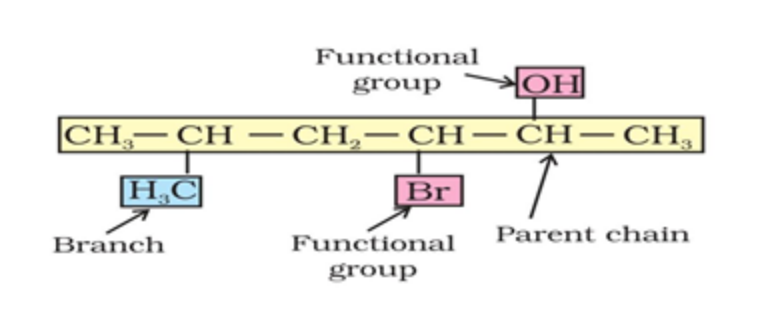
By further using prefixes and suffixes, the parent name can be modified to obtain the actual name. Compounds containing carbon and hydrogen only are called hydrocarbons. A hydrocarbon is termed saturated if it contains only carbon-carbon single bonds.
The IUPAC name for a homologous series of such compounds is alkane. Paraffin (Latin: little affinity) was the earlier name given to these compounds. Unsaturated hydrocarbons are those, which contain at least one carbon- carbon double or triple bond. IUPAC Nomenclature of Alkanes Straight chain hydrocarbons: The names of such compounds are based on their chain structure, and end with suffix ‘-ane’ and carry a prefix indicating the number of carbon atoms present in the chain (except from $CH_4$ to $C_4H_{10}$, where the prefixes are derived from trivial names). The IUPAC names of some straight chain saturated hydrocarbons are given in Table. The alkanes in table differ from each other by merely the number of $– CH_2$ groups in the chain. They are homologues of alkane series.
Name Molecular formula Name Molecular Formula
Methane $CH_4$ Heptane $C_7H_{16}$
Ethane $C_2H_6$ Octane $C_8H_{18}$
Propane $C_3H_8$ Nonane $C_9H_{20}$
Butane $C_4H_{10}$ Decane $C_{10}H_{22}$
Pentane $C_5H_{12}$ Icosane $C_{20}H_{42}$
Hexane $C_6H_{14}$ Triacontane $C_{30}H_{62}$
  1. IUPAC is an acronym for …
  1. International Union of Pure and Applied Chemistry
  2. International units of proteins and carbohydrates
  3. International understandings on physical aspects of chemistry
  4. Iodine under packings
  1. In homologous series, the successive members differ from each other in molecular formula by a … unit.
  1. $CH_3$
  2. $CH_2$
  3. $CH$
  4. $CH_4$
  1. A hydrocarbon is termed saturated if it contains only carbon-carbon … bonds.
  1. Triple
  2. Double
  3. Single
  4. Zero
  1. From ….., where the prefixes are derived from… trivial names.
  1. $CH_4$ to $C_2H_6$
  2. $CH_4$ to $C_3H_8$
  3. $CH_4$ to $C_6H_{14}$
  4. $CH_4$ to $C_4H_{10}$
  1. Molecular formula of octane is …
  1. $C_4H_{10}$
  2. $C_6H_{14}$
  3. $C_2H_6$
  4. $C_8H_{18}$

Answer

  1. (a) International Union of Pure and Applied Chemistry
  2. (b) $CH_2$
  3. (c) single
  4. (d) $CH_4$ to $C_4H_{10}$
  5. (d) $C_8H_{18}$​​​​​​​

Need a full question paper?

Generate a complete, print-ready paper with questions like this in minutes — across 16+ boards, with answer keys.

Start Generating Free

Similar questions

In order to explain the characteristic geometrical shapes of polyatomic molecules, Pauling introduced the concept of hybridisation. The orbitals undergoing hybridisation should have nearly the same energy. There are various type of hybridisations involving s, p and d-type of orbitals. The type of hybridisation gives the characteristic shape of the molecule or ion.

1. Why all the orbitals in a set of hybridised orbitals have the same shape and energy?
2. Out of $XeF _2$ and $SF _2$ which molecule has the same shape as $NO _2^{+}$ion?
3. Out of $XeF _4$ and $XeF _2$ which molecule doesn't have the same type of hybridisation as P (Phosphorus) has in $PF _5$ ?
OR
Unsaturated compounds undergo additional reactions. Why?
Read the passage given below and answer the following questions from 1 to 5.
A reagent that brings an electron pair to the reactive site is called a nucleophile (Nu:) i.e., nucleus seeking and the reaction is then called nucleophilic. A reagent that takes away an electron pair from reactive site is called electrophile (E+) i.e., electron seeking and the reaction is called electrophilic.
Electron Displacement Effects in Covalent Bonds The electron displacement in an organic molecule may take place either in the ground state under the influence of an atom or a substituent group or in the presence of an appropriate attacking reagent. The electron displacements due to the influence of an atom or a substituent group present in the molecule cause permanent polarlisation of the bond. Inductive effect and resonance effects are examples of this type of electron displacements. Temporary electron displacement effects are seen in a molecule when a reagent approaches to attack it. This type of electron displacement is called electrometric effect or polarisability effect.
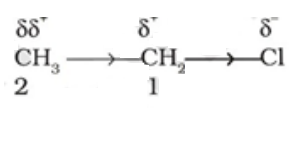
Inductive Effect When a covalent bond is formed between atoms of different electronegativity, the electron density is more towards the more electronegative atom of the bond. Such a shift of electron density results in a polar covalent bond. Bond polarity leads to various electronic effects in organic compounds. Let us consider cholorethane $(CH_3CH_2Cl)$ in which the C–Cl bond is a polar covalent bond. It is polarised in such a way that the carbon-1 gains some positive charge $(\delta+)$ and the chlorine some negative charge $(\delta-)$ The fractional electronic charges on the two atoms in a polar covalent bond are denoted by symbol (delta) and the shift of electron density is shown by an arrow that points from$(\delta+)$ to $(\delta-)$ end of the polar bond.

In turn carbon-1, which has developed partial positive charge $(\delta+)$draws some electron density towards it from the adjacent C-C bond. Consequently, some positive charge$(\delta\delta+)$develops on carbon-2 also, where $(\delta\delta+)$ symbolises relatively smaller positive charge as compared to that on carbon – 1. In other words, the polar C – Cl bond induces polarity in the adjacent bonds. Such polarisation of σ- bond caused by the polarisation of adjacent $σ-$bond is referred to as the inductive effect.
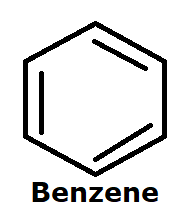
Resonance Structure There are many organic molecules whose behaviour cannot be explained by a single Lewis structure. An example is that of benzene. Its cyclic structure containing alternating C–C single and C=C double bonds shown is inadequate for explaining its characteristic properties.

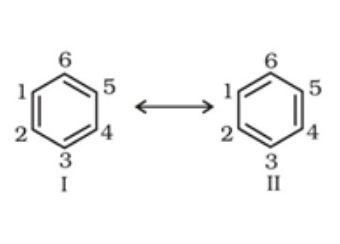
As per the above representation, benzene should exhibit two different bond lengths, due to C–C single and C=C double bonds. However, as determined experimentally benzene has a uniform C–C bond distances of 139 pm, a value intermediate between the C–C single(154 pm) and C=C double (134 pm) bonds. Thus, the structure of benzene cannot be represented adequately by the above structure. Further, benzene can be represented equally well by the energetically identical structures I and II.

Therefore, according to the resonance theory the actual structure of benzene cannot be adequately represented by any of these structures, rather it is a hybrid of the two structures (I and II) called resonance structures. The resonance structures (canonical structures or contributing structures) are hypothetical and individually do not represent any real molecule. They contribute to the actual structure in proportion to their stability.
Resonance Effect The resonance effect is defined as ‘the polarity produced in the molecule by the interaction of two π-bonds or between a π-bond and lone pair of electrons present on an adjacent atom’. The effect is transmitted through the chain. There are two types of resonance or mesomeric effect designated as R or M effect. (i) Positive Resonance Effect (+R effect) In this effect, the transfer of electrons is away from an atom or substituent group attached to the conjugated system. This electron displacement makes certain positions in the molecule of high electron densities. This effect in aniline is shown as : (ii) Negative Resonance Effect (- R effect) This effect is observed when the transfer of Electrons is towards the atom or substituent Group attached to the conjugated system. For Example in nitrobenzene this electron Displacement can be depicted as : The atoms or substituent groups, which represent +R or –R electron displacement effects are as follows: +R effect: – halogen, –OH, –OR, –OCOR, –NH2, –NHR, –NR2, –NHCOR, – R effect: $– COOH, –CHO, > C = O, – CN, – NO_2$ The presence of alternate single and double bonds in an open chain or cyclic system is termed as a conjugated system. These systems often show abnormal behaviour. The examples are 1,3- butadiene, aniline and nitrobenzene etc. In such systems, the π-electrons are delocalised and the system develops polarity.
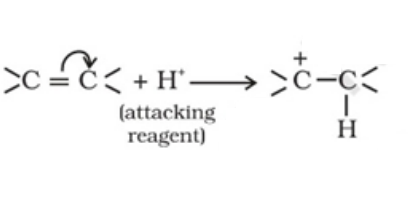
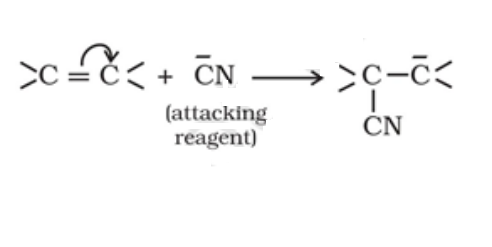
Electromeric Effect (E effect) It is a temporary effect. The organic compounds having a multiple bond (a double or triple bond) show this effect in the presence of an attacking reagent only. It is defined as the complete transfer of a shared pair of π-electrons to one of the atoms joined by a multiple bond on the demand of an attacking reagent. The effect is annulled as soon as the attacking reagent is removed from the domain of the reaction. It is represented by E and the shifting of the electrons is shown by a curved arrow ( ). There are two distinct types of electromeric effect.
a) Positive Electrometric Effect (+E effect)- In this effect the π−electrons of the multiple bond are transferred to that atom to which the reagent gets attached. For example

b) Negative Electromeric Effect (–E effect) -In this effect the $\pi-$ electrons of the multiple bond are transferred to that atom to which the attacking reagent does not get attached. For example: When inductive and electromeric effects operate in opposite directions, the electomeric effect predominates.
  1. A reagent that brings an electron pair to the reactive site is called a …
  1. nucleophile
  2. electrophile
  3. amphoteric
  4. amphophillic
  1. A reagent that takes away an electron pair from reactive site is called ..
  1. nucleophile
  2. electrophile
  3. amphoteric
  4. amphophillic
  1. The … effect is defined as the polarity produced in the molecule by the interaction of two π-bonds or between a π-bond and lone pair of electrons present on an adjacent atom.
  1. hindrance
  2. inductive
  3. resonance
  4. hyperconjunction
  1. –OH group, represent … electron displacement effect.
  1. M+
  2. M-
  3. R-
  4. R+
  1. – COOH group, represent … electron displacement effect.
  1. M+
  2. M-
  3. R-
  4. R+
Read the passage given below and answer the following questions from (i) to (v).
First complete data on pressure-volume-Temperature relations of a substance in bothGaseous and liquid state was obtained byThomas Andrews on Carbon dioxide. He plottedlsotherms of carbon dioxide at variousTemperatures.
Later on it was found That real gases behave in the same manner asCarbon dioxide. Andrews noticed that at highTemperatures isotherms look like that of anldeal gas and the gas cannot be liquified even atVery high pressure. As the temperature isLowered, shape of the curve changes and dataShow considerable deviation from idealBehaviour. At $30.98^{\circ} C$ carbon dioxide remainsGas upto 73 atmospheric pressure. At 73 atmospheric pressure, liquidCarbon dioxide appears for the first time. TheTemperature $30.98^{\circ} C$ is called criticalTemperature (TC) of carbon dioxide. This is theHighest temperature at which liquid carbonDioxide is observed. Above this temperature itls gas. Volume of one mole of the gas at criticalTemperature is called critical volume $\left( V _{ c }\right)$ andPressure at this temperature is called criticalPressure (pc). The critical temperature, pressureand volume are called critical constants. A gasBelow the critical temperature can be liquifiedBy applying pressure, and is called vapour ofThe substance. Carbon dioxide gas below itsCritical temperature is called carbon dioxideVapour.
Intermolecular forces are stronger in liquidState than in gaseous state. Molecules in liquidsAre so close that there is very little empty space between them and under normal conditionsLiquids are denser than gases.Molecules of liquids are held together byAttractive intermolecular forces. Liquids haveDefinite volume because molecules do notSeparate from each other. However, moleculesOf liquids can move past one another freely, Therefore, liquids can flow, can be poured andCan assume the shape of the container in whichThese are stored. If an evacuated container is partially filled withA liquid, a portion of liquid evaporates to fillthe remaining volume of the container withVapour. Initially the liquid evaporates andPressure exerted by vapours on the walls of The container (vapour pressure) increases. AfterSome time it becomes constant, an equilibriumls established between liquid phase andVapour phase. Vapour pressure at this stagels known as equilibrium vapour pressure orSaturated vapour pressure.. Since process ofVapourisation is temperature dependent; the Temperature must be mentioned whilereporting the vapour pressure of a liquid.
When a liquid is heated in an open vessel,The liquid vapourises from the surface. At theTemperature at which vapour pressure of theLiquid becomes equal to the external pressure,Vapourisation can occur throughout the bulkOf the liquid and vapours expand freely intoThe surroundings. The condition of freeVapourisation throughout the liquid is calledBoiling. The temperature at which vapourPressure of liquid is equal to the externalPressure is called boiling temperature at thatPressure. At 1 atm pressure boilingTemperature is called normal boiling point.If pressure is 1 bar then the boiling point isCalled standard boiling point of the liquid. Standard boiling point of the liquid is slightlyLower than the normal boiling point because 1 bar pressure is slightly less than 1 atmPressure . The normal boiling point of water is $100^{\circ} C (373 K)$, its standard boiling point is $99.6^{\circ} C (372.6 K)$.At high altitudes atmospheric pressure isLow. Therefore liquids at high altitudes boil atLower temperatures in comparison to that atSea level. Since water boils at low temperatureOn hills, the pressure cooker is used forCooking food. In hospitals surgical instrumentsAre sterilized in autoclaves in which boilingPoint of water is increased by increasing thePressure above the atmospheric pressure byUsing a weight covering the vent.Boiling does not occur when liquid isHeated in a closed vessel. On heatingContinuously vapour pressure increases.
AtFirst a clear boundary is visible between liquidAnd vapour phase because liquid is more denseThan vapour. As the temperature increases more and more molecules go to vapour phaseAnd density of vapours rises. At the same timeLiquid becomes less dense. It expands becauseMolecules move apart. When density of liquidAnd vapours becomes the same; the clearBoundary between liquid and vapoursDisappears. This temperature is called critical Temperature.
  1. First complete data on Pressure-Volume-Temperature relations of a substance in both Gaseous and liquid state was obtained by:
  1. Thomas Andrews
  2. Fritz London
  3. Robert Boyle
  4. Joseph Lewis Gay Lussac
  1. Critical Temperature (TC) of carbon dioxide is.....
  1. $24^\circ C$
  2. $30.8^\circ C$
  3. $56^\circ C$
  4. $29^\circ C$
  1. The condition of free Vapourisation throughout the liquid is called …
  1. Evaporation
  2. Melting
  3. Boiling
  4. None of above
  1. Standard boiling point of Water is....
  1. $100^\circ C$
  2. $3^\circ C$
  3. $105^\circ C$
  4. $99.6^\circ C$
  1. Boundary between liquid and vapours Disappears,This temperature is called
  1. Critical temperature
  2. Absolute temperature
  3. Normal temperature
  4. Boiling temperature
The molecular orbital theory is based on the principle of a linear combination of atomic orbitals. According to this approach when atomic orbitals of the atoms come closer, they undergo constructive interference as well as destructive interference giving molecular orbitals, i.e., two atomic orbitals overlap to form two molecular orbitals, one of which lies at a lower energy level (bonding molecular orbital). Each molecular orbital can hold one or two electrons in accordance with Pauli's exclusion principle and Hund's rule of maximum multiplicity. For molecules up to $N _2$, the order of filling of orbitals is:
Image
Bond order $=\frac{1}{2}$ [bonding electrons - antibonding electrons]
Bond order gives the following information:
i. If bond order is greater than zero, the molecule/ion exists otherwise not.
ii. Higher the bond order, higher is the bond dissociation energy.
iii. Higher the bond order, greater is the bond stability.
iv. Higher the bond order, shorter is the bond length.

1. Arrange the following negative stabilities of $CN , CN ^{+}$and $CN ^{-}$in increasing order of bond.
2. The molecular orbital theory is preferred over valence bond theory. Why?
3. Ethyne is acidic in nature in comparison to ethene and ethane. Why is it so?
OR
Bonding molecular orbital is lowered by a greater amount of energy than the amount by which antibonding molecular orbital is raised. Is this statement correct?
Read the passage given below and answer the following questions from 1 to 5. Since the isotopes have the same electronic Configuration, they have almost the same Chemical properties.The only difference is in Their rates of reactions, mainly due to their Different enthalpy of bond dissociation . However, in physical properties these Isotopes differ considerably due to their large Mass differences. There are a number of methods for preparing Dihydrogen from metals and metal hydrides. 1.) Laboratory Preparation of Dihydrogen – It is usually prepared by the reaction of Granulated zinc with dilute hydrochloric. $Zn + 2H + \rightarrow Zn_2+ + H_2$ It can also be prepared by the reaction of Zinc with aqueous alkali. $Zn + 2NaOH \rightarrow Na_2ZnO_2 + H_2$ Commercial Production of Dihydrogen – The commonly used processes are outlined Below: i) Electrolysis of acidified water using Platinum electrodes gives hydrogen. ii) High purity (> 99.95%) dihydrogen is Obtained by electrolysing warm aqueous Barium hydroxide solution between nickel iii) It is obtained as a by product in the Manufacture of sodium hydroxide and Chlorine by the electrolysis of brine Solution. During electrolysis, the reactions That take place are: at anode: $2\text{CI}(\text{aq})\rightarrow\text{CI}_2(\text{g})+2\bar{\text{e}}$ at cathode: $2\text{H}_2\text{O}(\text{l})+2\text{e}\rightarrow\text{H}_2(\text{g})+2\text{O}\bar{\text{H}}(\text{aq})$ The overall reaction is $2\text{Na }(\text {aq})+2\text{C}\bar{\text{I}}(\text{aq})+2\text{H}_2\text{O}(\text{l})$ $\text{CI}_2(\text{g})+\text{H}_2(\text{g})+2\text{Na}^+(\text{aq})+2\text{O}\bar{\text{H}}(\text{aq})$ That take place are: iv) Reaction of steam on hydrocarbons or coke At high temperatures in the presence of Catalyst yields hydrogen.

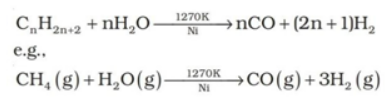
 The mixture of $CO$ and $H_2$ is called water Gas. As this mixture of $CO$ and $H_2$ is used for The synthesis of methanol and a number of Hydrocarbons, it is also called synthesis gas Or ‘syngas’. Nowadays ‘syngas’ is produced From sewage, saw-dust, scrap wood, Newspapers etc. The process of producing ‘syngas’ from coal is called ‘coal gasification’. The production of dihydrogen can be Increased by reacting carbon monoxide of Syngas mixtures with steam in the presence of Iron chromate as catalyst. This is called water-gas shift reaction. Carbon dioxide is removed by scrubbing with Sodium arsenite solution. Presently ~77% of the industrial Dihydrogen is produced from petro-chemicals, 18% from coal, 4% from electrolysis of aqueous Solutions and 1% from other sources. Physical Properties Dihydrogen is a colourless, odourless, Tasteless, combustible gas. It is lighter than Air and insoluble in water. Its other physical Properties are alongwith those of deuterium. The chemical behaviour of dihydrogen (and for That matter any molecule) is determined, to a Large extent, by bond dissociation enthalpy. The H–H bond dissociation enthalpy is the Highest for a single bond between two atoms Of any element. What inferences would you Draw from this fact ? It is because of this factor That the dissociation of dihydrogen into its Atoms is only~0.081% around 2000K which Increases to 95.5% at 5000K. Also, it is Relatively inert at room temperature due to the high H–H bond enthalpy. Thus, the atomic Hydrogen is produced at a high temperature In an electric arc or under ultraviolet Radiations. Since its orbital is incomplete with 1s1 Electronic configuration, it does combine With almost all the elements. It accomplishes Reactions by
i) loss of the only electron to Give H+, ii) gain of an electron to form H–, and iii) Sharing electrons to form a single covalent bond. The chemistry of dihydrogen can be Illustrated by the following reactions: Reaction with halogens: It reacts with Halogens, $X_2$ to give hydrogen halides, $\text{H}_2(\text{g})+\text{x}_2(\text{g})\rightarrow2\text{HX}(\text{g})(\text{x}=\text{F.CI.Br.I})$ While the reaction with fluorine occurs even in The dark, with iodine it requires a catalyst. Reaction with dioxygen: It reacts with Dioxygen to form water. The reaction is highly Exothermic. $2\text{H}_2(\text{g})+\text{O}_2(\text{g})\xrightarrow{\text{catalyst or beading}}2\text{H}_2\text{O}(\text{l}):$ $\triangle\text{H}^-=-285.9\text{kj}\text{mol}^-1$ This is the method for the manufacture of Ammonia by the Haber process. Reactions with metals: With many metals it Combines at a high temperature to yield the Corresponding hydrides $H_2$ (g) + 2M (g) → 2 MH (s); Where M is an alkali metal Reactions with metal ions and metal Oxides: It reduces some metal ions in aqueous Solution and oxides of metals (less active than Iron) into corresponding metals. $\text{H}_2(\text{g})+\text{Pd}^{2+}\text{(aq)}\rightarrow\text{Pd}(\text{s})+2\text{H}^+(\text{aq})$ $\text{y}\text{H}_2(\text{g})+\text{M}_\text{x}\text{O}_\text{y}(\text{S})\rightarrow\text{xM}(\text{s})+\text{y}\text{H}_2\text{O}\text{(l)}$ Reactions with organic compounds: It Reacts with many organic compounds in the Presence of catalysts to give useful Hydrogenated products of commercial Importance. For example: Hydrogenation of vegetable oils using Nickel as catalyst gives edible fats (margarine and vanaspati ghee) Hydroformylation of olefins yields Aldehydes which further undergo Reduction to give alcohols. $\text{H}_2+\text{CO}+\text{RCH}=\text{CH}_2\rightarrow\text{RCH}_2\text{CH}_2\text{CHO}$ $\text{H}_2+\text{RCH}_2\text{CH}_2\text{CHO}\rightarrow\text{RCH}_2\text{CH}_2\text{CH}_2\text{OH}$
  1. The mixture of CO and H2 is called …
  1. water Gas
  2. Dry ice
  3. Dry carbon
  4. Dry hydrogen
  1. Which of the following is not physical property of Dihydrogen.
  1. colourless
  2. Highest dissociation enthalpy
  3. odourless
  4. Tasteless
  1. Dihydrogen is reacts with dioxygen to get ….
  1. $H_2O_2$
  2. $2H_2O_2$
  3. $2H_2O$
  4. $H_2O$
  1. High purity dihydrogen is obtained by electrolysing warm aqueous barium hydroxide solution between… electrodes.
  1. Chromium
  2. Copper
  3. Platinum
  4. Nickel
Read the passage given below and answer the following questions from (i) to (v).
It is well known fact that liquids assume theshape of the container. Why is it then smalldrops of mercury form spherical bead insteadof spreading on the surface. Why do particlesof soil at the bottom of river remain separatedbut they stick together when taken out? Whydoes a liquid rise (or fall) in a thin capillary assoon as the capillary touches the surface ofthe liquid? All these phenomena are causeddue to the characteristic property of liquids,called surface tension. A molecule in the bulkof liquid experiences equal intermolecularforces from all sides. The molecule, thereforedoes not experience any net force. But for themolecule on the surface of liquid, net attractiveforce is towards the interior of the liquid, due to the molecules below it. Since thereare no molecules above it.Liquids tend to minimize their surface area.The molecules on the surface experience a netdownward force and have more energy than the molecules in the bulk, which do notexperience any net force. Therefore, liquids tendto have minimum number of molecules at theirsurface. If surface of the liquid is increased bypulling a molecule from the bulk, attractiveforces will have to be overcome. This willrequire expenditure of energy. The energyrequired to increase the surface area of theliquid by one unit is defined as surface energy.Its dimensions are Jm. Surface tension isdefined as the force acting per unit lengthperpendicular to the line drawn on the surfaceof liquid. It is denoted by Greek letter γ(Gamma). It has dimensions of kg $s^{–2}$ and in SIunit it is expressed as $Nm^{–1}.$
The lowest energystate of the liquid will be when surface area isminimum. Liquid tends to rise (or fall) in the capillarybecause of surface tension. Liquids wet thethings because they spread across their surfacesas thin film. Moist soil grains are pulled togetherbecause surface area of thin film of water isreduced. It is surface tension which givesstretching property to the surface of a liquid.On flat surface, droplets are slightly flattenedby the effect of gravity; but in the gravity freeenvironments drops are perfectly spherical. Viscosity is a measure of resistance toflow which arises due to the internal frictionbetween layers of fluid as they slip past oneanother while liquid flows. Strongintermolecular forces between molecules holdthem together and resist movement of layerspast one another.
When a liquid flows over a fixed surface,the layer of molecules in the immediate contactof surface is stationary. The velocity of upperlayers increases as the distance of layers fromthe fixed layer increases. This type of flow inwhich there is a regular gradation of velocityin passing from one layer to the next is calledlaminar flow.‘$ η’$ is proportionality constant and is calledcoefficient of viscosity. Viscosity coefficientis the force when velocity gradient is unity andthe area of contact is unit area. Thus ‘$ η’$ ismeasure of viscosity. SI unit of viscositycoefficient is $1$ newton second per square metre $\left( N s m ^{-2}\right)=$ pascal second (Pa s $\left.=1 g cm ^{-1} s^{-1}\right)$. Incgs system the unit of coefficient of viscosity ispoise (named after great scientist Jean LouisePoiseuille). 1 poise $=1 g cm ^{-1} S^{-1}=10^{-1} kg m ^{-1} S^{-1}$ Greater the viscosity, the more slowly theliquid flows. Hydrogen bonding and van derWaals forces are strong enough to cause highviscosity. Glass is an extremely viscous liquid.It is so viscous that many of its propertiesresemble solids.Viscosity of liquids decreases as thetemperature rises because at high temperaturemolecules have high kinetic energy and canovercome the intermolecular forces to slip pastone another between the layers.
  1. The dimension of surface energy is:
  1. $Jm^{–2}$
  2. $Jm^2$
  3. $Kjm^{–2}$
  4. $Kjm^2$
  1. 1 poise =
  1. $1cmskg^{-1}$
  2. $1gcm^{–1}s^{–1}$
  3. $1gcms^–1$
  4. $1gcm^{–1}s$
  1. Which of the following is most viscous liquid?
  1. Glass
  2. Water
  3. Mercury
  4. Kerosene
  1. Surface Tension denoteed by greek letter...
  1. $\in$
  2. $\zeta$
  3. $\delta$
  4. $\gamma$
  1. Flow in which there is a regular gradation of velocity in passing from one layer to the next is called:
  1. Turbulent flow
  2. Shear flow
  3. Streamline flow
  4. laminar flow.
Read the passage given below and answer the following questions from 1 to 5.
Hydrogen has the simplest atomic structure among all the elements around us in Nature. In atomic form it consists of only one proton and one electron. However, in elemental form it exists as a diatomic $(H_2)$ molecule and is called dihydrogen. It forms more compounds than any other element. Do you know that the global concern related to energy can be overcome to a great extent by the use of hydrogen as a source of energy? In fact, hydrogen is of great industrial importance as you will learn in this unit. Hydrogen is the first element in the periodic table. However, its placement in the periodic table has been a subject of discussion in the past. As you know by now that the elements in the periodic table are arranged according to their electronic configurations. Hydrogen has electronic configuration $1s^1$. On one hand, its electronic configuration is similar to the outer electronic configuration $(ns^1)$ of alkali metals , which belong to the first group of the periodic table. On the other hand, like halogens (with $ns^2 np^5$ configuration belonging to the seventeenth group of the periodic table), it is short by one electron to the corresponding noble gas configuration, helium $(1s^2)$. Hydrogen, therefore, has resemblance to alkali metals, which lose one electron to form unipositive ions, as well as with halogens, which gain one electron to form uninegative ion. Like alkali metals, hydrogen forms oxides, halides and sulphides. However, unlike alkali metals, it has a very high ionization enthalpy and does not possess metallic characteristics under normal conditions. In fact, in terms of ionization enthalpy, hydrogen resembles more with halogens, $\triangle _iH$ of Li is $520\ kJ\ mol^{–1}$, F is $1680\ kJ\ mol^{–1}$and that of H is $1312\ kJ\ mol^{–1}$. Like halogens, it forms a diatomic molecule, combines with elements to form hydrides and a large number of covalent compounds. However, in terms of reactivity, it is very low as compared to halogens.
Inspite of the fact that hydrogen, to a certain extent resembles both with alkali metals and halogens, it differs from them as well. Now the pertinent question arises as where should it be placed in the periodic table? Loss of the electron from hydrogen atom results in nucleus $(H^+) of ~1.5 \times 10^{–3}\ pm$ size. This is extremely small as compared to normal atomic and ionic sizes of 50 to 200pm. As a consequence, $H^+$ does not exist freely and is always associated with other atoms or molecules. Thus, it is unique in behaviour and is, therefore, best placed separately in the periodic table. Occurrence – Dihydrogen $H^2$ is the most abundant element in the universe $(70 \%$ of the total mass of the universe) and is the principal element in the solar atmosphere. The giant planets Jupiter and Saturn consist mostly of hydrogen. However, due to its light nature, it is much less abundant (0.15% by mass) in the earth’s atmosphere. Of course, in the combined form it constitutes $15.4 \%$ of the earth’s crust and the oceans. In the combined form besides in water, it occurs in plant and animal tissues, carbohydrates, proteins, hydrides including hydrocarbons and many other compounds.
Hydrogen has three isotopes: protium, 1H, deuterium, 2H or D and tritium, 3H or T. These isotopes differ from one another in respect of the presence of neutrons. Ordinary hydrogen, protium, has no neutrons, deuterium (also known as heavy hydrogen) has one and tritium has two neutrons in the nucleus. In the year 1934, an American scientist, Harold C. Urey, got Nobel Prize for separating hydrogen isotope of mass number 2 by physical methods. The predominant form is protium. Terrestrial hydrogen contains 0.0156% of deuterium mostly in the form of HD. The tritium concentration is about one atom per 1018 atoms of protium. Of these isotopes, only tritium is radioactive and emits low energy $\beta\text{ -particles}(\text{t}\frac{1}{2}12.33\text{ years})$
  1. Hydrogen has electronic configuration ..
  1. $1s^1$
  2. $1s^2$
  3. $2s^1$
  4. $2s^2$
  1. Ionisation enthalpy of hydrogen is ..
  1. $520\ kJ\ mol^{–1}$​​​​​​​
  2. $1312\ kJ\ mol^{–1}$
  3. $1249\ kJ\ mol^{–1}$
  4. $950\ kJ\ mol^{–1}$
  1. Hydrogen has … Isotopes.
  1. 1
  2. 2
  3. 3
  4. 4
  1. got Nobel Prize for separating hydrogen isotope of mass number 2 by physical methods.
  1. Nyholm
  2. Gillespie
  3. Heitler
  4. Harold C. Urey
  1. tritium is radioactive and emits low energy…. particles.
  1. $\alpha$
  2. $\beta$
  3. $\gamma$
  4. $\sigma$
Read the passage given below and answer the following questions from (i) to (v).
When a liquid evaporates in a closed container, molecules with relatively higher kinetic energy escape the liquid surface into the vapour phase and number of liquid molecules from the vapour phase strike the liquid surface and are retained in the liquid phase. It gives rise to a constant vapour pressure because of an equilibrium in which the number of molecules leaving the liquid equals the number returning to liquid from the vapour. We say that the system has reached equilibrium state at this stage. However, this is not static equilibrium and there is a lot of activity at the boundary between the liquid and the vapour. Thus, at equilibrium, the rate of evaporation is equal to the rate of condensation. It may be represented by
$\text{H}_2\text{O}_{(\text{l})}\rightleftharpoons\text{H}_2\text{O}_{(\text{vap})}$
The double half arrows indicate that the processes in both the directions are going on simultaneously. The mixture of reactants and products in the equilibrium state is called an equilibrium mixture.
Equilibrium can be established for both physical processes and chemical reactions. The reaction may be fast or slow depending on the experimental conditions and the nature of the reactants. When the reactants in a closed vessel at a particular temperature react to give products, the concentrations of the reactants keep on decreasing, while those of products keep on increasing for some time after which there is no change in the concentrations of either of the reactants or products. This stage of the system is the dynamic equilibrium
The chemical equilibrium may be classified in three groups.
  1. The reactions that proceed nearly to completion and only negligible concentrations of the reactants are left. In some cases, it may not be even possible to detect these experimentally.
  2. The reactions in which only small amounts of products are formed and most of the reactants remain unchanged at equilibrium stage.
  3. The reactions in which the concentrations of the reactants and products are comparable, when the system is in equilibrium.
The equilibrium involving ions in aqueous solutions which is called as ionic equilibrium.
Solid-Liquid Equilibrium Ice and water kept in a perfectly insulated thermos flask (no exchange of heat between its contents and the surroundings) at 273K and the atmospheric pressure are in equilibrium state and the system shows interesting characteristic features. We observe that the mass of ice and water do not change with time and the temperature remains constant. However, the equilibrium is not static. The intense activity can be noticed at the boundary between ice and water. Molecules from the liquid water collide against ice and adhere to it and some molecules of ice escape into liquid phase. There is no change of mass of ice and water, as the rates of transfer of molecules from ice into water and of reverse transfer from water into ice are equal at atmospheric pressure and 273 K. It is obvious that ice and water are in equilibrium only at particular temperature and pressure. For any pure substance at atmospheric pressure, the temperature at which the solid and liquid phases are at equilibrium is called the normal melting point or normal freezing point of the substance. The system here is in dynamic equilibrium and we can infer the following:
  1. Both the opposing processes occur simultaneously.
  2. Both the processes occur at the same rate so that the amount of ice and water remains constant.
Solid – Vapour Equilibrium Let us now consider the systems where solids sublime to vapour phase. If we place solid iodine in a closed vessel, after sometime the vessel gets filled up with violet vapour and the intensity of colour increases with time. After certain time the intensity of colour becomes constant and at this stage equilibrium is attained. Hence solid iodine sublimes to give iodine vapour and the iodine vapour condenses to give solid iodine. The equilibrium can be represented as,
$\text{l}_2(\text{solid})\rightleftharpoons\text{l}_2(\text{vapour})$
Other examples showing this kind of equilibrium are,
$\text{Camphor}_{(\text{solid})}\rightleftharpoons\text{Camphor}_{(\text{vapour})}$
$\text{NH}_4\text{CI}_{(\text{solid})}\rightleftharpoons\text{NH}_4\text{CI}_{(\text{vapour})}$
The equilibrium Involving Dissolution of Solid in Liquids Only a limited amount of salt or sugar can dissolves in a given amount of water at room temperature. If we make a thick sugar syrup solution by dissolving sugar at a higher temperature, sugar crystals separate out if we cool the syrup to the room temperature. We call it a saturated solution when no more of solute can be dissolved in it at a given temperature. The concentration of the solute in a saturated solution depends upon the temperature. In a saturated solution, a dynamic equilibrium exits between the solute molecules in the solid state and in the solution: Sugar (solution) Sugar (solid), and the rate of dissolution of sugar = rate of crystallisation of sugar. Equality of the two rates and dynamic nature of equilibrium has been confirmed with the help of radioactive sugar. If we drop some radioactive sugar into saturated solution of non-radioactive sugar, then after some time radioactivity is observed both in the solution and in the solid sugar. Initially there were no radioactive sugar molecules in the solution but due to dynamic nature of equilibrium, there is exchange between the radioactive and non-radioactive sugar molecules between the two phases. The ratio of the radioactive to non- radioactive molecules in the solution increases till it attains a constant value.
  1. Which of the following symbol represents equilibrium.
  1. $\rightleftharpoons$
  2. $\leftrightarrows$
  3. $\nLeftrightarrow$
  4. $\uparrow\downarrow$
  1. When there is no change in the concentrations of either of the reactants or products, this stage of the system is the …
  1. Static equilibrium
  2. Dynamic equilibrium
  3. Physical equilibrium
  4. Chemical equilibrium
  1. A … solution means no more of solute can be dissolved in it at a given temperature.
  1. Unsaturated
  2. Supersaturated
  3. Saturated
  4. None of these.
  1. The equilibrium involving ions in aqueous solutions which is called as …
  1. Static equilibrium
  2. Dynamic equilibrium
  3. Physical equilibrium
  4. Ionic equilibrium
  1. The concentration of the solute in a saturated solution depends upon the …
  1. Solvent
  2. Pressure
  3. Temperature
  4. System
Read the passage given below and answer the following questions from (i) to (v).
In a chemical reaction, reactants are converted into products and is represented by, Reactants → Products The enthalpy change accompanying a reaction is called the reaction enthalpy. The enthalpy change of a chemical reaction, is given by the symbol $\triangle\text{rH}.$
$\triangle\text{rH}$ = (sum of enthalpies of products) – (sum of enthalpies of reactants)
$\sum\limits_\text{t}\text{a}_{\text{t}}\text{H}_\text{products}-\sum\limits_\text{t}\text{b}_\text{t}\text{H}_\text{reactants}$
Here symbol ∑ (sigma) is used for summation and ai and bi are the stoichiometric coefficients of the products and reactants respectively in the balanced chemical equation. For example, for the reaction
$\text{CH}_4(\text{g})+2\text{O}_2(\text{g})\rightarrow\text{CO}_2(\text{g})+2\text{H}_2\text{O}(\text{l})$
$\triangle_\text{r}\text{H}=\sum\limits_\text{t}\text{a}_{\text{t}}\text{H}_\text{products}-\sum\limits_\text{t}\text{b}_\text{t}\text{H}_\text{reactants}$
$=[\text{H}_\text{m}(\text{CO}_2,\text{g})+2\text{H}_\text{m}(\text{H}_2\text{O},\text{l})]-[\text{H}_\text{m}(\text{CH}_4,\text{g})+2\text{H}_\text{m}(\text{O}_2,\text{g})]$
where $H_m$ is the molar enthalpy. Enthalpy change is a very useful quantity. Knowledge of this quantity is required when one needs to plan the heating or cooling required to maintain an industrial chemical reaction at constant temperature. It is also required to calculate temperature dependence of equilibrium constant.
Standard Enthalpy of Reactions Enthalpy of a reaction depends on the conditions under which a reaction is carried out. It is, therefore, necessary that we must specify some standard conditions. The standard enthalpy of reaction is the enthalpy change for a reaction when all the participating substances are in their standard states. The standard state of a substance at a specified temperature is its pure form at 1 bar. For example, the standard state of liquid ethanol at 298K is pure liquid ethanol at 1 bar; standard state of solid iron at 500K is pure iron at 1 bar. Usually data are taken at 298K. Standard conditions are denoted by adding the superscript 0 to the symbol $\triangle\text{H},$ e.g., $\triangle\text{H}^\phi$
Enthalpy Changes during Phase Transformations Phase transformations also involve energy changes. Ice, for example, requires heat for melting. Normally this melting takes place at constant pressure (atmospheric pressure) and during phase change, temperature remains constant (at 273K).
$\text{H}_2\text{O}(\text{s})\rightarrow\text{H}_2\text{O}(\text{l});\triangle_{\text{fus}}\text{H}^\phi=6.00\text{kJ}\ \text{mol}^{-1}$
Here $\triangle\text{vap}\text{H}^\phi$ is enthalpy of fusion in standard state. If water freezes, then process is reversed and equal amount of heat is given off to the surroundings. The enthalpy change that accompanies melting of one mole of a solid substance in standard state is called standard enthalpy of fusion or molar enthalpy of fusion, $\triangle\text{fus}\text{H}0.$Melting of a solid is endothermic, so all enthalpies of fusion are positive. Water requires heat for evaporation. At constant temperature of its boiling point Tb and at constant pressure:
$\text{H}_2\text{O}(\text{l})\rightarrow\text{H}_2\text{O}(\text{g});\triangle_{\text{vap}}\text{H}^\phi=+40.79\text{kJ}\ \text{mol}^{-1}$
$\triangle\text{vap}\text{H}^\phi$ is the standard enthalpy of vaporisation. Amount of heat required to vaporize one mole of a liquid at constant temperature and under standard pressure (1bar) is called its standard enthalpy of vaporization or molar enthalpy of vaporization, $\triangle\text{vap}\text{H}^\phi.$ Sublimation is direct conversion of a solid into its vapour. Solid $CO_2 $or ‘dry ice’ sublimes at 195K with $\triangle\text{sub}\text{H}^\phi=25.2\text{kJ}\text{mol}^{–1};$ naphthalene sublimes slowly and for this $\triangle\text{sub}\text{H}0= 73.0\text{kJ}\text{mol}^{–1}.$ Standard enthalpy of sublimation, $\triangle\text{sub}\text{H}^\phi$ is the change in enthalpy when one mole of a solid substance sublimes at a constant temperature and under standard pressure (1bar). The magnitude of the enthalpy change depends on the strength of the intermolecular interactions in the substance undergoing the phase transfomations. For example, the strong hydrogen bonds between water molecules hold them tightly in liquid phase. For an organic liquid, such as acetone, the intermolecular dipole-dipole interactions are significantly weaker. Thus, it requires less heat to vaporise 1 mol of acetone than it does to vaporize 1mol of water.
Standard Enthalpy of Formation The standard enthalpy change for the formation of one mole of a compound from its elements in their most stable states of aggregation (also known as reference states) is called Standard Molar Enthalpy of Formation. Its symbol is $\triangle\text{f}\text{H}^\phi$ where the subscript ‘ f ’ indicates that one mole of the compound in question has been formed in its standard state from its elements in their most stable states of aggregation. The reference state of an element is its most stable state of aggregation at $25^\circ C$ and 1 bar pressure.
Hess’s Law of Constant Heat Summation We know that enthalpy is a state function, therefore the change in enthalpy is independent of the path between initial state (reactants) and final state (products). In other words, enthalpy change for a reaction is the same whether it occurs in one step or in a series of steps. This may be stated as follows in the form of Hess’s Law. If a reaction takes place in several steps then its standard reaction enthalpy is the sum of the standard enthalpies of the intermediate reactions into which the overall reaction may be divided at the same temperature. Let us understand the importance of this law with the help of an example. Consider the enthalpy change for the reaction
$\text{C}(\text{graphite,s})+\frac{1}{2}\text{O}_2(\text{g})\rightarrow\text{CO}(\text{g});\triangle_\text{r}\text{H}^{\ominus}=?$
Although CO(g) is the major product, some $CO_2 $gas is always produced in this reaction. Therefore, we cannot measure enthalpy change for the above reaction directly. However, if we can find some other reactions involving related species, it is possible to calculate the enthalpy change for the above reaction. Let us consider the following reactions:
$\text{C}(\text{graphite,s})+\text{O}_2(\text{g}) \rightarrow\text{CO}_2(\text{g});\triangle\text{r}\text{H}^{\phi}=–393.5\text{kJ}\text{mol}^{–1}(\text{i})$
$\text{CO}(\text{g})+\frac{1}{2}\text{O}_2(\text{g})\rightarrow\text{CO}_2(\text{g})\triangle_\text{r}\text{H}^{\phi}=-283.0\text{kJ}\text{mol}^{-1}(\text{ii})$
We can combine the above two reactions in such a way so as to obtain the desired reaction. To get one mole of CO(g) on the right, we reverse equation (ii). In this, heat is absorbed instead of being released, so we change sign of $\triangle\text{r}\text{H}^\phi$ value
$\text{CO}_2(\text{g})\rightarrow\text{CO}(\text{g})+\frac{1}{2}\text{O}_2(\text{g});\triangle\text{r}\text{H}^{\phi}=+283.0\text{kJ}\text{mol}^{-1}...(\text{iii})$
Adding equation (i) and (iii), we get the desired equation,
$\text{C}(\text{graphite,s})+\frac{1}{2}\text{O}_2(\text{g})\rightarrow\text{CO}(\text{g});$
for which $\triangle_\text{r}\text{H}^{\phi}=(-393.5+283.0)=-110.5\text{kJ}\text{mol}^{-1}$
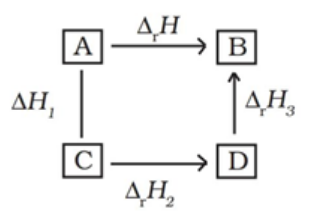
In general, if enthalpy of an overall reaction A → B along one route is $\triangle\text{rH}$ and$​​\triangle\text{rH}_1,\triangle\text{rH}_2,\triangle\text{rH}_3$ representing enthalpies of reactions leading to same product, B along another route, then we have
$\triangle\text{rH}=​​\triangle\text{rH}_1+\triangle\text{rH}_2+\triangle\text{rH}_3$

It can be represented as:
  1. The enthalpy change of a chemical reaction, is given by the symbol …
  1. $\triangle\text{rH}$
  2. $\triangle\text{rG}$
  3. $\triangle\text{rF}$
  4. $\triangle\text{rR}$'
  1. The molar enthalpy is denoted by:
  1. $H_k$
  2. $H_m$
  3. $H_l$
  4. $H_n$
  1. …is enthalpy of fusion in standard state.
  1. $\triangle\text{fus}\text{H}^{\phi}$
  2. $\triangle_\text{r}\text{H}^{\phi}$
  3. $\triangle\text{vap}\text{H}^{\phi}$
  4. $\triangle\text{w}\text{H}^{\phi}$
  1. Solid $CO_2$or ‘dry ice’ sublimes at..
  1. $100K$
  2. $195K$
  3. $150K$
  4. $200K$
  1. … is the standard enthalpy of vaporisation.
  1. $\triangle\text{fus}\text{H}^{\phi}$
  2. $\triangle_\text{r}\text{H}^{\phi}$
  3. $\triangle\text{vap}\text{H}^{\phi}$
  4. $\triangle\text{w}\text{H}^{\phi}$
Read the passage given below and answer the following questions from (i) to (v).
The covalent bond may be classified into twotypes depending upon the types ofoverlapping:(i) Sigma(σ) bond, and (ii) pi($\pi$) bond
  1. Sigma(σ) bond: This type of covalent bondis formed by the end to end (head-on)overlap of bonding orbitals along theinternuclear axis. This is called as headon overlap or axial overlap. This can beformed by any one of the following typesof combinations of atomic orbitals.
s-s overlapping: In this case, there isoverlap of two half filled s-orbitals alongthe internuclear axis.

s-p overlapping: This type of overlapoccurs between half filled s-orbitals of oneatom and half filled p-orbitals of anotheratom.

p–p overlapping: This type of overlaptakes place between half filled p-orbitalsof the two approaching atoms.
  1. pi($\pi$) bond: In the formation of $\pi$ bondthe atomic orbitals overlap in such a waythat their axes remain parallel to each otherand perpendicular to the internuclear axis.The orbitals formed due to sidewiseoverlapping consists of two saucer type charged clouds above and below the planeof the participating atoms.
Basically the strength of a bond depends uponthe extent of overlapping. In case of sigma bond,the overlapping of orbitals takes place to alarger extent. Hence, it is stronger as comparedto the pi bond where the extent of overlappingoccurs to a smaller extent. Further, it isimportant to note that in the formation ofmultiple bonds between two atoms of amolecule, pi bond(s) is formed in addition to asigma bond. In order to explain the characteristicgeometrical shapes of polyatomic moleculeslike $CH_4,NH_3$ and $H_2O$ etc., Pauling introducedthe concept of hybridisation. According to himthe atomic orbitals combine to form new set ofequivalent orbitals known as hybrid orbitals.Unlike pure orbitals, the hybrid orbitals areused in bond formation. The phenomenon isknown as hybridisation which can be definedas the process of intermixing of the orbitals ofslightly different energies so as to redistributetheir energies, resulting in the formation of newset of orbitals of equivalent energies and shape.For example when one 2s and three 2p-orbitalsof carbon hybridise, there is the formation offour new $sp_3$ hybrid orbitals. Salient features of hybridisation: The mainfeatures of hybridisation are as under:
  1. The number of hybrid orbitals is equal tothe number of the atomic orbitals that gethybridised.
  2. The hybridised orbitals are alwaysequivalent in energy and shape.
  3. The hybrid orbitals are more effective informing stable bonds than the pure atomicorbitals.
  4. These hybrid orbitals are directed in spacein some preferred direction to haveminimum repulsion between electronpairs and thus a stable arrangement.Therefore, the type of hybridisationindicates the geometry of the molecules. Important conditions for hybridisation
  5. The orbitals present in the valence shell of the atom are hybridised.
  6. The orbitals undergoing hybridisation should have almost equal energy.
  7. Promotion of electron is not essential condition prior to hybridisation.
  8. It is not necessary that only half filled orbitals participate in hybridisation.
some cases, even filled orbitals of valence shell take part in hybridisation.
There are various types of hybridisationinvolving s, p and d orbitals. The differenttypes of hybridisation are as under:
some cases, even filled orbitals of valence shell take part in hybridisation.
There are various types of hybridisationinvolving $s , p$ and d orbitals. The differenttypes of hybridisation are as under:
1. sp hybridisation: This type ofhybridisation involves the mixing of one $s$ andone $p$ orbital resulting in the formation of twoequivalent $s p$ hybrid orbitals. The suitableorbitals for sp hybridisation are $s$ and pz , ifthe hybrid orbitals are to lie along the $z$-axis. Example of molecule having sphybridisationBeCl2: The ground state electronicconfiguration of Be is $1 s^2 2 s^2$. In the exited stateone of the 2 s -electrons is promoted to vacant 2 p orbital to account for its bivalency.One 2 s and one 2 p -orbital gets hybridised toform two sp hybridised orbitals.
2. sp2 hybridisation: In this hybridisationthere is involvement of one s and twop-orbitals in order to form three equivalent sp2hybridised orbitals. For example, in BCI 3 molecule, the ground state electronicconfiguration of central boron atom is $1 s^2 2 s^2 2 p^1$. In the excited state, one of the 2 selectrons is promoted to vacant $2 p$ orbital as a result boron has three unpaired electrons. These three orbitals (one 2 s and two 2 p )hybridise to form three sp2 hybrid orbitals.
3. $sp ^3$ hybridisation: This type ofhybridisation can be explained by taking theexample of $CH _4$ molecule in which there ismixing of one $s$-orbital and three p -orbitals ofthe valence shell to form four $sp ^3$ hybrid orbitalof equivalent energies and shape. There is $25 \% s$-character and $75 \% p$-character in each $sp ^3$ hybrid orbital. The four $sp ^3$ hybrid orbitals soformed are directed towards the four cornersof the tetrahedron. The angle between $sp ^3$ hybrid orbital is $109.5^{\circ}$.
  1. ....ntroduced the concept of hybridisation.
  1. Pauling
  2. Lewis
  3. Nyholm
  4. Gillespie
  1. Which of the following is an example of sp3 hybridization?
  1. BeCl2
  2. Ch4
  3. BCl3
  4. C2H4
  1. The angle between sp3 hybrid orbital is ….
  1. $5^\circ$
  2. $9^\circ$
  3. $109.5^\circ$
  4. $120^\circ$
  1. A sigma bond is formed by the overlapping of …
  1. s−s,
  2. s−p
  3. p−p
  4. All the above
  1. When one 2s and three 2p-orbitals of carbon hybridise, there is the formation of four new … hybrid orbitals.
  1. sp3
  2. sp2
  3. sp
  4. None of above