Question
The separation between the objective and the eyepiece of a compound microscope can be adjusted between 9.8cm to 11.8cm. If the focal lengths of the objective and the eyepiece are 1.0cm and 6cm respectively, find the range of the magnifying power if the image is always needed at 24cm from the eye.
Answer

For the given compound microscope $f_0 = 1cm, f_e = 6cm, D = 24cm$
For the eye piece, $v_e= -24cm, f_e = 6cm$
Now, $\frac{1}{\text{v}_\text{e}}-\frac{1}{\text{u}_\text{e}}=\frac{1}{\text{f}_\text{e}}$
$\Rightarrow\frac{1}{\text{u}_\text{e}}=\frac{1}{\text{v}_\text{e}}-\frac{1}{\text{f}_\text{e}}\Rightarrow-\Big[\frac{1}{24}+\frac{1}{6}\Big]=-\frac{5}{24}$
$\Rightarrow \text{u}_\text{e}=-4.8\text{cm}$
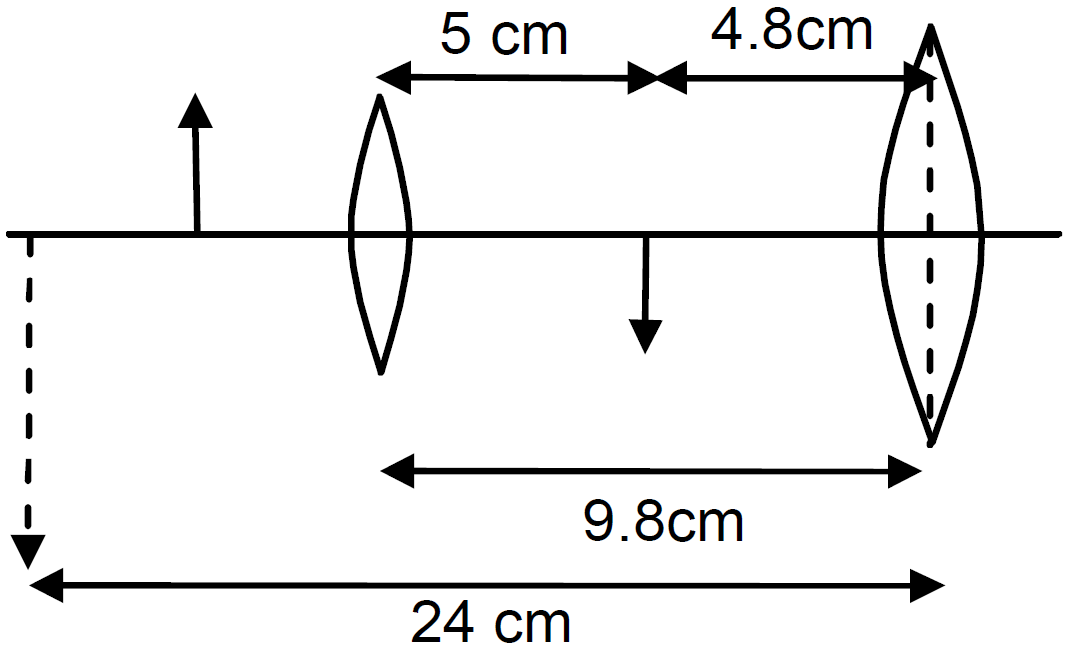
  1. When the separation between objective and eye piece is 9.8cm, the image distance for the objective lens must be $(9.8) - (4.8) = 5.0cm$
Now, $\frac{1}{\text{v}_0}-\frac{1}{\text{u}_0}=\frac{1}{\text{f}_0}$
$\Rightarrow\frac{1}{\text{u}_0}=\frac{1}{\text{v}_0}-\frac{1}{\text{f}_0}=\frac{1}{5}-\frac{1}{1}=-\frac{4}{5}$
$\Rightarrow\text{u}_0=-\frac{5}{4}=-1.25\text{cm}$
So, the magnifying power is given by,
$\text{m}=\frac{\text{v}_0}{\text{u}_\text{0}}\Big[1+\frac{\text{D}}{\text{f}}\Big]=\frac{-5}{-1.25}\Big[1+\frac{24}{6}\Big]=4\times5=20$
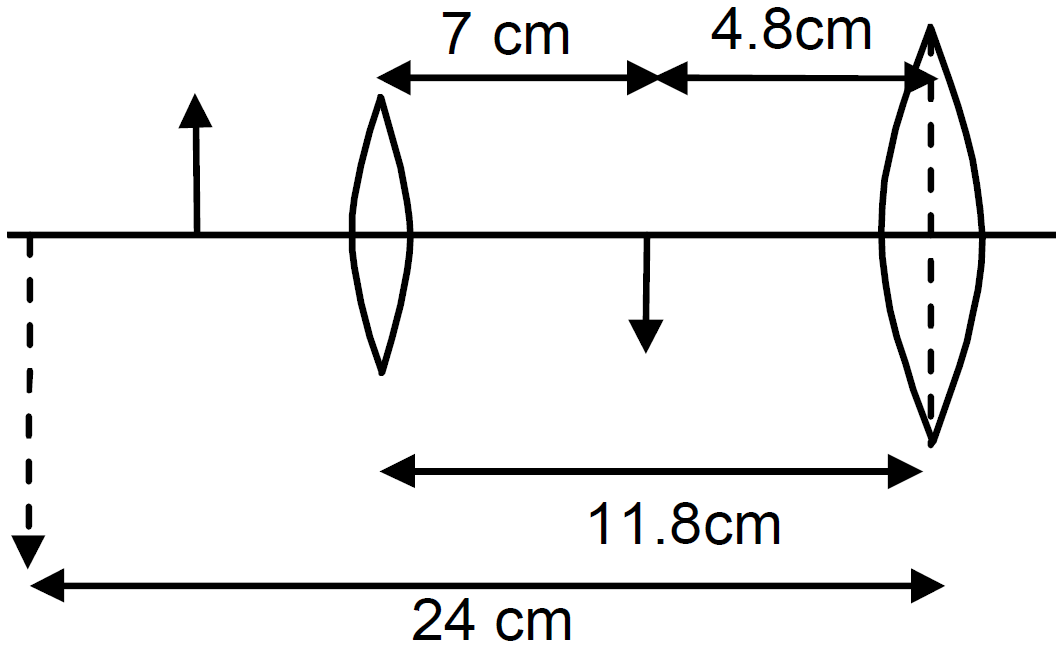
  1. When the separation is 11.8cm,
$v_0 = 11.8 - 4.8 = 7.0cm, f_0 = 1cm$
$\Rightarrow\frac{1}{\text{u}_0}=\frac{1}{\text{v}_0}-\frac{1}{\text{f}_0}=\frac{1}{7}-\frac{1}{1}=-\frac{6}{7}$
So, $\text{m}=-\frac{\text{v}_0}{\text{u}_\text{o}}\Big[1+\frac{\text{D}}{\text{f}}\Big]=\frac{-7}{-\Big(\frac{7}{6}\Big)}\Big[1+\frac{24}{6}\Big]=6\times5=30$
So, the range of magnifying power will be 20 to 30.

Need a full question paper?

Generate a complete, print-ready paper with questions like this in minutes — across 16+ boards, with answer keys.

Start Generating Free

Similar questions

Two blocks of masses 400g and 200g are connected through a light string going over a pulley which is free to rotate about its axis. The pulley has a moment of inertia $1.6 x 10^{-4}kg-m^2$ and a radius 2.0cm. Find:
  1. The kinetic energy of the system as the 400g block falls through 50cm.
  2. The speed of the blocks at this instant.
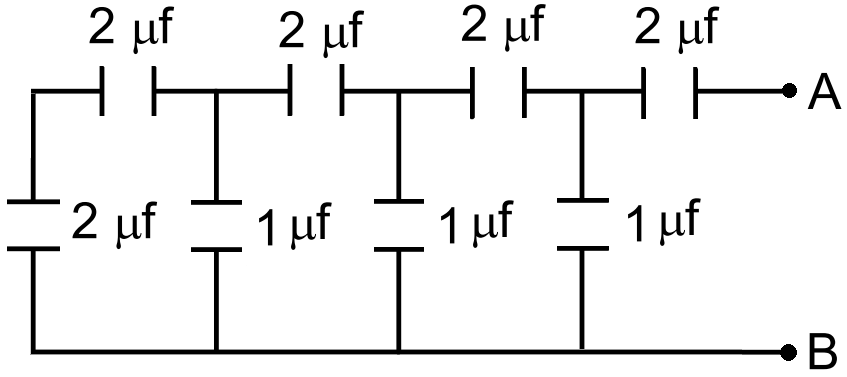
Find the capacitance of the combination shown in figure between A and B.
What are circular and elliptically polarized light?
What is magnetic flux. Explain factors on which it depends.
$(a)$ What is meant by compound microscope? Draw a ray diagram of image formation by a compound microscope. Briefly describe its working and derive the formula for its total magnification.
$(b)$ How does the resolving power of a microscope change when :
$(i)$ The diameter of the objective lens decreases,
$(ii)$ The wavelength of incident light increases?Justify your answer in each case.
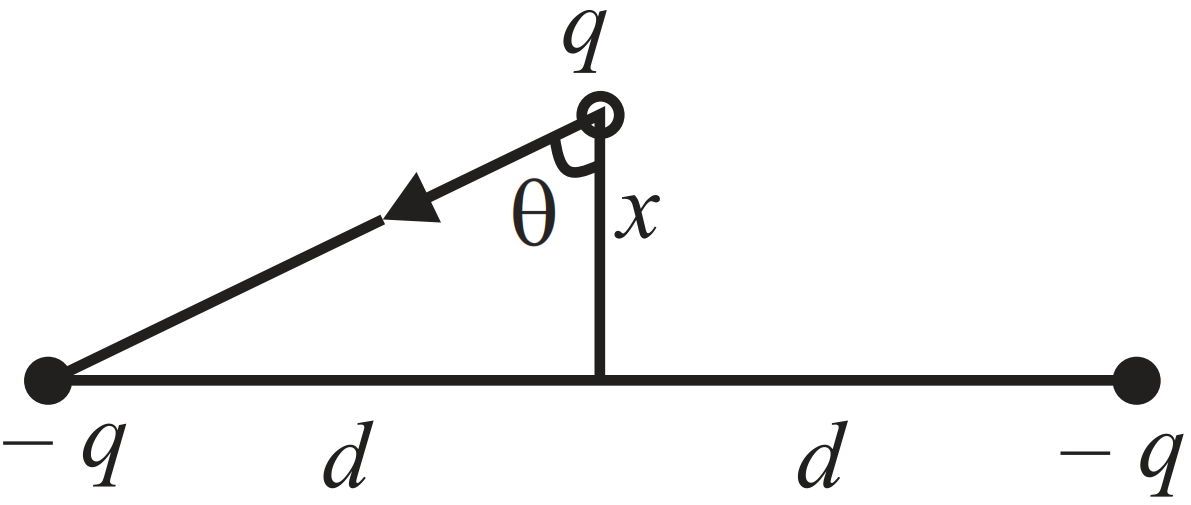
Two charges -q each are fixed separated by distance 2d. A third charge q of mass m placed at the mid-point is displaced slightly by x (x < < d) perpendicular to the line joining the two fixed charged as shown in Fig. Show that q will perform simple harmonic oscillation of time period.

$\text{T}=\Big[\frac{8\pi^3\in_0\text{md}^3}{\text{q}^2}\Big]^\frac{1}{2}$.
$4 \times 10^{23}$ tritium atoms are contained in a vessel. The half-life of decay tritium nuclei is 12.3y. Find:
  1. The activity of the sample.
  2. The number of decay in the next 10 hours.
  3. The number of decays in the next 6.15y.
A charged particle is accelerated through a potential difference of 12kV and acquires a speed of $1.0 \times 10^6m s^{−1}$. It is then injected perpendicularly into a magnetic field of strength 0.2T. Find the radius of the circle described by it.
A proton projected in a magnetic field of 0.020T travels along a helical path of radius 5.0cm and pitch 20cm. Find the components of the velocity of the proton along and perpendicular to the magnetic field. Take the mass of the proton $= 1.6 \times 10^{-27}kg$
A pendulum bob of mass 80mg and carrying a charge of $2 \times 10^{-8}C$ is at rest in a uniform, horizontal electric field of $20kVm^{-1}.$ Find the tension in the thread.