Question
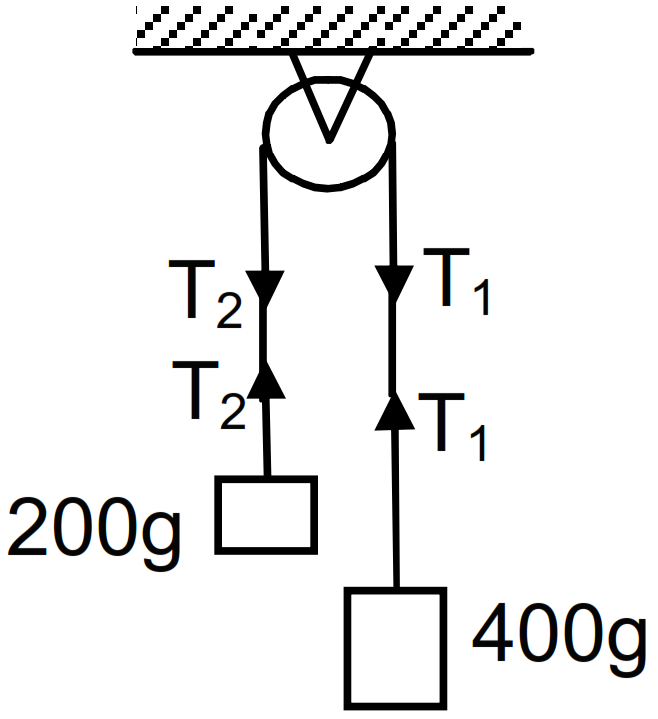
Two blocks of masses 400g and 200g are connected through a light string going over a pulley which is free to rotate about its axis. The pulley has a moment of inertia $1.6 x 10^{-4}kg-m^2$ and a radius 2.0cm. Find:
  1. The kinetic energy of the system as the 400g block falls through 50cm.
  2. The speed of the blocks at this instant.
Answer

  1. Total kinetic energy of the system
  1. According to the question

$0.4\text{g}-\text{T}_1=0.4\text{a}\ \dots(1)$
$\text{T}_2-0.2\text{g}=0.2\text{a}\ \dots(2)$
$(\text{T}_1-\text{T}_2)\text{r}=\frac{\text{la}}{\text{r}}\ \dots(3)$
From equation 1, 2 and 3
$\Rightarrow\text{a}=\frac{(0.4-0.2)\text{g}}{\big(0.4+0.2+\frac{1.6}{0.4}\big)}=\frac{\text{g}}5{}$
Therefore,
$\text{V}=\sqrt{2\text{ah}}=\sqrt{(2\times\text{gl}^5\times0.5)}$
$\Rightarrow\sqrt{\Big(\frac{\text{g}}5{}\Big)}=\sqrt{\Big(\frac{\text{9.8}}5{}\Big)}=1.4\text{m/s}.$
$\frac{1}{2}\text{m}_1\text{V}^2+\frac{1}{2}\text{m}_2\text{V}^2+\frac{1}{2}18^2$
$=\Big(\frac{1}{2}\times0.4\times1.4^2\Big)+\Big(\frac{1}{2}\times0.2\times1.4^2\Big)\\+\Big(\frac{1}{2}\times\Big(\frac{1.6}{4}\Big)\times1.4^2\Big)$
$=0.98\ \text{Joule.}$

Need a full question paper?

Generate a complete, print-ready paper with questions like this in minutes — across 16+ boards, with answer keys.

Start Generating Free

Similar questions

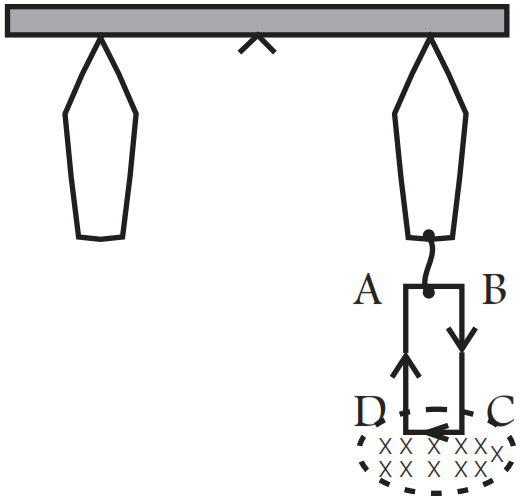
A 100 turn rectangular coil ABCD (in XY plane) is hung from one arm of a balance (Fig). A mass 500g is added to the other arm to balance the weight of the coil. A current 4.9A passes through the coil and a constant magnetic field of 0.2T acting inward (in xz plane) is switched on such that only arm CD of length 1cm lies in the field. How much additional mass 'm' must be added to regain the balance?
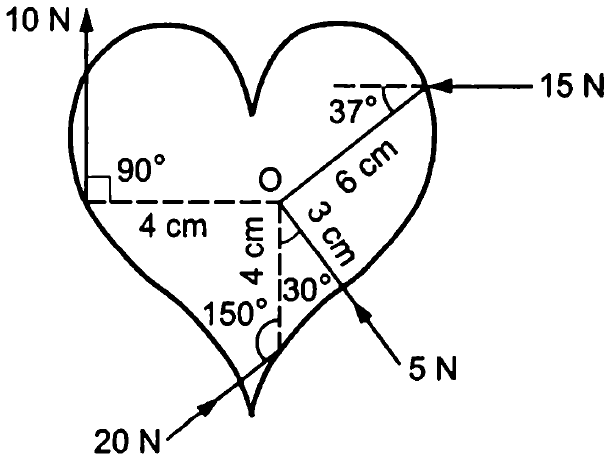
Calculate the total torque acting on the body shown in figure about the point O.
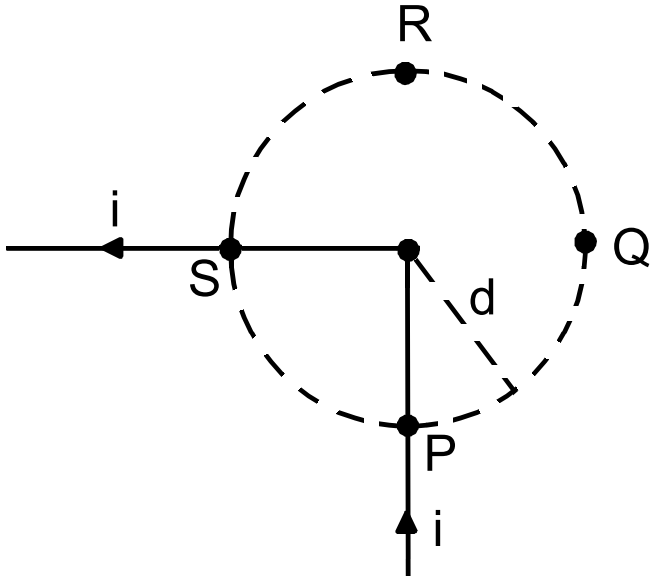
Figure shows a long wire bent at the middle to form a right angle. Show that the magnitudes of the magnetic fields at the points P, Q, R and S are equal and find this magnitude.
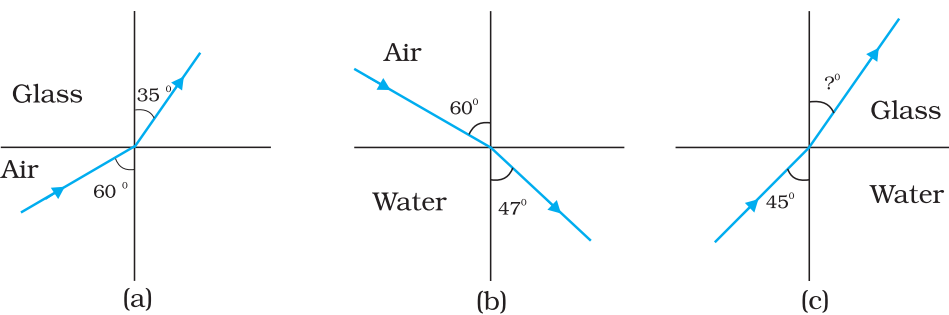
(a) and (b) show refraction of a ray in air incident at 60° with the normal to a glass-air and water-air interface, respectively. Predict the angle of refraction in glass when the angle of incidence in water is 45º with the normal to a water - glass interface.
$a.$ Show that an ideal inductor does not dissipate power in an ac circuit.
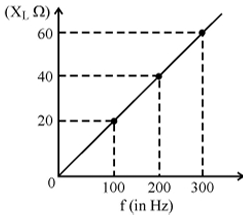
$b.$ The variation of inductive reactance $\left( X _{ L }\right)$ of an inductor with the frequency $( f )$ of the $ac$ source of $100 V$ and variable frequency is shown in the fig.
Image

$i.$ Calculate the self$-$inductance of the inductor.
$ii.$ When this inductor is used in series with a capacitor of unknown value and a resistor of $10 \Omega$ at $300 s^{-1}$, maximum power dissipation occurs in the circuit. Calculate the capacitance of the capacitor.
A U-tube having unequal arm-lengths has water in it. A tuning fork of frequency 440Hz can set up the air in the shorter arm in its fundamental mode of vibration and the same tuning fork can set up the air in the longer arm in its first overtone vibration. Find the length of the air columns. Neglect any end effect and assume that the speed of sound in air = 330m/s.
(I) (a) Write two limitations of ohm’s law. Plot their I-V characteristics.
(b) A heating element connected across a battery of 100 V having an internal resistance of $1 \Omega$ draws an initial current of 10 A at room temperature 20.0 °C which settles after a few seconds to a steady value. What is the power consumed by battery itself after the steady temperature of 320.0 °C is attained? Temperature coefficient of resistance averaged over the temperature range involved is $3.70 \times 10^{-4}{ }^{\circ} C ^{-1}$.
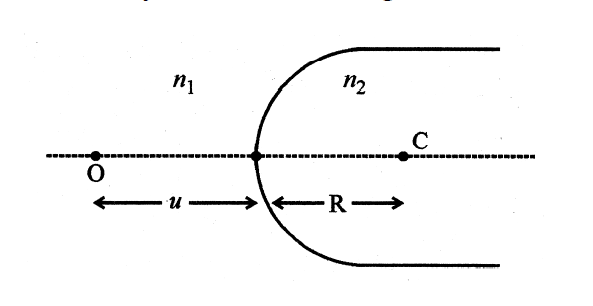
A point object 'O' is kept in a medium of refractive index $n_1$ in front of a convex spherical surface of radius of curvature R which separates the second medium of refractive index $n_2$ from the first one, as shown in the figure. Draw the ray diagram showing the image formation and deduce the relationship between the object distance and the image distance in terms of $n_1, n_2$ and R.
  1.  
  1. hen the image formed above acts as a virtual object for concave spherical, surface separating the medium $n_2$ from $n_1 (n_2> n_1),$ draw this ray diagram and write the similar (similar to (a) relation. Hence obtain the expression for the lens maker's formula.
The benches of a gallery in a cricket stadium are 1m wide and 1m high. A batsman strikes the ball at a level one metre above the ground and hits a mammoth sixer. The ball starts at 35m/s at an angle of 53° with the horizontal. The benches are perpendicular to the plane of motion and the first bench is 110m from the batsman. On which bench will the ball hit?
A box weighing 2000N is to be slowly slid through 20m on a straight track having friction coefficient 0.2 with the box.
  1. Find the work done by the person pulling the box with a chain at an angle $\theta $ with the horizontal.
  2. Find the work when the person has chosen a value of $\theta $ which ensures him the minimum magnitude of the force.