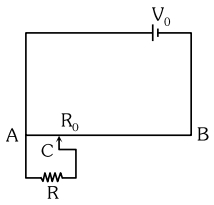
The sliding contact $C$ is at one fourth of the length of the potentiometer wire $( AB )$ from $A$ as shown in the circuit diagram. If the resistance of the wire $AB$ is $R _0$, then the potential drop $( V )$ across the resistor $R$ is
NEET 2022, Medium
Download our app for free and get started
In series, potential divides in direct ratio of resistance,
So, $V_{A C}=\frac{R_{A C}}{R_{A C}+R_{C B}} V_0$
$=\frac{\frac{ RR _0}{4 R + R _0}}{\frac{ RR _0}{4 R + R _0}+\frac{3 R _0}{4}} \times V _0=\frac{4 RV _0}{16 R +3 R _0}$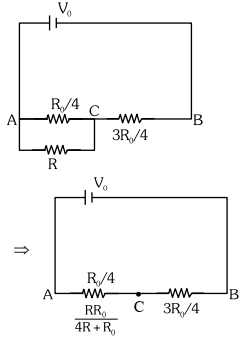

Download our appand get started for free
Experience the future of education. Simply download our apps or reach out to us for more information. Let's shape the future of learning together!No signup needed.*
Similar Questions
- 1In an experiment to measure the internal resistance of a cell by potentiometer, it is found that the balance point is at a length of $2\,m$ when the cell is shunted by a $5\,\Omega $ resistance; and is at a length of $3\,m$ when the cell is shunted by a $10\,\Omega $ resistance. The internal resistance of the cell is, then ................ $\Omega $View Solution
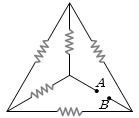
- 2In the network shown in the figure, each of the resistance is equal to $2\,\Omega $. The resistance between the points $A$ and $B$ is .............. $\Omega$View Solution
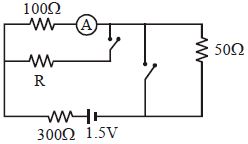
- 3In the circuit shown, the reading of the ammeter (ideal) is the same with both switches open as with both closed find the value of resistance $R$ in $ohm$ . ................ $\Omega$View Solution
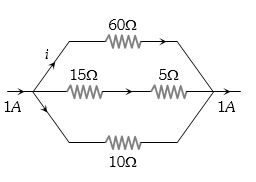
- 4The magnitude of $i$ in ampere unit isView Solution
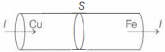
- 5Two rods of copper and iron with the same cross-sectional area are joined at $S$ and a steady current $I$ flows through the rods as shown in the figure. Choose the most appropriate representation of charges accumulated near the junction $S$.View Solution
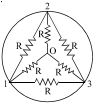
- 6Inside $a$ super conducting ring six identical resistors each of resistance $R$ are connected as shown in figure. The equivalent resistance $(s)$View Solution
- 7A copper wire has a square cross-section, $2.0\, mm$ on a side. It carries a current of $8\, A$ and the density of free electrons is $8 \times {10^{28}}\,{m^{ - 3}}$. The drift speed of electrons is equal toView Solution
- 8If you are provided three resistances $2 \,\Omega$, $3 \,\Omega$ and $6 \,\Omega$. How will you connect them so as to obtain the equivalent resistance of $4 \,\Omega$View Solution
- 9The reading of voltmeter in the circuit shown is ............. $V$View Solution
- 10In the circuit shown below, a student performing Ohm's law experiment accidently puts the voltmeter and the ammeter as shown in the circuit below. The reading in the voltmeter will be close to .......... $V$View Solution