MCQ
The specific heat of a gas in an isothermal process is
  • Infinite
  • B
    Zero
  • C
    Negative
  • D
    Remains constant

Answer

Correct option: A.
Infinite
a
(a)In isothermal process temperature remains constant. i.e., $\Delta T = 0$. Hence according to $C = \frac{Q}{{m\Delta T}}$==>${C_{iso}} = \infty $

Need a full question paper?

Generate a complete, print-ready paper with questions like this in minutes — across 16+ boards, with answer keys.

Start Generating Free

Similar questions

A body of mass $1\,kg$ is executing simple harmonic motion. Its displacement $y(cm)$ at $t$ seconds is given by $y = 6\sin (100t + \pi /4)$. Its maximum kinetic energy is ..... $J$
The pressure and volume of an ideal gas are related as $\mathrm{PV}^{3 / 2}=\mathrm{K}$ (Constant). The work done when the gas is taken from state $A\left(P_1, V_1, T_1\right)$ to state $\mathrm{B}\left(\mathrm{P}_2, \mathrm{~V}_2, \mathrm{~T}_2\right)$ is :
Position of a body with acceleration '$a$' is given by $x = K{a^m}{t^n},$ here $t$ is time. Find dimension of $m$ and $n$.
Two sound waves of slightly different frequencies propagating in the same direction produce beats due to:
If the rotational kinetic energy of a body is increased by $300\ \%$ then the percentage increase in its angular momentum will be .......... $\%$
The mean free path of the molecules of a gas is proportional to:
The identical spheres each of mass $2 \mathrm{M}$ are placed at the corners of a right angled triangle with mutually perpendicular sides equal to $4 \mathrm{~m}$ each. Taking point of intersection of these two sides as origin, the magnitude of position vector of the centre of mass of the system is $\frac{4 \sqrt{2}}{x}$, where the value of $x$ is_____
A rope ladder with a length $l$ carrying a man with a mass $m$ at its end is attached to the basket of balloon with a mass $M.$ The entire system is in equilibrium in the air. As the man climbs up to the end of the ladder into the balloon, the balloon descends by a height $h.$ Then the potential energy of the man
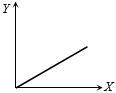
A student plots a graph from his reading on the determination of Young’s modulus of a metal wire but forgets to label. The quantities on $X$ and $Y$ axes may be respectively.
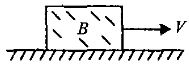
A block $B$ is pushed momentarily along a horizontal surface with an initial velocity $V.$ If $\mu $ is the coefficient of sliding friction between $B$ and the surface, block $B$ will come to rest after a time