The wall with a cavity consists of two layers of brick separated by a layer of air.All three layers have the same thickness and the thermal conductivity of the brick is much greater than that of air. The left layer is at a higher temperature than the right layer and steady state condition exists. Which of the following graphs predicts correctly the variation of temperature $T$ with distance $d$ inside the cavity?
- A

- B

- C

- D

Advanced


Download our appand get started for free
Experience the future of education. Simply download our apps or reach out to us for more information. Let's shape the future of learning together!No signup needed.*
Similar Questions
- 1A black metal foil is warmed by radiation from a small sphere at temperature $T$ and at a distance $d$. It is found that the power received by the foil is $`P$ '. If both the temperature and the distance are doubled, the power received by the foil will beView Solution
- 2A body cools in $7$ minutes from $60^{\circ}\,C$ to $40^{\circ}\,C$. The temperature of the surrounding is $10^{\circ}\,C$. The temperature of the body after the next $7$ minutes will beView Solution
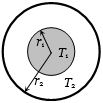
- 3The figure shows a system of two concentric spheres of radii $r_1$ and $r_2$ and kept at temperatures $T_1$ and $T_2$, respectively. The radial rate of flow of heat in a substance between the two concentric spheres is proportional toView Solution
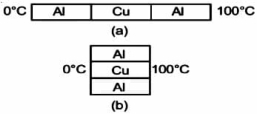
- 4The three rods shown in figure have identical dimensions. Heat flows from the hot end at a rate of $40 \,W$ in the arrangement $(a)$. Find the rates of heat flow when the rods are joined as in arrangement $(b)$ is ......... $W$ (Assume $K_al=200 \,W / m ^{\circ} C$ and $\left.K_{c u}=400 \,W / m ^{\circ} C \right)$View Solution
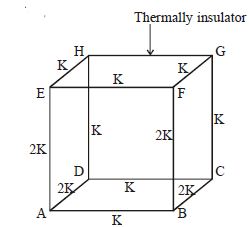
- 5Find effective thermal resistance between $A$ & $B$ of cube made up of $12$ rods of same dimensions and shown given thermal conductivity. [ $l =$ length of rod, $a =$ cross section area of rod]View Solution
- 6A body takes $4$ minutes to cool from ${100^o}C$ to ${70^o}C$. To cool from ${70^o}C$ to ${40^o}C$ it will take ........ $\min.$ (room temperature is ${15^o}C$)View Solution
- 7The maximum energy in the thermal radiation from a hot source occurs at a wavelength of $11 \times {10^{ - 5}}cm$. According to Wein's law, the temperature of the source (on Kelvin scale) will be $n$ times the temperature of another source (on Kelvin scale) for which the wavelength at maximum energy is $5.5 \times {10^{ - 5}}cm$. The value $n$ isView Solution
- 8Certain substance emits only the wavelengths ${\lambda _1},\;{\lambda _2},\;{\lambda _3}$ and ${\lambda _4}$ when it is at a high temperature. When this substance is at a colder temperature, it will absorb only the following wavelengthsView Solution
- 9A cup of tea cools from $65.5^o C to 62.5 ^o C$ in one minute in a room of $22.5 ^o C$. How long will the same cup of tea take, in.............. minutes, to cool from $46.50^o C to 40.5 ^o C$ in the same room ? (choose nearest value)View Solution
- 10A particular star (assuming it as a black body) has a surface temperature of about $5 \times {10^4}K.$The wavelength in nanometers at which its radiation becomes maximum is $(b = 0.0029 mK)$View Solution