MCQ
The temperature of equal masses of three different liquids ${x}, {y}$ and ${z}$ are $10^{\circ} {C}, 20^{\circ} {C}$ and $30^{\circ} {C}$ respectively. The temperature of mixture when ${x}$ is mixed with ${y}$ is $16^{\circ} {C}$ and that when ${y}$ is mixed with $z$ is $26^{\circ} {C}$. The temperature of mixture when $x$ and $z$ are mixed will be ...... $^{\circ} {C}$
  • A
    $28.32$
  • B
    $25.62$
  • $23.84$
  • D
    $20.28$

Answer

Correct option: C.
$23.84$
c
${X} \quad \quad\quad \quad \quad\quad {Y} \quad\quad \quad \quad \quad \quad {Z}$

${m}_{1}={m}\quad\quad \quad {m}_{2}={m}\quad \quad \quad \quad {m}_{3}={m}$

${T}_{1}=10^{\circ} {C}\quad \quad {T}_{2}=20^{\circ} {C}\quad \quad {T}_{3}=30^{\circ} {C}$

${s}_{1}\quad \quad \quad \quad \quad \quad {s}_{2}\quad \quad \quad \quad \quad \quad \quad {s}_{3}$

when ${x} \;and\; {y}$ are mixed, ${T}_{{f}_{{l}}}=16^{\circ} {C}$

${m}_{1} {S}_{1} {T}+{m}_{2} {s}_{2} {T}_{2}=\left({m}_{1} {S}_{1}+{m}_{2} {S}_{2}\right) {Tf}_{1}$

${s}_{1} \times 10+{s}_{2} \times 20=\left({s}_{1}+{s}_{2}\right) \times 16$

${s}_{1}=\frac{2}{3} {s}_{2}$

When $y \;and\; z$ are mixex, $T_{f_{2}}=26^{\circ} {C}$

${m}_{2} {s}_{2} {T}+{m}_{3} {s}_{3} {T}_{3}=\left({m}_{3} {s}_{3}+{m}_{3} {s}_{3}\right) {T} {f}_{2}$

${s}_{2} \times 20+{s}_{3} \times 30=\left({s}_{2}+{s}_{3}\right) \times 26$

${s}_{3}=\frac{3}{2} {s}_{2} \quad \ldots . . \text { (ii) }$

when $x \;and\; z$ are mixex

${m}_{1} {s}_{1} {T}_{1}+{m}_{3} {S}_{3} {T}_{3}=\left({m}_{1} {s}_{1}+{m}_{3} {S}_{3}\right) {Tf}$

$\frac{2}{3} {s}_{2} \times 10+\frac{2}{3} {s}_{2} \times 20=\left(\frac{2}{3} {s}_{2}+\frac{3}{2} {s}_{2}\right) {T}_{{f}}$

${T}_{{f}}=23.84^{\circ} {C}$
Need a full question paper?

Generate a complete, print-ready paper with questions like this in minutes — across 16+ boards, with answer keys.

Start Generating Free

Similar questions

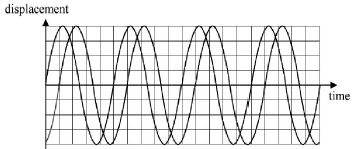
The diagram shows two oscillations. What is the phase difference between the oscillations?
A diatomic gas $(\gamma=1.4)$ does $400 J$ of work when it is expanded isobarically. The heat given to the gas in the process is ............ $J$
Match the column $-I$ with column $-II$ For a satellite in circular orbit,

  Column $-I$   Column $-II$
$(A)$ Kinetic energy $(p)$ $ - \frac{{G{M_E}m}}{{2r}}$
$(B)$ Potential energy $(q)$ $\sqrt {\frac{{G{M_E}}}{r}} $
$(C)$ Total energy $(r)$ $ - \frac{{G{M_E}m}}{{r}}$
$(D)$ Orbital energy $(s)$ $ \frac{{G{M_E}m}}{{2r}}$

 (where $M_E$ is the mass of the earth, $m$ is mass of the satellite and $r$ is the radius of the orbit)

A student of mass $M$ is $1.5 \,m$ tall and has her centre of mass $1 \,m$ above ground when standing straight. She wants to jump up vertically. To do so. she bends her knees so that her centre of mass is lowered by $0.2 \,m$ and then pushes the ground by a constant force F. As a result, she jumps up such that the maximum height of her feet is $0.3 \,m$ above ground. The ratio $F / Mg$ is
​​​​50% of the X-rays coming from a Coolidge tube are able to pass through a 0.1mm thick aluminium foil. If the potential difference between the target and the filament is increased, the fraction of the X-rays passing through the same foil will be:
Which graph shows best the velocity-time graph for an object launched vertically into the air when air resistance is given by $| D | = bv?$ The dashed line shows the velocity graph if there were no air resistance.
A satellite of mass m is at a distance of $'a'$ from a star of mass $M.$ The speed of the satellite is $u.$ Suppose the law of universal gravity is $F=-G\frac{Mm}{r^{2.1}}$ instead of $F=-G\frac{Mm}{r^{2}}$ find the speed of the satellite when it is at $a$ distance $b$ from the star.
A piece of blue glass heated to a high temperature and a piece of red glass at room temperature, are taken inside a dimly lit room then
Water rise in a capillary upto an extension height such that upward force of surface tension balances the force of $75 \times 10^{-4}\,N$ due to weight of water. If surface tension of water is $12 \times 10^{-2}\,N/m$. The internal circumference of the capillary must be
First law of thermodynamics: