An electron (charge = $1.6 \times {10^{ - 19}}$ $coulomb$) is accelerated through a potential of $1,00,000$ $volts$. The energy required by the electron is
Easy


Download our appand get started for free
Experience the future of education. Simply download our apps or reach out to us for more information. Let's shape the future of learning together!No signup needed.*
Similar Questions
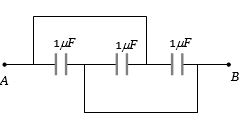
- 1The equivalent capacitance in the circuit between $A$ and $B$ will be.....$\mu \,F$View Solution
- 2View SolutionThree equal charges are placed at the corners of an equilateral triangle. Which of the graphs below correctly depicts the equally-spaced equipotential surfaces in the plane of the triangle? (All graphs have the same scale.)
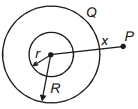
- 3Two concentric hollow conducting spheres of radius $r$ and $R$ are shown. The charge on outer shell is $Q$. What charge should be given to inner sphere so that the potential at any point $P$ outside the outer sphere is zero?View Solution
- 4The potentials of the two plates of capacitor are $+10\,V$ and $-10\, V$. The charge on one of the plates is $40 \,C$. The capacitance of the capacitor is........$F$View Solution
- 5Eight small drops, each of radius $r$ and having same charge $q$ are combined to form a big drop. The ratio between the potentials of the bigger drop and the smaller drop isView Solution
- 6The election field in a region is given by $\vec E = (Ax + B)\hat i$ where $E$ is in $N\,C^{-1}$ and $x$ in meters. The values of constants are $A = 20\, SI\, unit$ and $B = 10\, SI\, unit$. If the potential at $x =1$ is $V_1$ and that at $x = -5$ is $V_2$ then $V_1 -V_2$ is.....$V$View Solution
- 7The work done to take an electron from rest where potential is $-60\, V$ to another point where potential is $-20\, V$ is given by.....$eV$View Solution
- 8Between the plates of a parallel plate condenser, a plate of thickness ${t_1}$ and dielectric constant ${k_1}$ is placed. In the rest of the space, there is another plate of thickness ${t_2}$ and dielectric constant ${k_2}$. The potential difference across the condenser will beView Solution
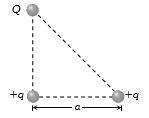
- 9Three charges $Q,\, + q$ and $ + q$ are placed at the vertices of a right-angled isosceles triangle as shown. The net electrostatic energy of the configuration is zero if $Q$ is equal toView Solution
- 10Two metallic plates form a parallel plate capacitor. The distance between the plates is $'d'.$ A metal sheet of thickness $\frac{d}{2}$ and of area equal to area of each plate is introduced between the plates. What will be the ratio of the new capacitance to the original capacitance of the capacitor $?$View Solution