MCQ
The time period of a mass suspended from a spring is $T$. If the spring is cut into four equal parts and the same mass is suspended from one of the parts, then the new time period will be
  • A
    $T$
  • $\frac{T}{2}$
  • C
    $2 T$
  • D
    $\frac{T}{4}$

Answer

Correct option: B.
$\frac{T}{2}$
b
(b)By cutting spring in four equal parts force constant (K) of each parts becomes four times so by using $T = 2\pi \sqrt {\frac{m}{K}} ;$ time period will be half i.e. $T' = T/2$

Need a full question paper?

Generate a complete, print-ready paper with questions like this in minutes — across 16+ boards, with answer keys.
Start Generating Free

Similar questions

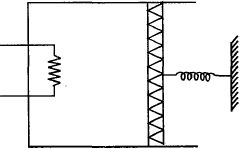
An ideal monoatomic gas is confined in a cylinder by a spring loaded piston of cross section $8.0\times10^{-3}\, m^2$ . Initially the gas is at $300\, K$ and occupies a volume of $2.4\times10^{-3}\, m^3$ and the spring is in its relaxed state as shown in figure. The gas is heated by a small heater until the piston moves out slowly by $0.1\, m$. The force constant of the spring is $8000\, N/m$ and the atmospheric pressure is $1.0\times10^5\, N/m^2$ . The cylinder and the piston are thermally insulated. The piston and the spring are massless and there is no friction between the piston and the cylinder. The final temperature of the gas will be: (Neglect the heat loss through the lead wires of the heater . The heat capacity of the heater coil is also negligible)
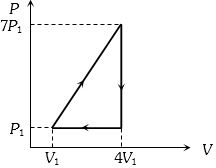
In the cyclic process shown in the figure, the work done by the gas in one cycle is
Kepler discovered
A frame of reference that is accelerated with respect to an inertial frame of reference is called a non-inertial frame of reference. A coordinate system fixed on a circular disc rotating about a fixed axis with a constant angular velocity $\omega$ is an example of a non-intertial fiame of reference. The relationship between the force $\vec{F}_{\text {rot }}$ experienced by a particle of nass in moving on the rotating disc and the force $\vec{F}_{\text {in }}$ experienced by the particle in an inertial frame of reference is

$\vec{F}_{\text {rot }}=\vec{F}_{\text {in }}+2 m\left(\vec{v}_{\text {rot }} \times \vec{\omega}\right)+m(\vec{\omega} \times \vec{r}) \times \vec{\omega},$

where $\vec{v}_{\text {rot }}$ is the velocity of the particle in the rotating frame of reference and $\bar{r}$ is the position vector of the particle with respect to the centre of the disc.

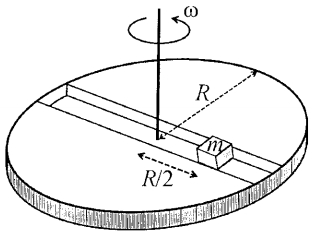
Now consider a smooth slot along a diameter of a disc of radius $R$ rotating counter-clockwise with a constant angular speed $\omega$ about its vertical axis through its center. We assign a coordinate system with the origin at the center of the disc, the $x$-axis along the slot, the $y$-axis perpendicular to the slot and the $z$-axis along the rotation axis $(\vec{\omega}=\omega \hat{k})$. A sm a $1$ block of mass $m$ is gently placed in the slot at $\vec{r}=(R / 2) \hat{i}$ at $t=0$ and is constrained to move only along the slot.

(Image)

($1$) The distance $r$ of the block at time $t$ is

($A$) $\frac{R}{4}\left(e^{\omega t}+e^{-\omega t}\right)$   ($B$) $\frac{R}{2} \cos \omega t$   ($C$) $\frac{R}{4}\left(e^{2 \omega t}+e^{-2 \omega t}\right)$

($D$) $\frac{F}{2} \cos 2 \omega t$

($2$) The net reaction of the disc on the block is

($A$) $\frac{1}{2} m \omega^2 R\left(e^{2 \omega t}-e^{-2 \omega t}\right) \hat{j}+m g \hat{k}$

($B$) $\frac{1}{2} m \omega^2 R\left(e^{\omega t}-e^{-a t t}\right) j+m g k$

($C$) $-m \omega^2 R \cos \omega t \hat{j}-m g \hat{k}$

($D$) $m \omega^2 R \sin \omega t \hat{j}-m g \hat{k}$

Give the answer quetioin ($1$) ($2$)
Given below are two statements :

Statement $I$ : The law of gravitation holds good for any pair of bodies in the universe.

Statement $II$ : The weight of any person becomes zero when the person is at the centre of the earth. In the light of the above statements, choose the correct answer from the options given below.

A sphere of diameter $7\,\, cm$ and mass $266.5 \,\,gm$ floats in a bath of a liquid. As the temperature is raised, the sphere just begins to sink at a temperature $35^o C$. If the density of a liquid at $0^o C$ is $1.527 \,\,gm/cc$, then neglecting the expansion of the sphere, the coefficient of cubical expansion of the liquid is$f$ :
A bullet is fired from a gun. The force on the bullet is given by $F = 600 - 2 \times {10^5}t$, where $F$ is in newtons and $t$ in seconds. The force on the bullet becomes zero as soon as it leaves the barrel. What is the average impulse imparted to the bullet  ........... $N-s$
If mass of earth decreases by $25 \%$ and its radius increases by $50 \%$, then acceleration due to gravity at its surface decreases by nearly ......... $\%$
A hot liquid is kept in a big room. The logarithm of the numerical value of the temperature difference between the liquid and the room is plotted against time. The plot will be very nearly:
A $140\, g$ ball, in horizontal flight with a speed $v_1$ of $39.0\, m/s$, is struck by a bat. After leaving the bat, the ball travel in the opposite direction with speed $v_2 = 39.0\, m/s$. If the impact time $\Delta t$ for the ball-bat collision is $1.20\, ms$, what average net force acts on the ball ......... $N$