MCQ
A pendulum is swinging in an elevator. Its period will be greatest when the elevator is
  • A
    moving upwards at constant speed
  • B
    moving downwards
  • C
    moving downwards at constant speed
  • accelerating downwards

Answer

Correct option: D.
accelerating downwards
d
Time period of a simple pendulum is given by

$T=2 \pi \sqrt{\frac{l}{g}}$ or $T \propto \sqrt{\frac{l}{g}}$

when the elevator is accelerating downwards, the net gravitational acceleration is $(g-a),$ so, the time period when elevation is accelerating downwards, is greatest.

Need a full question paper?

Generate a complete, print-ready paper with questions like this in minutes — across 16+ boards, with answer keys.

Start Generating Free

Similar questions

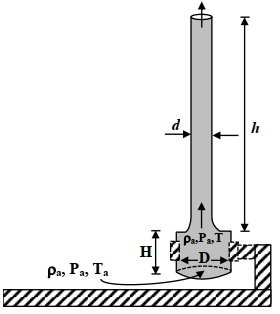
A cylindrical furnace has height $(H)$ and diameter $(D)$ both $1 \mathrm{~m}$. It is maintained at temperature $360 \mathrm{~K}$. The air gets heated inside the furnace at constant pressure $P_a$ and its temperature becomes $T=360 \mathrm{~K}$. The hot air with density $\rho$ rises up a vertical chimney of diameter $d=0.1 \mathrm{~m}$ and height $h=9 \mathrm{~m}$ above the furnace and exits the chimney (see the figure). As a result, atmospheric air of density $\rho_a=1.2 \mathrm{~kg} \mathrm{~m}^{-3}$, pressure $P_a$ and temperature $T_a=300 \mathrm{~K}$ enters the furnace. Assume air as an ideal gas, neglect the variations in $\rho$ and $T$ inside the chimney and the furnace. Also ignore the viscous effects.

[Given: The acceleration due to gravity $g=10 \mathrm{~ms}^{-2}$ and $\pi=3.14$ ]

(image)

($1$) Considering the air flow to be streamline, the steady mass flow rate of air exiting the chimney is

. . . . .$\mathrm{gm} \mathrm{s}^{-1}$.

($2$) When the chimney is closed using a cap at the top, a pressure difference $\Delta P$ develops between the top and the bottom surfaces of the cap. If the changes in the temperature and density of the hot air, due to the stoppage of air flow, are negligible then the value of $\Delta P$ is. . . . .$\mathrm{Nm}^{-2}$.
An object is projected from ground with speed $u$ at angle $\theta$ with horizontal. the radius of curvature of its trajectory at maximum height from ground is ..........
Mercury has an angle of contact equal to $140^{\circ}$ with soda lime glass. A narrow tube of radius $1.00 \;mm$ made of this glass is dipped in a trough containing mercury. By what amount does the mercury dip down (in $mm$) in the tube relative to the liquid surface outside? Surface tension of mercury at the temperature of the experiment is $0.465\; N m ^{-1} .$ Density of mercury $=13.6 \times 10^{3} \;kg m ^{-3}$
In the first second of its flight, rocket ejects $1/60$ of its mass with a velocity of $2400\,m/s$. The acceleration of the rocket is ............ $ms^{-2}$
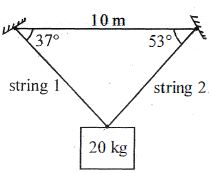
A mass of $20\  kg$ is hanging with support of two strings of same linear mass density. Now pulses are generated in both strings at same time near the joint at mass. Ratio of time, taken by a pulse travel through string $1$ to that taken by pulse on string $2$ is
$Assertion :$ At a given temperature the specific heat of a gas at constant pressure. is always greater than its specific heat at constant volume

$Reason :$ When a gas is heated at constant volume some extra heat is needed compared to that at constant pressure for doing work in expansion.

A particle execute $S.H.M.$ along a straight line. The amplitude of oscillation is $2 \,cm$. When displacement of particle from the mean position is $1 \,cm$, the magnitude of its acceleration is equal to magnitude of its velocity. The time period of oscillation is ........
Column $II$ gives certain systems undergoing a process. Column $I$ suggests changes in some of the parameters related to the system. Match the statements in Column $I$ to the appropriate process$(es)$ from Column $II$.

Column $I$  Column $II$ 
$(A)$ The energy of the system is increased

$(p)$ $System:$ A capacitor, initially uncharged

$Process:$ It is connected to a battery

$(B)$ Mechanical energy is provided to the system, which is converted into energy of random motion of its parts

$(q)$ $System:$ A gas in an adiabatic container fitted with an adiabatic piston

$Process:$ The gas is compressed by pushing the piston

$(C)$ Internal energy of the system is converted into its mechanical energy

$(r)$ $System:$ A gas in a rigid container

$Process:$ The gas gets cooled due to colder atmosphere surrounding it

$(D)$ Mass of the system is decreased

$(s)$ $System:$ A heavy nucleus, initially at rest

$Process:$ The nucleus fissions into two fragments of nearly equal masses and some neutrons are emitted


$(t)$ $System:$ A resistive wire loop

$Process:$ The loop is placed in a time varying magnetic field perpendicular to its plane

Water rises to height $'h'$ in capillary tube. If the length of capillary tube above the surface of water is made less than $'h'$, then
The dimensions of $C{V^2}$ matches with the dimensions of