The transconductance of a triode amplifier is $2.5\ mili$ mho having plate resistance of $20\ K \Omega$, amplification $10.$ Find the load resistance
[RPMT 2001]


Download our appand get started for free
Experience the future of education. Simply download our apps or reach out to us for more information. Let's shape the future of learning together!No signup needed.*
Similar Questions
- 1View SolutionThe temperature coefficient of resistance of a semiconductor
- 2On increasing the reverse bias to a large value in a $P N$-junction diode, currentView Solution
- 3View SolutionWhen phosphorus and antimony are mixed in zermaniun, then
- 4View SolutionWhich one is reverse-biased
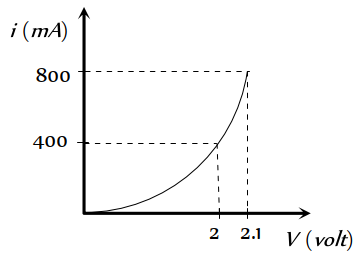
- 5The $i-V$ characteristic of a $P-N$ junction diode is shown below. The approximate dynamic resistance of the $P-N$ junction when a forward bias of $2$ volt is appliedView Solution
- 6For a transistor, in a common emitter arrangement, the alternating current gain $\beta$ is given byView Solution
- 7View SolutionThe thermionic emission of electron is due to
- 8In forward bias, the width of potential barrier in a $P-N$ junction diodeView Solution
- 9View SolutionWhich of the energy band diagrams shown in the figure corresponds to that of a semiconductor
- 10A triode has a mutual conductance of $2 \times 10^{-3} mho$ and an amplification factor of $50.$ The anode is connected through a resistance of $25 \times 10^3$ ohms to a $250$ volts supply. The voltage gain of this amplifier isView Solution