The two ends of a uniform conductor are joined to a cell of $e.m.f.$ $E$ and some internal resistance. Starting from the midpoint $P$ of the conductor, we move in the direction of current and return to $P$. The potential $V$ at every point on the path is plotted against the distance covered $(x)$. Which of the following graphs best represents the resulting curve
Medium
Download our app for free and get started
(b) When we move in the direction of the current in a uniform conductor, the potential difference decreases linearly. When we pass through the cell, from it's negative to it's positive terminal, the potential increases by an amount equal to it's potential difference. This is less than it's $emf$, as there is some potential drop across it's internal resistance when the cell is driving current.

Download our appand get started for free
Experience the future of education. Simply download our apps or reach out to us for more information. Let's shape the future of learning together!No signup needed.*
Similar Questions
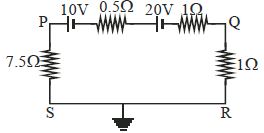
- 1View SolutionIn the circuit shown in figure, which of the statement is incorrect ?
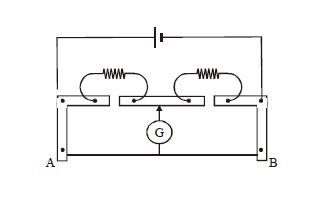
- 2A meter bridge set up as shown to determine end correction at $A$ and $B$. When a resistance of $15\ \Omega$ is used in left gap and of $20\ \Omega$ in right gap, then null point comes at a distance $42\ cm$ from $A$. When these resistances are interchanged null point comes at a distance $57\ cm$ from $A$. Values of end corrections areView Solution
- 3The heat produced by a $100\, watt$ heater in $2$ minute will be equal toView Solution
- 4Two batteries with e.m.f $12\ V$ and $13\ V$ are connected in parallel across a load resistor of $10\,\Omega$ . The internal resistances of the two batteries are $1\,\Omega$ and $2\,\Omega$ respectively. The voltage across the load lies betweenView Solution
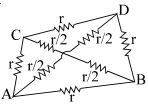
- 5The figure shows a tetrahedron, each side of which has a resistance $r$ Choose the correct statement $(s)$ related to the resistance between any two points.View Solution
- 6Assertion : The current density $\vec J$ at any point in ohmic resistor is in direction of electric field $\vec E$ at that point.View Solution
Reason : A point charge when released from rest in a region having only electrostatic field always moves along electric lines of force.
- 7A student obtained following observations in an experiment of meter bridge to find the unknown resistance of the circuit The most accurate value of unknown resistance is ............ $\Omega$View Solution
S.No. $R$ $l$ $100-l$ $S = \left( {\frac{{100 - l}}{l}} \right)R$ $1$ $20\,\Omega $ $43$ $57$ $26.51\,\Omega $ $2$ $30\,\Omega $ $51$ $49$ $28.82\,\Omega $ $3$ $40\,\Omega $ $59$ $41$ $27.80\,\Omega $ $4$ $60\,\Omega $ $70$ $30$ $25.71\,\Omega $ - 8A primary cell has an $e.m.f.$ of $1.5\,volts$, when short-circuited it gives a current of $3$ amperes. The internal resistance of the cell is .............. $ohm$View Solution
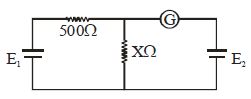
- 9In the adjoining circuit, the battery $E_1$ has an emf of $12\, volt$ and zero internal resistance while the battery $E_2$ has an $emf$ of $2\, volt$. If the galvanometer $G$ reads zero, then the value of the resistance $X$ (in $ohm$ ) isView Solution
- 10An electric fan and a heater are marked as $100\, watt$, $220\, volt$ and $1000\, watt$, $220\, volt$ respectively. The resistance of the heater isView Solution