The convex surface of a thin concavo-convex lens of glass of refractive index 1.5 has a radius of curvature 20cm. The concave surface has a radius of curvature 60cm. The convex side is silvered and placed on a horizontal surface as shown in figure.
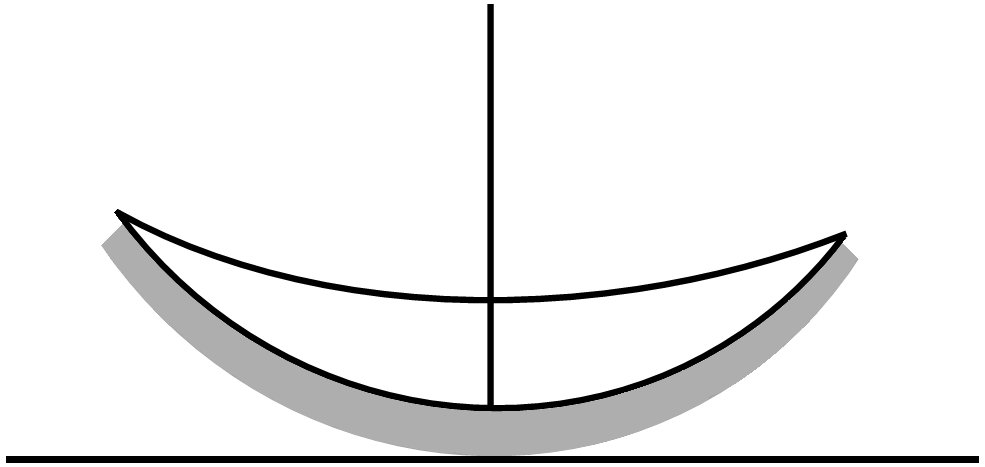
- Where should a pin be placed on the axis so that its image is formed at the same place?
- If the concave part is filled with water $\Big(\mu=\frac{4}{3}\Big),$ find the distance through which the pin should be moved so that the image of the pin again coincides with the pin.
Download our app for free and get started
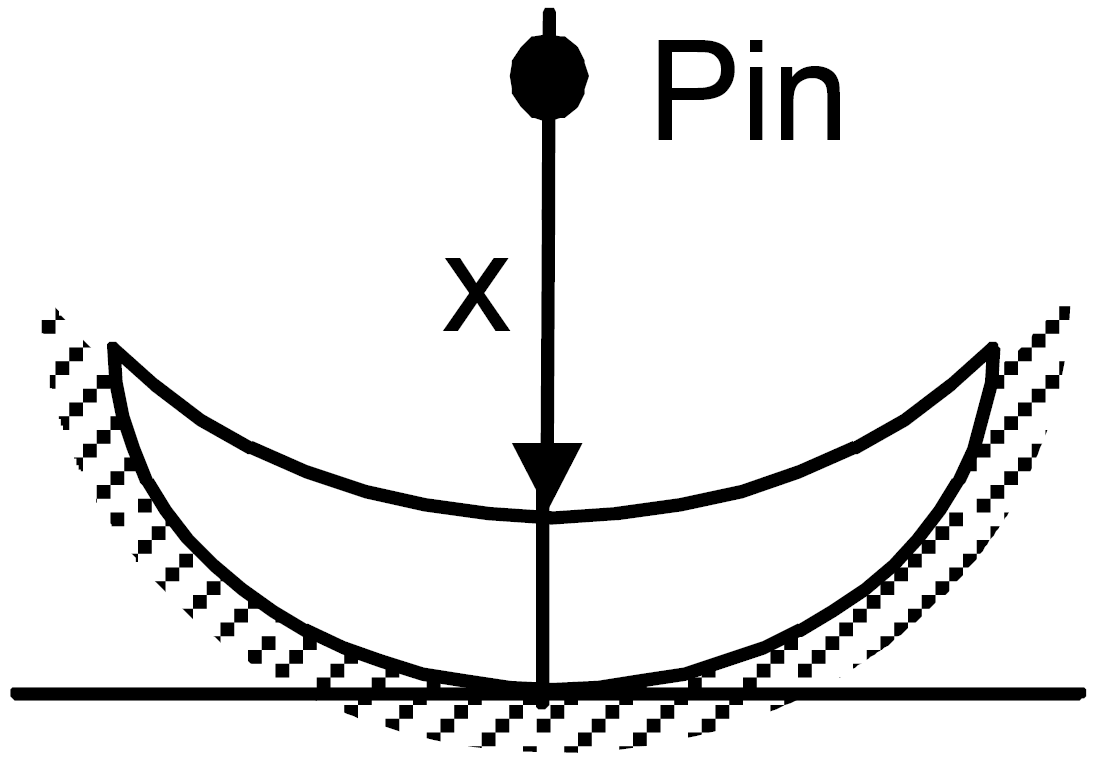
Let the pin is at a distance of x from the lens.
Then for $1^{st}$ refraction, $\frac{\mu_2}{\text{v}}-\frac{\mu_1}{\text{u}}=\frac{\mu_2-\mu_1}{\text{R}}$
Here, $\mu_2=1.5, \ \mu_1=1, \ \text{u}=-\text{x}, \ \text{R}=-60\text{cm}$
$\therefore \ \frac{1.5}{\text{v}}-\frac{1}{-\text{x}}=\frac{0.5}{-60}$
$\Rightarrow120(1.5\text{x}+\text{v})=-\text{vx} \ ...(1)$
$\Rightarrow\text{v}(120+\text{x})=-180\text{x}$
$\Rightarrow\text{v}=\frac{-180\text{x}}{120+\text{x}}$
This image distance is again object distance for the concave mirror.
$\text{u}=\frac{-180\text{x}}{120+\text{x}}, \ \text{f}=-10\text{cm} \ \Big(\therefore \ \text{f}=\frac{\text{R}}{2}\Big)$
$\therefore \ \frac{1}{\text{v}}+\frac{1}{\text{u}}=\frac{1}{\text{f}}\Rightarrow\frac{1}{\text{v}_1}=\frac{1}{-10}-\frac{-(120+\text{x})}{180\text{x}}$
$\Rightarrow\frac{1}{\text{v}_1}=\frac{120+\text{x}-18\text{x}}{180\text{x}}\Rightarrow\text{v}_1=\frac{180\text{x}}{120-17\text{x}}$
Again the image formed is refracted through the lens so that the image is formed on the object taken in the $1^{st}$ refraction. So, for $2^{nd}$ refraction.
According to sign conversion $\text{v}=-\text{x}, \ \mu_2=1, \ \mu_1=1.5, \ \text{R}=-60$
Now, $\frac{\mu_2}{\text{v}}-\frac{\mu_1}{\text{u}}=\frac{\mu_2-\mu_1}{\text{R}} \ \Big[\text{u}=\frac{180\text{x}}{120-17\text{x}}\Big]$
$\Rightarrow\frac{1}{-\text{x}}-\frac{1.5}{180\text{x}}(120-17\text{x})=\frac{-0.5}{-60}$
$\Rightarrow\frac{1}{\text{x}}+\frac{120-17\text{x}}{120\text{x}}=\frac{-1}{120}$
Multiplying both sides with 120m, we get
$120 + 120 - 17x = -x$
$⇒ 16x = 240 ⇒ x = 15cm$
$\therefore$ Object should be placed at 15cm from the lens on the axis.

Download our appand get started for free
Experience the future of education. Simply download our apps or reach out to us for more information. Let's shape the future of learning together!No signup needed.*
Similar Questions
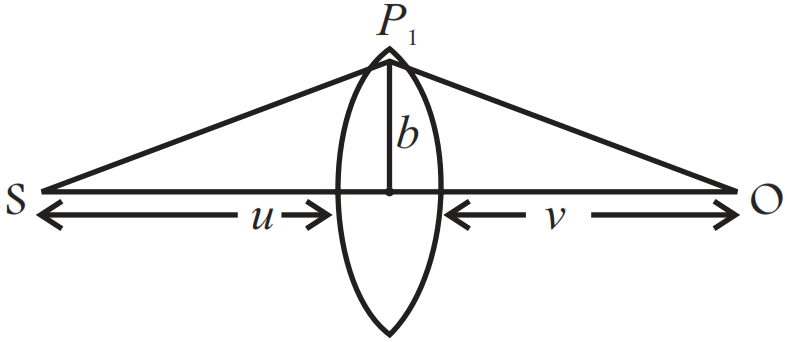
- 1Consider a thin lens placed between a source (S) and an observer (O) (Fig). Let the thickness of the lens vary as $\text{w}\text{(b)}=\text{w}_0-\frac{\text{b}^2}{\alpha}$, where b is the verticle distance from the pole. $w_0$ is a constant. Using Fermat’s principle i.e. the time of transit for a ray between the source and observer is an extremum, find the condition that all paraxial rays starting from the source will converge at a point O on the axis. Find the focal length.View Solution
- 2View Solution
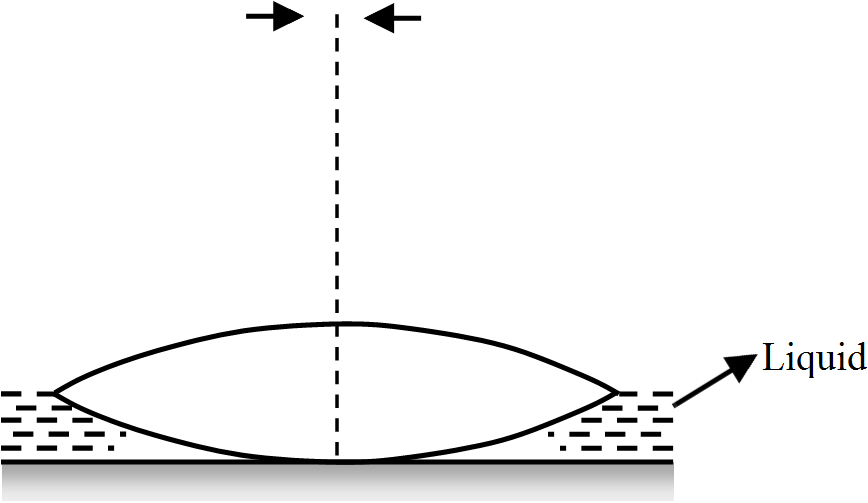
- An equiconvex lens with radii of curvature of magnitude r each, is put over a liquid layer poured on top of a plane mirror. A small needle, with its tip on the principal axis of the lens, is moved along the axis until its inverted real image coincides with the needle itself. The distance of the needle from the lens is measured to be 'a'. On removing the liquid layer and repeating the experiment the distance is found to be 'b'.
- If r = 10cm, a = 15cm, b = 10cm, find the refractive index of the liquid.
- 3View Solution
- Draw a ray diagram to show image formation when the concave mirror produces a real, inverted and magnified image of the object.
- Obtain the mirror formula and write the expression for the linear magnification.
- Explain two advantages of a reflecting telescope over a refracting telescope.
- 4A biconvex thick lens is constructed with glass $(\mu=1.50)$ Each of the surfaces has a radius of 10cm and the thickness at the middle is 5cm. Locate the image of an object placed far away from the lens.View Solution
- 5View SolutionThe mixture a pure liquid and a solution in a long vertical column (i.e, horizontal dimensions < < vertical dimensions) produces diffusion of solute particles and hence a refractive index gradient along the vertical dimension. A ray of light entering the column at right angles to the vertical is deviated from its original path. Find the deviation in travelling a horizontal distance d < < h, the height of the column.
- 6View SolutionAn eye can distinguish between two points of an object if they are separated by more than 0.22mm when the object is placed at 25cm from the eye. The object is now seen by a compound microscope having a 20D objective and 10D eyepiece separated by a distance of 20cm. The final image is formed at 25cm from the eye. What is the minimum separation between two points of the object which can now be distinguished?
- 7View SolutionAt what angle should a ray of light be incident on the face of a prism of refracting angle 60° so that it just suffers total internal reflection at the other face? The refractive index of the material of the prism is 1.524.
- 8View SolutionFind the maximum magnifying power of a compound Microscope having a 25 diopter lens as the objective, a 5 diopter lens as the eyepiece and the separation 30cm between the two lenses. The least distance for clear vision is 25cm.
- 9For a glass prism $(\mu=\sqrt{3})$ the angle of minimum deviation is equal to the angle of the prism. Find the angle of the prism.View Solution
- 10A small block of mass m and a concave mirror of radius R fitted with a stand lie on a smooth horizontal table with a separation d between them. The mirror together with its stand has a mass m. The block is pushed at t = 0 towards the mirror so that it starts moving towards the mirror at a constant speed V and collides with it. The collision is perfectly elastic. Find the velocity of the image:View Solution
- At a time $\text{t}<\frac{\text{d}}{\text{V}}$
- At a time $\text{t}>\frac{\text{d}}{\text{V}}.$