The two thin coaxial rings, each of radius $'a'$ and having charges $+{Q}$ and $-{Q}$ respectively are separated by a distance of $'s'.$ The potential difference between the centres of the two rings is :
JEE MAIN 2021, Diffcult
Download our app for free and get started
${V}_{{A}}=\frac{{KQ}}{{a}}-\frac{{KQ}}{\sqrt{{a}^{2}+{s}^{2}}}$
${V}_{{B}}=\frac{-{KQ}}{{a}}+\frac{{KQ}}{\sqrt{{a}^{2}+{s}^{2}}}$
${V}_{{A}}-{V}_{{B}}=\frac{2 {KQ}}{{a}}-\frac{2 {KQ}}{\sqrt{{a}^{2}+{s}^{2}}}$
$=\frac{{Q}}{2 \pi \varepsilon_{0}}\left(\frac{1}{{a}}-\frac{1}{{s}^{2}+{a}^{2}}\right)$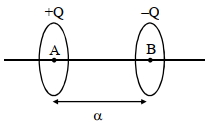

Download our appand get started for free
Experience the future of education. Simply download our apps or reach out to us for more information. Let's shape the future of learning together!No signup needed.*
Similar Questions
- 1Assume that an electric field $\vec E = 30{x^2}\hat i$ exists in space. Then the potential difference $V_A-V_O$ where $V_O$ is the potential at the origin and $V_A$ the potential at $x = 2\ m$ is....$V$View Solution
- 2A particle of mass $m$ and charge $q$ is kept at the top of a fixed frictionless sphere. $A$ uniform horizontal electric field $E$ is switched on. The particle looses contact with the sphere, when the line joining the center of the sphere and the particle makes an angle $45^o$ with the vertical. The ratio $\frac{qE}{mg}$ is :-View Solution
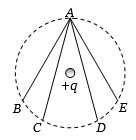
- 3In the electric field of a point charge $q$, a certain charge is carried from point $A$ to $B$, $C$, $D$ and $E$. Then the work doneView Solution
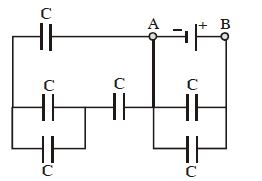
- 4Find equivalent capacitance between $A$ and $B$View Solution
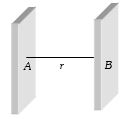
- 5There are two equipotential surface as shown in figure. The distance between them is $r$. The charge of $-q\,$ coulomb is taken from the surface $A$ to $B$, the resultant work done will beView Solution
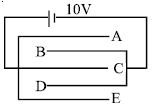
- 6Five identical capacitor plates are arranged such that they make capacitors each of $2\ \mu F$. The plates are connected to a source of $emf$ $10\ V$. The charge on plate $C$ is......$ \mu C$View Solution
- 7View SolutionAfter charging a capacitor the battery is removed. Now by placing a dielectric slab between the plates :-
- 8Two capacitors of capacitances $1\ \mu F$ and $3\ \mu F$ are charged to the same voltages $5\,V$. They are connected in parallel with oppositely charged plates connected together. Then:View Solution
- 9View SolutionA parallel plate capacitor is charged and then disconnected from the source of potential difference. If the plates of the condenser are then moved farther apart by the use of insulated handle, which one of the following is true?
- 10The ratio of momenta of an electron and an $\alpha$-particle which are accelerated from rest by a potential difference of $100\, volts$ isView Solution