Question
The uncertainty in the experimental or the calculated values is indicated by mentioning the number of significant figures. Significant figures are meaningful digits which are known with certainty plus one which is estimated or uncertain. The uncertainty is indicated by writing the certain digits and the last uncertain digit. there are certain rules for determining the Number of significant figures. These are Stated below:
  • All non-zero digits are significant. For Example in 285cm, there are three Significant figures and in 0.25 mL, there are two significant figures.
  • Zeros preceding to first non-zero digit are not significant. such zero indicates the position of decimal point. thus, 0.03 has one significant figure and 0.0052 has two significant figures.
  • Zeros between two non-zero digits are significant. thus, 2.005 has four Significant figures.
  • Zeros at the end or right of a number are significant, provided they are on the right side of the decimal point. For example, 0.200 g has three significant figures. But, if otherwise, the terminal zeros are not significant if there is no decimal point.
Precision refers to the closeness of various measurements for the same quantity. However, accuracy is the agreement of a particular valueto the true value of the result.
LAWS OF CHEMICALCOMBINATIONS- The combination of elements to form compounds is governed by the following five basic laws.
  1. Law of Conservation of Mass-This law was put forth by Antoine Lavoisierin 1789. He performed careful experimental studies for combustion reactions and reached to the conclusion that in all physical andchemical changes, there is no net change inmassduring the process. Hence, he reachedto the conclusion that matter can neither becreated nor destroyed. This is called ‘Law ofConservation of Mass’.
  2. Law of Definite Proportions-This law was given by, a French chemist, Joseph Proust. He stated that a given compound always contains exactly the same proportion of elements by weight.
  3. Law of Multiple Proportions-This law was proposed by John Dalton. According to this law, if two elements can combine to form more than one compound, the masses of one element that combine with a fixed mass of the other element, are in the ratio of small whole numbers. For example, hydrogen combines with oxygen to form two compounds, namely, water and hydrogen peroxide.
Hydrogen + Oxygen→ Water

2g 16g 18g

Hydrogen + Oxygen → Hydrogen Peroxide

2g 32g 34g

Here, the masses of oxygen (i.e., 16 g and 32 g), which combine with a fixed mass of hydrogen (2g) bear a simple ratio, i.e., 16:32 or 1:2.
  1. Gay Lussac’s Law of Gaseous Volumes-This law was given by Gay Lussac in 1808. Heobserved that when gases combine or are produced in a chemicalreaction they do so in asimple ratio by volume,provided all gases are at the same temperature and pressure.
  2. Avogadro’s Law – In 1811, Avogadro proposed that equal volumes of all gases at the same temperature and pressure should contain equal number of molecules.
In 1808, Dalton published ‘A New System of Chemical Philosophy’, in which he proposed the following :
  1. Matter consists of indivisible atoms.
  2. All atoms of a given element have identical properties, including identical mass. Atoms of different elements differ in mass.
  3. Compounds are formed when atoms of different elements combine in a fixed ratio.
  4. Chemical reactions involve reorganisati on of atoms. These are neither created nor destroyed in a chemical reaction.
  1. … refers to the closeness of variousmeasurements for the same quantity.
  1. Accuracy
  2. Reliability
  3. Precision
  4. Uncertainty
  1. Law of Conservation of mass was put forth by ….in 1789.
  1. Joseph Proust
  2. Antoine Lavoisier
  3. Joseph Louis
  4. Gay Lussac
  1. Which of the following number has twosignificant figures.
  1. 0.0052
  2. 052
  3. 52
  4. 0052
  1. … is the agreement of a particular valueto the true value of the result.
  1. Accuracy
  2. Reliability
  3. Precision
  4. Uncertainty
  1. Law of Multiple Proportions proposed by....
  1. Joseph Proust
  2. Antoine Lavoisier
  3. Joseph Louis
  4. John Dalton

Answer

  1. (c) Precision
  1. (b) Antoine Lavoisier
  1. (a) 0.0052
  1. (a) Accuracy
  1. (d) John Dalton

Need a full question paper?

Generate a complete, print-ready paper with questions like this in minutes — across 16+ boards, with answer keys.

Start Generating Free

Similar questions

Read the passage given below and answer the following questions from 1 to 5.
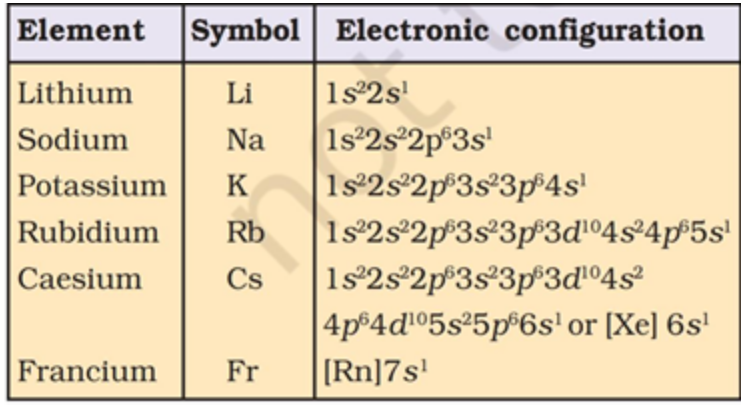
The s-block elements of the Periodic Table are those in which the last electron enters the outermost s-orbital. as the s-orbital can accommodate only two electrons, two Groups (1 & 2) belong to the s-block of the Periodic Table. Group 1 of the Periodic Table consists of the elements: Lithium, sodium, potassium, rubidium, caesium and Francium. They are collectively known as the alkali metals. These are so called because they form hydroxides on Reaction with water which are strongly alkaline in nature. The elements of Group 2 include beryllium, magnesium, Calcium, strontium, barium and radium. These elements With the exception of beryllium are commonly known as The alkaline earth metals. These are so called because their Oxides and hydroxides are alkaline in nature and these Metal oxides are found in the earth’s crust. The general electronic configuration of s-block elements is [noble gas] ns1 for alkali metals and [noble gas] $ns^2$ for Alkaline earth metals.

All the alkali metals have one valence electron, ns1 outside the noble gas core. The loosely held s-electron in the outermost Valence shell of these elements makes them the Most electropositive metals. They readily lose Electron to give monovalent M+ Ions. The monovalent ions (M+) are smaller than the parent atom. Hence they Are never found in free state in nature.
The alkali metal atoms have the largest sizes In a particular period of the periodic table. With increase in atomic number, the atom becomes Larger. the atomic and ionic Radii of alkali metals increase on moving down the group i.e., they increase in size while going From Li to Cs.
The ionization enthalpies of the alkali metals Are considerably low and decrease down the Group from Li to Cs. this is because the effect of increasing size outweighs the increasing Nuclear charge, and the outermost electron is very well screened from the nuclear charge.
The hydration enthalpies of alkali metal ions Decrease with increase in ionic sizes. $Li^+ > Na^+ > K^+ > Rb^+ > Cs^+ > Li^+$ Has maximum degree of hydration and For this reason lithium salts are mostly Hydrated, e.g., $LiCl·2H_2O$.
All the alkali metals are silvery white, soft and Light metals. Because of the large size, these Elements have low density which increases down The group from Li to Cs. However, potassium is Lighter than sodium. The melting and boiling Points of the alkali metals are low indicating Weak metallic bonding due to the presence of Only a single valence electron in them. The alkali Metals and their salts impart characteristic Colour to an oxidizing flame. This is because the Heat from the flame excites the outermost orbital Electron to a higher energy level. When the excited Electron comes back to the ground state . Alkali metals can therefore, be detected by The respective flame tests and can be Determined by flame photometry or atomic Absorption spectroscopy. These elements when Irradiated with light, the light energy absorbed May be sufficient to make an atom lose electron. This property makes caesium and potassium Useful as electrodes in photoelectric cells.
The alkali metals are highly reactive due to Their large size and low ionization enthalpy. The Reactivity of these metals increases down the Group.
Reactivity towards air: The alkali metals Tarnish in dry air due to the formation of Their oxides which in turn react with Moisture to form hydroxides. They burn Vigorously in oxygen forming oxides. Lithium forms monoxide, sodium forms Peroxide, the other metals form Superoxide. The superoxide $O^{2–}$ Ion is Stable only in the presence of large cations Such as K, Rb, Cs.
Reactivity towards water: The alkali Metals react with water to form hydroxide And dihydrogen.
$2\text{M}+2\text{H}_2\text{O}\rightarrow2\text{M}^++2\text{OH}^-+\text{H}_2$
(M = analkali metal)
Reactivity towards dihydrogen: The Alkali metals react with dihydrogen at About 673K (lithium at 1073K) to form Hydrides. All the alkali metal hydrides are Ionic solids with high melting points.
Reactivity towards halogens: The alkali Metals readily react vigorously with Halogens to form ionic halides, $M^+X^–$ .
Reducing nature: The alkali metals are Strong reducing agents, lithium being the Most and sodium the least powerful.
Solutions in liquid ammonia: The alkali Metals dissolve in liquid ammonia giving Deep blue solutions which are conducting in nature.
  1. The general electronic configuration of s-block elements is … for alkali metals.
  1. [noble gas] $ns^1$
  2. [noble gas] $ns^2$
  3. [noble gas] $ns^1np^1$
  4. [noble gas] $ns^1np^2$
  1. The general electronic configuration of s-block elements is … for alkaline earth metals.
  1. noble gas] $ns^1$
  2. [noble gas] $ns^2$
  3. [noble gas] $ns^1np^1$
  4. [noble gas] $ns^1np^2$
  1. The atomic and ionic Radii of alkali metals … on moving down the group.
  1. constant
  2. decrease
  3. increase
  4. All the above
  1. The hydration enthalpies of alkali metal ions … with … in ionic sizes.
  1. increase, decrease
  2. increase, increase
  3. decrease, decrease
  4. decrease, increase
  1. Which of the following element is strong reducing agent?
  1. Lithium
  2. Sodium
  3. Fluorine
  4. Helium
Read the passage given below and answer the following questions from 1 to 5.
Oxidation state and trends in chemical Reactivity Due to small size of boron, the sum of its first Three ionization enthalpies is very high. This Prevents it to form +3 ions and forces it to form Only covalent compounds. But as we move from B to Al, the sum of the first three ionisation Enthalpies of Al considerably decreases, and Is therefore able to form $Al^{3+}$ ions. In fact, Aluminium is a highly electropositive metal. However, down the group, due to poor Shielding effect of intervening d and f orbitals, The increased effective nuclear charge holds ns Electrons tightly (responsible for inert pair Effect) and thereby, restricting their Participation in bonding. As a result of this, Only p-orbital electron may be involved in Bonding. In fact in Ga, In and Tl, both +1 and +3 oxidation states are observed. The relative Stability of +1 oxidation state progressively Increases for heavier elements: A l< Ga < In< Tl. In Thallium +1 oxidation state is predominant whereas the +3 oxidation state is highly Oxidising in character. The compounds in +1 oxidation state, as expected from energy Considerations, are more ionic than those in +3 oxidation state.
Important trends and anomalous properties of boron – certain important trends can be observed in the chemical behaviour of group 13 elements. The tri-chlorides, bromides and iodides of all these elements being covalent in nature are hydrolysed in water. Species like tetrahedral $[M(OH)_4]^–$ and octahedral $[M(H_2O)6]^{3+}$, except in boron, exist in aqueous medium. The monomeric trihalides, being electron deficient, are strong Lewis acids. Boron trifluoride easily reacts with Lewis bases such as $NH_3$ to complete octet around boron. It is due to the absence of d orbitals that the maximum covalence of B is 4. Since the d orbitals are available with Al and other elements, the maximum covalence can be expected beyond 4. Most of the other metal halides (e.g., $AlCl_3$) are dimerised through halogen bridging (e.g., $Al2Cl_6$). The metal species completes its octet by accepting electrons from halogen in these halogen bridged molecules.
i) Reactivity towards air Boron is unreactive in crystalline form. Aluminium forms a very thin oxide layer on The surface which protects the metal from Further attack. Amorphous boron and Aluminium metal on heating in air form $B_2O_3$ And $Al_2O_3$ respectively. With dinitrogen at high Temperature they form nitrides. The nature of these oxides varies down the Group. Boron trioxide is acidic and reacts with Basic (metallic) oxides forming metal borates. Aluminium and gallium oxides are amphoteric And those of indium and thallium are basic in Their properties.
ii) Reactivity towards acids and alkalies Boron does not react with acids and alkalies Even at moderate temperature; but aluminium Dissolves in mineral acids and aqueous alkalies And thus shows amphoteric character. Aluminium dissolves in dilute HCl and Liberates dihydrogen.
$2Al(s) + 6HCl (aq) \rightarrow 2Al_3^+ (aq) + 6Cl^– (aq) + 3H_2 (g)$
However, concentrated nitric acid renders Aluminium passive by forming a protective Oxide layer on the surface. Aluminium also reacts with aqueous alkali And liberates dihydrogen.
$2Al (s) + 2NaOH(aq) + 6H_2O(l) \rightarrow 2 Na+ [Al(OH)_4]^– (aq) + 3H_2(g)$
Sodium Tetrahydroxoaluminate(III).
iii) Reactivity towards halogens These elements react with halogens to form Trihalides (except TlI3). $2E(s) + 3 X_2 (g) \rightarrow 2EX_3 (s) (X = F, Cl, Br, I)$
Borax- It is the most important compound of boron. It is a white crystalline solid of formula $Na_2B_4O_7⋅10H_2O$. In fact it contains the Tetranuclear units and correct Formula; therefore, is $Na2 [B4O5 (OH) 4].8H2O$. Borax dissolves in water to give an alkaline Solution.
$Na_2B_4O7 + 7H_2O \rightarrow 2NaOH + 4H_3BO_3$
On heating, borax first loses water Molecules and swells up. On further heating it Turns into a transparent liquid, which solidifies Into glass like material known as borax Bead. $Na_2B_4O_7.10H_2O \rightarrow Na^2B_4O_7\rightarrow 2NaBO_2+ B2O_3​​​​​​​$
Metaborate Boric Anhydride The metaborates of many transition metals Have characteristic colours and, therefore, Borax bead test can be used to identify them In the laboratory. For example, when borax is Heated in a Bunsen burner flame with CoO on A loop of platinum wire, a blue coloured Co(BO2) 2 bead is formed.
Orthoboric acid, $H_3BO_3$ is a white crystalline Solid, with soapy touch. It is sparingly soluble In water but highly soluble in hot water. It can Be prepared by acidifying an aqueous solution Of borax.
$Na_2B_4O_7 + 2HCl + 5H_2O \rightarrow 2NaCl + 4B(OH)_3​​​​​​​$
It is also formed by the hydrolysis (reaction With water or dilute acid) of most boron Compounds (halides, hydrides, etc.). It has a layer structure in which planar $BO_3$ units are Joined by hydrogen.
  1. Boron is … in crystalline form.
  1. unreactive
  2. highly reactive
  3. less reactive
  4. only (a) or (c)
  1. Orthoboric acid is …
  1. Amorphous
  2. Crystalline
  3. Polyamorphous
  4. None of above
  1. Aluminium and gallium oxides are … in their properties.
  1. acidic
  2. Basic
  3. amphoteric
  4. None of above
  1. Indium and thallium are … in their properties.
  1. acidic
  2. Alkali
  3. amphoteric
  4. basic
  1. Aluminium is a highly … metal.
  1. electronegative
  2. Neutral
  3. electropositive
  4. None of above
Read the passage given below and answer the following questions from (i) to (v).

The attractive force which holds variousconstituents (atoms, ions, etc.) together in differentchemical species is called a chemical bond. In order to explain the formation of chemicalbond in terms of electrons, a number ofattempts were made, but it was only in 1916 when Kössel and Lewis succeededindependently in giving a satisfactoryexplanation. They were the first to providesome logical explanation of valence which wasbased on the inertness of noble gases. Lewis postulated that atoms achieve thestable octet when they are linked bychemical bonds. In the formation of amolecule, only the outer shell electrons takepart in chemical combination and they areknown as valence electrons. The inner shellelectrons are well protected and are generallynot involved in the combination process.G.N. Lewis, an American chemist introducedsimple notations to represent valenceelectrons in an atom. These notations arecalled Lewis symbols. For example, the Lewissymbols for the elements of second period areas under:
The bond formed, as a result of theelectrostatic attraction between thepositive and negative ions was termed as the electrovalent bond. The electrovalenceis thus equal to the number of unitcharge(s) on the ion.
Kössel and Lewis in 1916 developed animportant theory of chemical combinationbetween atoms known as electronic theoryof chemical bonding. According to this,atoms can combine either by transfer ofvalence electrons from one atom to another(gaining or losing) or by sharing of valenceelectrons in order to have an octet in theirvalence shells. This is known as octet rule. when two atoms share oneelectron pair they are said to be joined bya single covalent bond. In many compoundswe have multiple bonds between atoms. Theformation of multiple bonds envisagessharing of more than one electron pairbetween two atoms. If two atoms share twopairs of electrons, the covalent bondbetween them is called a double bond. Forexample, in the carbon dioxide molecule, wehave two double bonds between the carbonand oxygen atoms. Similarly in ethenemolecule the two carbon atoms are joined bya double bond. The Lewis dot structures provide a pictureof bonding in molecules and ions in termsof the shared pairs of electrons and theoctet rule. The Lewis dotstructures can be written by adopting thefollowing steps:
- The total number of electrons required forwriting the structures are obtained byadding the valence electrons of thecombining atoms. For example, in the $CH _4$ molecule there are eight valence electronsavailable for bonding.
- For anions, each negative charge wouldmean addition of one electron. Forcations, each positive charge would result in subtraction of one electron from the totalnumber of valence electrons. For example,for the $CO _3{ }^{2-}$ ion, the two negative chargesindicate that there are two additionalelectrons than those provided by theneutral atoms.
- Knowing the chemical symbols of thecombining atoms and having knowledgeof the skeletal structure of the compound, it is easyto distribute the total number of electronsas bonding shared pairs between theatoms in proportion to the total bonds.
- In general the least electronegative atomoccupies the central position in themolecule/ion. For example in the $NF _3$ andCO ${ }_3{ }^{2-}$, nitrogen and carbon are the centralatoms whereas fluorine and oxygenoccupy the terminal positions.
- After accounting for the shared pairs ofelectrons for single bonds, the remainingelectron pairs are either utilized for multiplebonding or remain as the lone pairs. Thebasic requirement being that each bondedatom gets an octet of electrons.
i. ... postulated that atoms achieve the stable octet when they are linked by chemical bonds.
  1. … postulated that atoms achieve the stable octet when they are linked by chemical bonds.
  1. Lewis
  2. Debye
  3. Charles
  4. Sidgwick
  1. … in 1916 developed an important theory of chemical combination between atoms known as electronic theory of chemical bonding.
  1. Kössel
  2. Lewis
  3. Both a) & b)
  4. Sidgwick
  1. In the formation of a molecule, only the outer shell electrons take part in chemical combination and they are known as …
  1. Backscattered electrons
  2. Valence electrons
  3. Primary electrons
  4. Secondary electrons
  1. In the $CH_4$​​​​​​​ molecule there are … valence electrons available for bonding.
  1. 4
  2. 6
  3. 8
  4. 10
  1. The type of bond between atoms in a molecule of CO2 is:
  1. Ionic bond
  2. Metallic bond
  3. Hydrogen bond
  4. Covalent bond.
The idea of oxidation number has been invariably applied to define oxidation, reduction, oxidising agent (oxidant), reducing agent (reductant) and the redox reaction. To summarise, we may say that:
Oxidation: An increase in the oxidation number of the element in the given substance.
Reduction: A decrease in the oxidation number of the element in the given substance.
Oxidising agent: A reagent which can increase the oxidation number of an element in a given substance. These reagents are called as oxidants also.
Reducing agent: A reagent which lowers the oxidation number of an element in a given substance. These reagents are also called as reductants.
Redox reactions: Reactions which involve change in oxidation number of the interacting species.
Types of Redox Reactions
1.) Combination reactions -A combination reaction may be denoted in the manner:
$A + B → C$
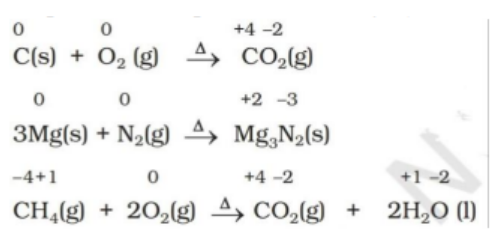
Either A and B or both A and B must be in the elemental form for such a reaction to be a redox reaction. All combustion reactions, which make use of elemental dioxygen, as well as other reactions involving elements other than dioxygen, are redox reactions. Some important examples of this category are:

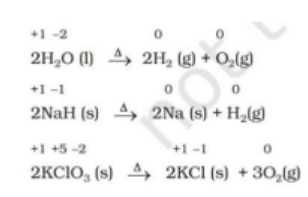
2.) Decomposition reactions- Decomposition reactions are the opposite of combination reactions. Precisely, a decomposition reaction leads to the breakdown of a compound into two or more components at least one of which must be in the elemental state.
Examples of this class of reactions are:

It may carefully be noted that there is no change in the oxidation number of hydrogen in methane under combination reactions and that of potassium in potassium chlorate in reaction. This may also be noted here that all decomposition reactions are not redox reactions. For example, decomposition of calcium carbonate is not a redox reaction.
3.) Displacement reactions- In a displacement reaction, an ion (or an atom) in a compound is replaced by an ion (or an atom) of another element. It may be denoted as:
$X + YZ → XZ + Y$
Displacement reactions fit into two categories: metal displacement and non-metal displacement.
(a) Metal displacement: A metal in a compound can be displaced by another metal in the uncombined state. Metal displacement reactions find many applications in metallurgical processes in which pure metals are obtained from their compounds in ores.
(b) Non-metal displacement: The non-metal displacement redox reactions include hydrogen displacement and a rarely occurring reaction involving oxygen displacement. All alkali metals and some alkaline earth metals (Ca, Sr, and Ba) which are very good reductants, will displace hydrogen from cold water. Many metals, including those which do not react with cold water, are capable of displacing hydrogen from acids. Dihydrogen from acids may even be produced by such metals which do not react with steam. Cadmium and tin are the examples of such metals.
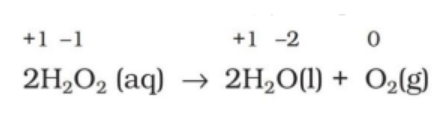
4.) Disproportionation reactions – Disproportionation reactions are a special type of redox reactions. In a disproportionation reaction an element in one oxidation state is simultaneously oxidised and reduced. One of the reacting substances in a disproportionation reaction always contains an element that can exist in at least three oxidation states. The element in the form of reacting substance is in the intermediate oxidation state; and both higher and lower oxidation states of that element are formed in the reaction. The decomposition of hydrogen peroxide is a familiar example of the reaction, where oxygen experiences disproportionation.

Here the oxygen of peroxide, which is present in –1 state, is converted to zero oxidation state in $O2$ and decreases to –2 oxidation state in $H_2O$.
  1. In … an ion (or an atom) in a compound is replaced by an ion (or an atom) of another element.
  1. displacement reaction
  2. decomposition reaction
  3. disproportionation reaction
  4. combination reaction
  1. leads to the breakdown of a compound into two or more components at least one of which must be in the elemental state.
  1. displacement reaction
  2. decomposition reaction
  3. disproportionation reaction
  4. combination reaction
  1. In …. an element in one oxidation state is simultaneously oxidised and reduced.
  1. displacement reaction
  2. decomposition reaction
  3. disproportionation reaction
  4. combination reaction
  1. Reactions which involve change in oxidation number of the interacting species…
  1. Exothermic reaction
  2. Endothermic reaction
  3. Neutralization reaction
  4. Redox reaction
  1. One of the reacting substances in a disproportionation reaction always contains an element that can exist in at least … oxidation states.
  1. 1
  2. 2
  3. 3
  4. 4
Read the passage given below and answer the following questions from 1 to 5. Since the isotopes have the same electronic Configuration, they have almost the same Chemical properties.The only difference is in Their rates of reactions, mainly due to their Different enthalpy of bond dissociation . However, in physical properties these Isotopes differ considerably due to their large Mass differences. There are a number of methods for preparing Dihydrogen from metals and metal hydrides. 1.) Laboratory Preparation of Dihydrogen – It is usually prepared by the reaction of Granulated zinc with dilute hydrochloric. $Zn + 2H + \rightarrow Zn_2+ + H_2$ It can also be prepared by the reaction of Zinc with aqueous alkali. $Zn + 2NaOH \rightarrow Na_2ZnO_2 + H_2$ Commercial Production of Dihydrogen – The commonly used processes are outlined Below: i) Electrolysis of acidified water using Platinum electrodes gives hydrogen. ii) High purity (> 99.95%) dihydrogen is Obtained by electrolysing warm aqueous Barium hydroxide solution between nickel iii) It is obtained as a by product in the Manufacture of sodium hydroxide and Chlorine by the electrolysis of brine Solution. During electrolysis, the reactions That take place are: at anode: $2\text{CI}(\text{aq})\rightarrow\text{CI}_2(\text{g})+2\bar{\text{e}}$ at cathode: $2\text{H}_2\text{O}(\text{l})+2\text{e}\rightarrow\text{H}_2(\text{g})+2\text{O}\bar{\text{H}}(\text{aq})$ The overall reaction is $2\text{Na }(\text {aq})+2\text{C}\bar{\text{I}}(\text{aq})+2\text{H}_2\text{O}(\text{l})$ $\text{CI}_2(\text{g})+\text{H}_2(\text{g})+2\text{Na}^+(\text{aq})+2\text{O}\bar{\text{H}}(\text{aq})$ That take place are: iv) Reaction of steam on hydrocarbons or coke At high temperatures in the presence of Catalyst yields hydrogen.

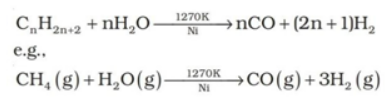
 The mixture of $CO$ and $H_2$ is called water Gas. As this mixture of $CO$ and $H_2$ is used for The synthesis of methanol and a number of Hydrocarbons, it is also called synthesis gas Or ‘syngas’. Nowadays ‘syngas’ is produced From sewage, saw-dust, scrap wood, Newspapers etc. The process of producing ‘syngas’ from coal is called ‘coal gasification’. The production of dihydrogen can be Increased by reacting carbon monoxide of Syngas mixtures with steam in the presence of Iron chromate as catalyst. This is called water-gas shift reaction. Carbon dioxide is removed by scrubbing with Sodium arsenite solution. Presently ~77% of the industrial Dihydrogen is produced from petro-chemicals, 18% from coal, 4% from electrolysis of aqueous Solutions and 1% from other sources. Physical Properties Dihydrogen is a colourless, odourless, Tasteless, combustible gas. It is lighter than Air and insoluble in water. Its other physical Properties are alongwith those of deuterium. The chemical behaviour of dihydrogen (and for That matter any molecule) is determined, to a Large extent, by bond dissociation enthalpy. The H–H bond dissociation enthalpy is the Highest for a single bond between two atoms Of any element. What inferences would you Draw from this fact ? It is because of this factor That the dissociation of dihydrogen into its Atoms is only~0.081% around 2000K which Increases to 95.5% at 5000K. Also, it is Relatively inert at room temperature due to the high H–H bond enthalpy. Thus, the atomic Hydrogen is produced at a high temperature In an electric arc or under ultraviolet Radiations. Since its orbital is incomplete with 1s1 Electronic configuration, it does combine With almost all the elements. It accomplishes Reactions by
i) loss of the only electron to Give H+, ii) gain of an electron to form H–, and iii) Sharing electrons to form a single covalent bond. The chemistry of dihydrogen can be Illustrated by the following reactions: Reaction with halogens: It reacts with Halogens, $X_2$ to give hydrogen halides, $\text{H}_2(\text{g})+\text{x}_2(\text{g})\rightarrow2\text{HX}(\text{g})(\text{x}=\text{F.CI.Br.I})$ While the reaction with fluorine occurs even in The dark, with iodine it requires a catalyst. Reaction with dioxygen: It reacts with Dioxygen to form water. The reaction is highly Exothermic. $2\text{H}_2(\text{g})+\text{O}_2(\text{g})\xrightarrow{\text{catalyst or beading}}2\text{H}_2\text{O}(\text{l}):$ $\triangle\text{H}^-=-285.9\text{kj}\text{mol}^-1$ This is the method for the manufacture of Ammonia by the Haber process. Reactions with metals: With many metals it Combines at a high temperature to yield the Corresponding hydrides $H_2$ (g) + 2M (g) → 2 MH (s); Where M is an alkali metal Reactions with metal ions and metal Oxides: It reduces some metal ions in aqueous Solution and oxides of metals (less active than Iron) into corresponding metals. $\text{H}_2(\text{g})+\text{Pd}^{2+}\text{(aq)}\rightarrow\text{Pd}(\text{s})+2\text{H}^+(\text{aq})$ $\text{y}\text{H}_2(\text{g})+\text{M}_\text{x}\text{O}_\text{y}(\text{S})\rightarrow\text{xM}(\text{s})+\text{y}\text{H}_2\text{O}\text{(l)}$ Reactions with organic compounds: It Reacts with many organic compounds in the Presence of catalysts to give useful Hydrogenated products of commercial Importance. For example: Hydrogenation of vegetable oils using Nickel as catalyst gives edible fats (margarine and vanaspati ghee) Hydroformylation of olefins yields Aldehydes which further undergo Reduction to give alcohols. $\text{H}_2+\text{CO}+\text{RCH}=\text{CH}_2\rightarrow\text{RCH}_2\text{CH}_2\text{CHO}$ $\text{H}_2+\text{RCH}_2\text{CH}_2\text{CHO}\rightarrow\text{RCH}_2\text{CH}_2\text{CH}_2\text{OH}$
  1. The mixture of CO and H2 is called …
  1. water Gas
  2. Dry ice
  3. Dry carbon
  4. Dry hydrogen
  1. Which of the following is not physical property of Dihydrogen.
  1. colourless
  2. Highest dissociation enthalpy
  3. odourless
  4. Tasteless
  1. Dihydrogen is reacts with dioxygen to get ….
  1. $H_2O_2$
  2. $2H_2O_2$
  3. $2H_2O$
  4. $H_2O$
  1. High purity dihydrogen is obtained by electrolysing warm aqueous barium hydroxide solution between… electrodes.
  1. Chromium
  2. Copper
  3. Platinum
  4. Nickel
The ionic character of metallic halides tends toward covalent nature as per Fajan's rule. Such covalent halides behave as non-metal in their higher oxidation states. The property to hydrolyse to give oxy-acids of the element and corresponding hydro halogen acid for most non-metallic elements proceeds exceptionally in the way, keeping oxidation number of element and halide sam in oxo-acids.
Non-polar halides are immiscible in water, as they do not show hydrolysis, but halides of some elements with empty d-orbital undergo hydrolysis. Stability of halides of the higher state is governed by the inert-pair effect.

1. How does halide undergo hydrolysis to give oxy-acids of underlined element $PCl _3$ ? (1)
2. Out of $NCl _3$ and $BCl _3$ undergoes hydrolysis to form oxy-acids? Write the chemical reaction for the correct answer. (1)
3. Out of $PbCl _4, PbF _4, PbI _4$ and $PbBr _4$ which one doesn't exist? (2)
OR
Non-Polar halides are immiscible in water. Why? (2)
Read the passage given below and answer the following questions from 1 to 5.
Chemistry is the science of molecules and theirtransformations. It is the science not so much of the one hundred elements but of the infinite variety of molecules thatmay be built from them. Chemistry plays a central role in science andis often intertwined with other branches ofscience.to understand thebasic concepts of chemistry, which begin withthe concept of matter. Let us start with thenature of matter. matter can exist in threephysical states viz. solid, liquid and gas.Particles are held very close to each otherin solids in an orderly fashion and there is notmuch freedom of movement. In liquids, theparticles are close to each other but they canmove around. However, in gases, the particlesare far apart as compared to those present insolid or liquid states and their movement iseasy and fast. different states of matter exhibitthe following characteristics:
  1. Solids have definite volume and definiteshape.
  2. Liquids have definite volume but do nothave definite shape. They take the shapeof the container in which they are placed.
  3. Gases have neither definite volume nordefinite shape. They completely occupy thespace in the container in which they are placed.
Matter can be classified as mixture or pure substance. A mixture may be homogeneous or heterogeneous. Pure substances can further be classified into elements and compounds. Particles of an element consist of only one type of atoms. These particles may exist as atoms or molecules. When two or more atoms of different elements combine together in a definite ratio, the molecule of a compound is obtained.
Every substance has unique or characteristic properties. These properties can be classified into two categories — physical properties, such as colour, odour, melting point, boiling point, density, etc., and chemical properties, like composition, combustibility, ractivity with acids and bases, etc. Physical properties can be measured or observed without changing the identity or the composition of the substance. The measurement or observation of chemical properties requires a chemical change to occur. Measurement of physical properties does not require occurance of a chemical change.
  1. Which of the following state of matter have definite volume but do not have definite shape?
  1. Solid
  2. Liquid
  3. Gas
  4. Plasma
  1. Particles are held very close to each other in … in an orderly fashion and there is not much freedom of movement.
  1. Liquid
  2. Gas
  3. Solid
  4. Plasma
  1. Particles of …. consist of only one type of atom.
  1. Compound
  2. Mixture
  3. Element
  4. All the above
  1. Water molecule comprises …hydrogen atoms and … oxygen atom.
  1. One, two
  2. Three, one
  3. One, three
  4. Two, one
  1. Which of the following is not an example of Physical Properties of substance.?
  1. Odour
  2. Melting point
  3. Density
  4. Composition
Once an organic compound is extracted from a natural source or synthesised in the laboratory, it is essential to purify it. Various methods used for the purification of organic compounds are based on the nature of the compound and the impurity present in it. Finally, the purity of a compound is ascertained by determining its melting or boiling point. This is one of the most commonly used techniques for the purification of solid organic compounds. In crystallisation Impurities, which impart colour to the solution are removed by adsorbing over activated charcoal. In distillation Liquids having different boiling points vaporise at different temperatures. The vapours are cooled and the liquids so formed are collected separately. Steam Distillation is applied to separate substances which are steam volatile and are immiscible with water. Distillation under reduced pressure: This method is used to purify liquids having very high boiling points.

1. Which method can be used to separate two compounds with different solubilities in a solvent?
OR
Why chloroform and aniline are easily separated by the technique of distillation?
2. Distillation method is used to separate which type of substance?
3. Which technique is used to separate aniline from aniline water mixture?
Read the passage given below and answer the following questions from (i) to (v).
Relation between Ka and Kb – Ka and Kb represent the strength of an acid and a base, respectively. In case of a conjugate acid-base pair, they are related in a simple manner so that if one is known, the other can be deduced. Considering the example of $NH_4^+$ and $NH_3$ we see,
${\text{NH}_4}^+{_{(\text{aq})}+\text{H}_2\text{O}_{(\text{l})}}\rightleftharpoons{\text{H}_3\text{O}}{^+}_{(\text{aq})}+\text{NH}_{3(\text{aq})}$
$\text{Ka}=\frac{[\text{H}_3\text{O}^+][\text{NH}_3]}{{[\text{NH}_4}^{+}]}=5.6\times10^{-10}$
$\text{NH}_{3(\text{aq})}+\text{H}_2\text{O}_{(\text{l})}\rightleftharpoons{{\text{NH}_4}^+}_{(\text{aq})}+{\text{OH}^-}_{(\text{aq})}$
$\text{Kb}=\frac{[{\text{NH}_4}^+][\text{OH}^-]}{[\text{NH}_3]}=1.8\times10^{-5}$
$\text{Net}:2{\text{H}_2\text{O}_{(\text{l})}}\rightleftharpoons{\text{H}_3\text{O}}{^+}_{(\text{aq})}+{\text{OH}^-}_{(\text{aq})}$
$\text{Kw}=[\text{H}_3\text{O}^+][\text{OH}^-]=1.0\times10^{-14}\text{M}$
Where, Ka represents the strength of $NH_4^+$ as an acid and Kb represents the strength of $NH_3$ as a base. It can be seen from the net reaction that the equilibrium constant is equal to the product of equilibrium constants Ka and Kb for the reactions added. Thus,
$\text{Ka}\times\text{Kb}=\Big\{\frac{[\text{H}_3\text{O}^+][\text{NH}_3]}{[{\text{NH}_4}^+]}\Big\}\times\Big\{\frac{[{\text{NH}_4}^+][\text{OH}^-]}{[\text{NH}_3]}\Big\}$
$= [H_3O^+ ][ OH^– ] = Kw = (5.6\times 10^{–10}) \times (1.8 \times 10^{–5}) = 1.0 \times 10^{–14} M$
This can be extended to make a generalisation. The equilibrium constant for a net reaction obtained after adding two (or more) reactions equals the product of the equilibrium constants for individual reactions:
$K_{NET} = K1 \times K2 \times$ ……
Similarly, in case of a conjugate acid-base pair,
Ka × Kb = Kw
Knowing one, the other can be obtained. It should be noted that a strong acid will have a weak conjugate base and vice-versa. Alternatively, the above expression
Kw = Ka × Kb, can also be obtained by considering the base-dissociation equilibrium reaction:
$\text{B}_{(\text{aq})}+\text{H}_2\text{O}_{(\text{l})}\rightleftharpoons{\text{BH}^+}_{(\text{aq})}+{\text{OH}^-}_{(\text{aq})}$
$\text{Kb}=\frac{[\text{BH}^+][\text{OH}^-]}{[\text{B}]}$
As the concentration of water remains constant it has been omitted from the denominator and incorporated within the dissociation constant. Then multiplying and dividing the above expression by $[H^+]$, we get:
$\text{Kb}=\frac{[\text{BH}^+][\text{OH}^-][\text{H}^+]}{[\text{B}][\text{H}^+]}$
$=\frac{[\text{OH}^-][\text{H}^+][\text{BH}^+]}{[\text{B}][\text{H}^+]}$
$=\frac{\text{Kw}}{\text{Ka}}$
or Ka × Kb = Kw
It may be noted that if we take negative logarithm of both sides of the equation, then pK values of the conjugate acid and base are related to each other by the equation:
pKa + pKb = pKw = 14 (at 298K)
Factors Affecting Acid Strength Having discussion on quantitatively the strengths of acids and bases, we come to a stage where we can calculate the pH of a given acid solution. But, the curiosity rises about why should some acids be stronger than others? What factors are responsible for making them stronger? The answer lies in its being a complex phenomenon. But, broadly speaking we can say that the extent of dissociation of an acid depends on the strength and polarity of the H-A bond. In general, when strength of H-A bond decreases, that is, the energy required to break the bond decreases, HA becomes a stronger acid. Also, when the H-A bond becomes more polar i.e., the electronegativity difference between the atoms H and A increases and there is marked charge separation, cleavage of the bond becomes easier thereby increasing the acidity. But it should be noted that while comparing elements in the same group of the periodic table, H-A bond strength is a more important factor in determining acidity than its polar nature. As the size of A increases down the group, H-A bond strength decreases and so the acid strength increases. For example,
Size increases
$HF << HCl << HBr << HI$
Acid strength increases
Similarly, $H_2S$ is stronger acid than $H_2O$. But, when we discuss elements in the same row of the periodic table, H-A bond polarity becomes the deciding factor for determining the acid strength. As the electronegativity of A increases, the strength of the acid also increases. For example,
Electronegativity of A increases
$CH4 < NH_3 < H_2O < HF$
Acid strength increases
Common Ion Effect in the Ionization of Acids and Bases Consider an example of acetic acid dissociation equilibrium represented as:
$CH3COOH_{(aq)} H^+_{(aq)} + CH3COO^–_{(aq)}$
or $HAc_{(aq)} H^+_{(aq)} + Ac^–_{(aq)}$
$\text{Ka}=\frac{[\text{H}^+][\text{Ac}^-]}{[\text{HAc}]}$
Addition of acetate ions to an acetic acid solution results in decreasing the concentration of hydrogen ions, $[H^+ ]$. Also, if $H^+$ ions are added from an external source then the equilibrium moves in the direction of undissociated acetic acid i.e., in a direction of reducing the concentration of hydrogen ions, $[H^+]$. This phenomenon is an example of common ion effect. It can be defined as a shift in equilibrium on adding a substance that provides more of an ionic species already present in the dissociation equilibrium. Thus, we can say that common ion effect is a phenomenon based on the Le Chatelier’s principle discussed earlier. In order to evaluate the pH of the solution resulting on addition of 0.05M acetate ion to 0.05M acetic acid solution, we shall consider the acetic acid dissociation equilibrium once again,
$\text{HAc}_{(\text{aq})}\rightleftharpoons{\text{H}^+}_{(\text{aq})}+{\text{Ac}^-}_{(\text{aq})}$
Initial concentration (M)
0.05 0 0.05
Let x be the extent of ionization of acetic acid.
Change in concentration (M)
-x +x +x
Equilibrium concentration (M)
0.05-x. x 0.05+x
Therefore, $\text{Ka}=\frac{[\text{H}^+][\text{Ac}^-]}{\text{HAc}}=\Big\{\frac{(0.05+\text{x})(\text{x})}{(0.05-\text{x})}\Big\}$
As Ka is small for a very weak acid, x<<0.05.
Hence, $(0.05+\text{x})\approx(0.05-\text{x})\approx0.05$
Thus, $=1.8\times10-5=\frac{(\text{x})(0.05+\text{x})}{(0.05-\text{x})}$
$=\frac{\text{x}(0.05)}{(0.05)}=\text{x}=[\text{H}^+]=1.8\times10^{-5}\text{M}$
$\text{pH}=-\log(1.8\times10^{-5})=4.74$
Buffer Solutions Many body fluids e.g., blood or urine have definite pH and any deviation in their pH indicates malfunctioning of the body. The control of pH is also very important in many chemical and biochemical processes. Many medical and cosmetic formulations require that these be kept and administered at a particular pH. The solutions which resist change in pH on dilution or with the addition of small amounts of acid or alkali are called Buffer Solutions. Buffer solutions.
Common Ion Effect on Solubility of Ionic Salts– It is expected from Le Chatelier’s principle that if we increase the concentration of any one of the ions, it should combine with the ion of its opposite charge and some of the salt will be precipitated till once again Ksp = Qsp . Similarly, if the concentration of one of the ions is decreased, more salt will dissolve to increase the concentration of both the ions till once again Ksp = Qsp . This is applicable even to soluble salts like sodium chloride except that due to higher concentrations of the ions, we use their activities instead of their molarities in the expression for Qsp . Thus if we take a saturated solution of sodium chloride and pass HCl gas through it, then sodium chloride is precipitated due to increased concentration (activity) of chloride ion available from the dissociation of HCl. Sodium chloride thus obtained is of very high purity and we can get rid of impurities like sodium and magnesium sulphates. The common ion effect is also used for almost complete precipitation of a particular ion as its sparingly soluble salt, with very low value of solubility product for gravimetric estimation. Thus we can precipitate silver ion as silver chloride, ferric ion as its hydroxide (or hydrated ferric oxide) and barium ion as its sulphate for quantitative estimations.
  1. H-A bond strength … and so the acid strength:
  1. Decreases, increases
  2. Increases, increases
  3. Increases, decreases
  4. Decreases, decreases
  1. As the electronegativity of A … the strength of the acid also:
  1. Decreases, increases
  2. Increases, increases
  3. Increases, decreases
  4. Decreases, decreases
  1. If the concentration of one of the ions is … more salt will dissolve to … the concentration of both the ions till once again Ksp = Qsp.
  1. Decreases, increases
  2. Increases, increases
  3. Increases, decreases
  4. Decreases, decreases
  1. The solutions which resist change in pH on dilution or with the addition of small amounts of acid or alkali are called:
  1. Neutral solution
  2. Basic solution
  3. Acidic solution
  4. Buffer solution
  1. When the H-A bond becomes more polar then the cleavage of the bond becomes easier thereby increasing the:
  1. Acidity
  2. Basicity
  3. Aromaticity
  4. Alkalinity
Read the passage given below and answer the following questions from 1 to 5.
The unusual properties of water in the Condensed phase (liquid and solid states) are Due to the presence of extensive hydrogen Bonding between water molecules. This leads To high freezing point, high boiling point, high Heat of vaporisation and high heat of fusion in Comparison to $H_2S$ and $H_2Se$. In comparison To other liquids, water has a higher specific Heat, thermal conductivity, surface tension, Dipole moment and dielectric constant, etc. these properties allow water to play a key role In the biosphere. In the gas phase water is a bent molecule with a bond angle of $104.5^\circ$ , and O–H bond length Of 95.7 pm
It is a highly polar molecule. Its orbital overlap. In the liquid Phase water molecules are associated together By hydrogen bonds. The crystalline form of water is ice. At Atmospheric pressure ice crystallises in the Hexagonal form, but at very low temperatures It condenses to cubic form.
Density of ice is Less than that of water. Therefore, an ice cube Floats on water. In winter season ice formed On the surface of a lake provides thermal Insulation which ensures the survival of the Aquatic life. This fact is of great ecological Significance. Structure of Ice Ice has a highly ordered three dimensional Hydrogen bonded structure. Examination of ice crystals with X-rays shows that each oxygen atom is Surrounded tetrahedrally by four other oxygen Atoms at a distance of 276 pm.
Hydrogen bonding gives ice a rather open Type structure with wide holes. These holes can Hold some other molecules of appropriate size Interstitially.
Water reacts with a large number of Substances. Some of the important reactions Are given below.
Amphoteric Nature: It has the ability to act as an acid as well as a base i.e., it behaves As an amphoteric substance. In the Brönsted Sense it acts as an acid with $NH_3$ and a base with $H_2S.$
$\text{H}_2\text{O}(\text{l})+\text{NH}_3(\text{aq})\rightleftharpoons\text{OH}^-(\text{aq})+\text{NH}^+_4\text{aq}$
$\text{H}_2\text{O}(\text{l})+\text{H}_2\text{S}(\text{aq})\rightleftharpoons\text{H}_3\text{O}^+(\text{aq})+\text{HS}^-\text{(aq)}$
The auto protolysis (self-ionzation) of water takes palace as follow:
$\text{H}_2\text{O}(\text{l})+\text{H}_2\text{O}(\text{l})\rightleftharpoons\text{H}_3\text{O}^+(\text{aq})+\text{OH}^-(\text{aq})$
$\text{acid-1 base-2 (acid-2) base-1}$
$\text{(acid) (base) (conjugate acid) (conjugate base)}$
Redox Reactions Involving Water: Water Can be easily reduced to dihydrogen by highly Electropositive metals.
$2\text{H}_2\text{O}(\text{l})+2\text{Na}\text{(s)}\rightarrow2\text{NaOH}\text{(aq)}+\text{H}_2\text{g}$
Thus. it is a great source of dihydrogen.
water is oxidished to $O_2$ during photosynthesis.
$6\text{CO}_2\text{g}+12\text{H}_2\text{O}(\text{l})\rightarrow\text{C}_6\text{H}_{12}\text{O}_6(\text{aq})+6\text{H}_2\text{O}{\text{l}}+6\text{O}_2\text{(g)}$
With fluorine also it is oxidised to $O_2.$
$2\text{F}_2\text{g}+2\text{H}_2\text{O}(\text{l})\rightarrow4\text{H}^+(\text{aq})+4\text{F}^-(\text{aq})+\text{O}_2\text{(G)}$
Hydrolysis Reaction: Due to high Dielectric constant, it has a very strong Hydrating tendency. It dissolves many ionic Compounds. However, certain covalent and Some ionic compounds are hydrolysed in water.
$\text{P}_4\text{O}_{10}(\text{s})+6\text{H}_2\text{O}(\text{l})\rightarrow4\text{H}_3\text{PO}_4\text{(aq)}$
$\text{SiCl}_4{\text{l}}+2\text{H}_2\text{O}(\text{l})\rightarrow\text{SiO}_2\text{(s)}+4\text{HCl}\text{(aq)}$
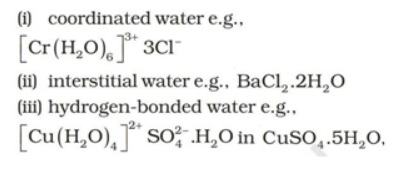
Hydrates Formation: From aqueous Solutions many salts can be crystallised as Hydrated salts. Such an association of water Is of different types viz., Coordinated water e.g.,

Hard and Soft Water- Rain water is almost pure (may contain some Dissolved gases from the atmosphere). Being a Good solvent, when it flows on the surface of The earth, it dissolves many salts. Presence of Calcium and magnesium salts in the form of Hydrogencarbonate, chloride and sulphate in Water makes water ‘hard’. Hard water does Not give lather with soap. Water free from Soluble salts of calcium and magnesium is Called Soft water. It gives lather with soap Easily. Temporary hardness is due to the presence of Magnesium and calcium hydrogen- Carbonates. It can be removed by:
Boiling: During boiling, the soluble $Mg(HCO_3)_2$ is converted into insoluble $Mg(OH)_2$ And $Ca(HCO_3)_2$ is changed to insoluble $CaCO_3$. It is because of high solubility product of $Mg(OH)_2$ as compared to that of $MgCO_3$, that $Mg(OH)_2$ is precipitated. These precipitates can Be removed by filtration. Filtrate thus obtained
Will be soft water.
$\text{Mg}(\text{HCO}_3)_2\xrightarrow{\text{Heating}}\text{Mg}(\text{OH})_2\downarrow+2\text{CO}_2\uparrow$
$\text{Ca}(\text{HCO}_3)_2\xrightarrow{\text{Heating}}\text{CaCO}_3\downarrow+\text{H}_2\text{O}+\text{CO}_2\uparrow$
Clark’s method: In this method calculated Amount of lime is added to hard water. It Precipitates out calcium carbonate and Magnesium hydroxide which can be filtered off.
Permanent Hardness is due to the presence of soluble salts of Magnesium and calcium in the form of Chlorides and sulphates in water. Permanent Hardness is not removed by boiling.
$\text{Ca}(\text{Hco}_3)_2+\text{Ca}(\text{OH)}_2\rightarrow2\text{CaCO}_3\downarrow2\text{H}_2\text{O}$
$\text{Mg}(\text{HCO)}_3+2\text{Ca}\text{(Oh)}_2\rightarrow2\text{CaCO}_3\downarrow+\text{Mg}(\text{OH)}_2\downarrow2\text{H}_2\text{O}$
Permanent Hardness is due to the presence of soluble salts of Magnesium and calcium in the form of Chlorides and sulphates in water. Permanent Hardness is not removed by boiling.
  1. In the gas phase water is a bent molecule with a bond angle of:
  1. $104.5^\circ$
  2. $94.5^\circ$
  3. $110.5^\circ$
  4. $95.5^\circ$
  1. At Atmospheric pressure ice crystallises in the … form.
  1. Cubic
  2. Hexagonal
  3. Octagonal
  4. Pentagonal
  1. Water free from Soluble salts of calcium and magnesium is called …
  1. hard water
  2. dry water
  3. soft water
  4. None of above
  1. Water has…. Nature.
  1. acidic
  2. basic
  3. neutral
  4. amphoteric
  1. Water is…. Molecule.
  1. Polar
  2. Non- Polar
  3. Ionic
  4. All the above