Question
Read the passage given below and answer the following questions from (i) to (v).

The attractive force which holds variousconstituents (atoms, ions, etc.) together in differentchemical species is called a chemical bond. In order to explain the formation of chemicalbond in terms of electrons, a number ofattempts were made, but it was only in 1916 when Kössel and Lewis succeededindependently in giving a satisfactoryexplanation. They were the first to providesome logical explanation of valence which wasbased on the inertness of noble gases. Lewis postulated that atoms achieve thestable octet when they are linked bychemical bonds. In the formation of amolecule, only the outer shell electrons takepart in chemical combination and they areknown as valence electrons. The inner shellelectrons are well protected and are generallynot involved in the combination process.G.N. Lewis, an American chemist introducedsimple notations to represent valenceelectrons in an atom. These notations arecalled Lewis symbols. For example, the Lewissymbols for the elements of second period areas under:
The bond formed, as a result of theelectrostatic attraction between thepositive and negative ions was termed as the electrovalent bond. The electrovalenceis thus equal to the number of unitcharge(s) on the ion.
Kössel and Lewis in 1916 developed animportant theory of chemical combinationbetween atoms known as electronic theoryof chemical bonding. According to this,atoms can combine either by transfer ofvalence electrons from one atom to another(gaining or losing) or by sharing of valenceelectrons in order to have an octet in theirvalence shells. This is known as octet rule. when two atoms share oneelectron pair they are said to be joined bya single covalent bond. In many compoundswe have multiple bonds between atoms. Theformation of multiple bonds envisagessharing of more than one electron pairbetween two atoms. If two atoms share twopairs of electrons, the covalent bondbetween them is called a double bond. Forexample, in the carbon dioxide molecule, wehave two double bonds between the carbonand oxygen atoms. Similarly in ethenemolecule the two carbon atoms are joined bya double bond. The Lewis dot structures provide a pictureof bonding in molecules and ions in termsof the shared pairs of electrons and theoctet rule. The Lewis dotstructures can be written by adopting thefollowing steps:
- The total number of electrons required forwriting the structures are obtained byadding the valence electrons of thecombining atoms. For example, in the $CH _4$ molecule there are eight valence electronsavailable for bonding.
- For anions, each negative charge wouldmean addition of one electron. Forcations, each positive charge would result in subtraction of one electron from the totalnumber of valence electrons. For example,for the $CO _3{ }^{2-}$ ion, the two negative chargesindicate that there are two additionalelectrons than those provided by theneutral atoms.
- Knowing the chemical symbols of thecombining atoms and having knowledgeof the skeletal structure of the compound, it is easyto distribute the total number of electronsas bonding shared pairs between theatoms in proportion to the total bonds.
- In general the least electronegative atomoccupies the central position in themolecule/ion. For example in the $NF _3$ andCO ${ }_3{ }^{2-}$, nitrogen and carbon are the centralatoms whereas fluorine and oxygenoccupy the terminal positions.
- After accounting for the shared pairs ofelectrons for single bonds, the remainingelectron pairs are either utilized for multiplebonding or remain as the lone pairs. Thebasic requirement being that each bondedatom gets an octet of electrons.
i. ... postulated that atoms achieve the stable octet when they are linked by chemical bonds.
  1. … postulated that atoms achieve the stable octet when they are linked by chemical bonds.
  1. Lewis
  2. Debye
  3. Charles
  4. Sidgwick
  1. … in 1916 developed an important theory of chemical combination between atoms known as electronic theory of chemical bonding.
  1. Kössel
  2. Lewis
  3. Both a) & b)
  4. Sidgwick
  1. In the formation of a molecule, only the outer shell electrons take part in chemical combination and they are known as …
  1. Backscattered electrons
  2. Valence electrons
  3. Primary electrons
  4. Secondary electrons
  1. In the $CH_4$​​​​​​​ molecule there are … valence electrons available for bonding.
  1. 4
  2. 6
  3. 8
  4. 10
  1. The type of bond between atoms in a molecule of CO2 is:
  1. Ionic bond
  2. Metallic bond
  3. Hydrogen bond
  4. Covalent bond.

Answer

  1. (a) Lewis
  1. (c) Both a) & b)
  1. (b) Valence electrons
  1. (c) 8
  1. (d) Covalent bond.

Need a full question paper?

Generate a complete, print-ready paper with questions like this in minutes — across 16+ boards, with answer keys.

Start Generating Free

Similar questions

Read the passage given below and answer the following questions from $1$ to $5.$
Quantitative measurement of properties isreaquired for scientific investigation. Earlier, two different systems of measurement, i.e., the English System and the Metric System were being used indifferent parts of the world. The metric system, which originated in France in late eighteenth century. The SI system has seven base units. these are listed as follow.
 
Base Physical Quantities
Unit
1
Length
Metre – m
2
Mass
Kilogram – kg
3
Time
Second – s
4
Electric current
Ampere- A
5
Thermodynamic Temperature
Kelvin – K
6
Amount of substance
Mole – mol
7
Luminous intensity
Candela- cd
Here, Mass of a substance is the amount of matter present in it, while weight is the force exerted by gravity on an object. Density of a substance is its amount of mass per unit volume. The mole, symbol mol, is the SI unit of amount of substance. One mole contains exactly $6.02214076 \times 10^{23}$ elementary entities. This number is the fixed numerical value of the Avogadro constant, NA, when expressed in the unit per moland is called the Avogadro number. The amount of substance, symbol $n$, of a system is a measure of the number of specified elementary entities. An elementary entity may be an atom, a molecule, an ion, an electron, any other particle or specified group of particles.There are three common scales to measure temperature - ${ }^{\circ} C$ (degree celsius), ${ }^{\circ} F$ (degree fahrenheit) and K (kelvin). Here, K is the Slunit. Generally, the thermometer with celsius scale are calibrated from $0^{\circ}$ to $100^{\circ}$, where these two temperatures are the freezing point and the boiling point of water, respectively. The fahrenheit scale is represented between $32^{\circ}$ to $212^{\circ}$.
The temperatures on two scales are related to each other by the following relationship:
$^\circ{F} = 9 (^\circ{C}) + 32$
$5$
The kelvin scale is related to celsius scaleas follows:
$K = ^\circ{C} + 273.15$
  1. The metric system,which originated in … in late eighteenthcentury.
  1. Ukraine
  2. German
  3. Russia
  4. France
  1. The SI system has …. base units.
  1. $7$
  2. $3$
  3. $9$
  4. $1$
  1. The symbol for SI unit of thermodynamic temperature is …
  1. Kelvin
  2. $K$
  3. Degree Celsius
  4. ${}^\circ C$
  1. A prefix giga equivalents to:
  1. $10^9$
  2. $10^{10}$
  3. $10^{11}$
  4. $10^{12}$
  1. The fahrenheit scale is represented between..
  1. $0^\circ F \ to\ 100^\circ F$
  2. $32^\circ F \ to\ 212^\circ .F$
  3. $15^\circ F \ to\ 373^\circ F$
Read the passage given below and answer the following questions from (i) to (v).
When a liquid evaporates in a closed container, molecules with relatively higher kinetic energy escape the liquid surface into the vapour phase and number of liquid molecules from the vapour phase strike the liquid surface and are retained in the liquid phase. It gives rise to a constant vapour pressure because of an equilibrium in which the number of molecules leaving the liquid equals the number returning to liquid from the vapour. We say that the system has reached equilibrium state at this stage. However, this is not static equilibrium and there is a lot of activity at the boundary between the liquid and the vapour. Thus, at equilibrium, the rate of evaporation is equal to the rate of condensation. It may be represented by
$\text{H}_2\text{O}_{(\text{l})}\rightleftharpoons\text{H}_2\text{O}_{(\text{vap})}$
The double half arrows indicate that the processes in both the directions are going on simultaneously. The mixture of reactants and products in the equilibrium state is called an equilibrium mixture.
Equilibrium can be established for both physical processes and chemical reactions. The reaction may be fast or slow depending on the experimental conditions and the nature of the reactants. When the reactants in a closed vessel at a particular temperature react to give products, the concentrations of the reactants keep on decreasing, while those of products keep on increasing for some time after which there is no change in the concentrations of either of the reactants or products. This stage of the system is the dynamic equilibrium
The chemical equilibrium may be classified in three groups.
  1. The reactions that proceed nearly to completion and only negligible concentrations of the reactants are left. In some cases, it may not be even possible to detect these experimentally.
  2. The reactions in which only small amounts of products are formed and most of the reactants remain unchanged at equilibrium stage.
  3. The reactions in which the concentrations of the reactants and products are comparable, when the system is in equilibrium.
The equilibrium involving ions in aqueous solutions which is called as ionic equilibrium.
Solid-Liquid Equilibrium Ice and water kept in a perfectly insulated thermos flask (no exchange of heat between its contents and the surroundings) at 273K and the atmospheric pressure are in equilibrium state and the system shows interesting characteristic features. We observe that the mass of ice and water do not change with time and the temperature remains constant. However, the equilibrium is not static. The intense activity can be noticed at the boundary between ice and water. Molecules from the liquid water collide against ice and adhere to it and some molecules of ice escape into liquid phase. There is no change of mass of ice and water, as the rates of transfer of molecules from ice into water and of reverse transfer from water into ice are equal at atmospheric pressure and 273 K. It is obvious that ice and water are in equilibrium only at particular temperature and pressure. For any pure substance at atmospheric pressure, the temperature at which the solid and liquid phases are at equilibrium is called the normal melting point or normal freezing point of the substance. The system here is in dynamic equilibrium and we can infer the following:
  1. Both the opposing processes occur simultaneously.
  2. Both the processes occur at the same rate so that the amount of ice and water remains constant.
Solid – Vapour Equilibrium Let us now consider the systems where solids sublime to vapour phase. If we place solid iodine in a closed vessel, after sometime the vessel gets filled up with violet vapour and the intensity of colour increases with time. After certain time the intensity of colour becomes constant and at this stage equilibrium is attained. Hence solid iodine sublimes to give iodine vapour and the iodine vapour condenses to give solid iodine. The equilibrium can be represented as,
$\text{l}_2(\text{solid})\rightleftharpoons\text{l}_2(\text{vapour})$
Other examples showing this kind of equilibrium are,
$\text{Camphor}_{(\text{solid})}\rightleftharpoons\text{Camphor}_{(\text{vapour})}$
$\text{NH}_4\text{CI}_{(\text{solid})}\rightleftharpoons\text{NH}_4\text{CI}_{(\text{vapour})}$
The equilibrium Involving Dissolution of Solid in Liquids Only a limited amount of salt or sugar can dissolves in a given amount of water at room temperature. If we make a thick sugar syrup solution by dissolving sugar at a higher temperature, sugar crystals separate out if we cool the syrup to the room temperature. We call it a saturated solution when no more of solute can be dissolved in it at a given temperature. The concentration of the solute in a saturated solution depends upon the temperature. In a saturated solution, a dynamic equilibrium exits between the solute molecules in the solid state and in the solution: Sugar (solution) Sugar (solid), and the rate of dissolution of sugar = rate of crystallisation of sugar. Equality of the two rates and dynamic nature of equilibrium has been confirmed with the help of radioactive sugar. If we drop some radioactive sugar into saturated solution of non-radioactive sugar, then after some time radioactivity is observed both in the solution and in the solid sugar. Initially there were no radioactive sugar molecules in the solution but due to dynamic nature of equilibrium, there is exchange between the radioactive and non-radioactive sugar molecules between the two phases. The ratio of the radioactive to non- radioactive molecules in the solution increases till it attains a constant value.
  1. Which of the following symbol represents equilibrium.
  1. $\rightleftharpoons$
  2. $\leftrightarrows$
  3. $\nLeftrightarrow$
  4. $\uparrow\downarrow$
  1. When there is no change in the concentrations of either of the reactants or products, this stage of the system is the …
  1. Static equilibrium
  2. Dynamic equilibrium
  3. Physical equilibrium
  4. Chemical equilibrium
  1. A … solution means no more of solute can be dissolved in it at a given temperature.
  1. Unsaturated
  2. Supersaturated
  3. Saturated
  4. None of these.
  1. The equilibrium involving ions in aqueous solutions which is called as …
  1. Static equilibrium
  2. Dynamic equilibrium
  3. Physical equilibrium
  4. Ionic equilibrium
  1. The concentration of the solute in a saturated solution depends upon the …
  1. Solvent
  2. Pressure
  3. Temperature
  4. System
Read the passage given below and answer the following questions from 1 to 5. Since the isotopes have the same electronic Configuration, they have almost the same Chemical properties.The only difference is in Their rates of reactions, mainly due to their Different enthalpy of bond dissociation . However, in physical properties these Isotopes differ considerably due to their large Mass differences. There are a number of methods for preparing Dihydrogen from metals and metal hydrides. 1.) Laboratory Preparation of Dihydrogen – It is usually prepared by the reaction of Granulated zinc with dilute hydrochloric. $Zn + 2H + \rightarrow Zn_2+ + H_2$ It can also be prepared by the reaction of Zinc with aqueous alkali. $Zn + 2NaOH \rightarrow Na_2ZnO_2 + H_2$ Commercial Production of Dihydrogen – The commonly used processes are outlined Below: i) Electrolysis of acidified water using Platinum electrodes gives hydrogen. ii) High purity (> 99.95%) dihydrogen is Obtained by electrolysing warm aqueous Barium hydroxide solution between nickel iii) It is obtained as a by product in the Manufacture of sodium hydroxide and Chlorine by the electrolysis of brine Solution. During electrolysis, the reactions That take place are: at anode: $2\text{CI}(\text{aq})\rightarrow\text{CI}_2(\text{g})+2\bar{\text{e}}$ at cathode: $2\text{H}_2\text{O}(\text{l})+2\text{e}\rightarrow\text{H}_2(\text{g})+2\text{O}\bar{\text{H}}(\text{aq})$ The overall reaction is $2\text{Na }(\text {aq})+2\text{C}\bar{\text{I}}(\text{aq})+2\text{H}_2\text{O}(\text{l})$ $\text{CI}_2(\text{g})+\text{H}_2(\text{g})+2\text{Na}^+(\text{aq})+2\text{O}\bar{\text{H}}(\text{aq})$ That take place are: iv) Reaction of steam on hydrocarbons or coke At high temperatures in the presence of Catalyst yields hydrogen.

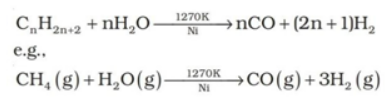
 The mixture of $CO$ and $H_2$ is called water Gas. As this mixture of $CO$ and $H_2$ is used for The synthesis of methanol and a number of Hydrocarbons, it is also called synthesis gas Or ‘syngas’. Nowadays ‘syngas’ is produced From sewage, saw-dust, scrap wood, Newspapers etc. The process of producing ‘syngas’ from coal is called ‘coal gasification’. The production of dihydrogen can be Increased by reacting carbon monoxide of Syngas mixtures with steam in the presence of Iron chromate as catalyst. This is called water-gas shift reaction. Carbon dioxide is removed by scrubbing with Sodium arsenite solution. Presently ~77% of the industrial Dihydrogen is produced from petro-chemicals, 18% from coal, 4% from electrolysis of aqueous Solutions and 1% from other sources. Physical Properties Dihydrogen is a colourless, odourless, Tasteless, combustible gas. It is lighter than Air and insoluble in water. Its other physical Properties are alongwith those of deuterium. The chemical behaviour of dihydrogen (and for That matter any molecule) is determined, to a Large extent, by bond dissociation enthalpy. The H–H bond dissociation enthalpy is the Highest for a single bond between two atoms Of any element. What inferences would you Draw from this fact ? It is because of this factor That the dissociation of dihydrogen into its Atoms is only~0.081% around 2000K which Increases to 95.5% at 5000K. Also, it is Relatively inert at room temperature due to the high H–H bond enthalpy. Thus, the atomic Hydrogen is produced at a high temperature In an electric arc or under ultraviolet Radiations. Since its orbital is incomplete with 1s1 Electronic configuration, it does combine With almost all the elements. It accomplishes Reactions by
i) loss of the only electron to Give H+, ii) gain of an electron to form H–, and iii) Sharing electrons to form a single covalent bond. The chemistry of dihydrogen can be Illustrated by the following reactions: Reaction with halogens: It reacts with Halogens, $X_2$ to give hydrogen halides, $\text{H}_2(\text{g})+\text{x}_2(\text{g})\rightarrow2\text{HX}(\text{g})(\text{x}=\text{F.CI.Br.I})$ While the reaction with fluorine occurs even in The dark, with iodine it requires a catalyst. Reaction with dioxygen: It reacts with Dioxygen to form water. The reaction is highly Exothermic. $2\text{H}_2(\text{g})+\text{O}_2(\text{g})\xrightarrow{\text{catalyst or beading}}2\text{H}_2\text{O}(\text{l}):$ $\triangle\text{H}^-=-285.9\text{kj}\text{mol}^-1$ This is the method for the manufacture of Ammonia by the Haber process. Reactions with metals: With many metals it Combines at a high temperature to yield the Corresponding hydrides $H_2$ (g) + 2M (g) → 2 MH (s); Where M is an alkali metal Reactions with metal ions and metal Oxides: It reduces some metal ions in aqueous Solution and oxides of metals (less active than Iron) into corresponding metals. $\text{H}_2(\text{g})+\text{Pd}^{2+}\text{(aq)}\rightarrow\text{Pd}(\text{s})+2\text{H}^+(\text{aq})$ $\text{y}\text{H}_2(\text{g})+\text{M}_\text{x}\text{O}_\text{y}(\text{S})\rightarrow\text{xM}(\text{s})+\text{y}\text{H}_2\text{O}\text{(l)}$ Reactions with organic compounds: It Reacts with many organic compounds in the Presence of catalysts to give useful Hydrogenated products of commercial Importance. For example: Hydrogenation of vegetable oils using Nickel as catalyst gives edible fats (margarine and vanaspati ghee) Hydroformylation of olefins yields Aldehydes which further undergo Reduction to give alcohols. $\text{H}_2+\text{CO}+\text{RCH}=\text{CH}_2\rightarrow\text{RCH}_2\text{CH}_2\text{CHO}$ $\text{H}_2+\text{RCH}_2\text{CH}_2\text{CHO}\rightarrow\text{RCH}_2\text{CH}_2\text{CH}_2\text{OH}$
  1. The mixture of CO and H2 is called …
  1. water Gas
  2. Dry ice
  3. Dry carbon
  4. Dry hydrogen
  1. Which of the following is not physical property of Dihydrogen.
  1. colourless
  2. Highest dissociation enthalpy
  3. odourless
  4. Tasteless
  1. Dihydrogen is reacts with dioxygen to get ….
  1. $H_2O_2$
  2. $2H_2O_2$
  3. $2H_2O$
  4. $H_2O$
  1. High purity dihydrogen is obtained by electrolysing warm aqueous barium hydroxide solution between… electrodes.
  1. Chromium
  2. Copper
  3. Platinum
  4. Nickel
Read the passage given below and answer the following questions from (i) to (v).
The covalent bond may be classified into twotypes depending upon the types ofoverlapping:(i) Sigma(σ) bond, and (ii) pi($\pi$) bond
  1. Sigma(σ) bond: This type of covalent bondis formed by the end to end (head-on)overlap of bonding orbitals along theinternuclear axis. This is called as headon overlap or axial overlap. This can beformed by any one of the following typesof combinations of atomic orbitals.
s-s overlapping: In this case, there isoverlap of two half filled s-orbitals alongthe internuclear axis.

s-p overlapping: This type of overlapoccurs between half filled s-orbitals of oneatom and half filled p-orbitals of anotheratom.

p–p overlapping: This type of overlaptakes place between half filled p-orbitalsof the two approaching atoms.
  1. pi($\pi$) bond: In the formation of $\pi$ bondthe atomic orbitals overlap in such a waythat their axes remain parallel to each otherand perpendicular to the internuclear axis.The orbitals formed due to sidewiseoverlapping consists of two saucer type charged clouds above and below the planeof the participating atoms.
Basically the strength of a bond depends uponthe extent of overlapping. In case of sigma bond,the overlapping of orbitals takes place to alarger extent. Hence, it is stronger as comparedto the pi bond where the extent of overlappingoccurs to a smaller extent. Further, it isimportant to note that in the formation ofmultiple bonds between two atoms of amolecule, pi bond(s) is formed in addition to asigma bond. In order to explain the characteristicgeometrical shapes of polyatomic moleculeslike $CH_4,NH_3$ and $H_2O$ etc., Pauling introducedthe concept of hybridisation. According to himthe atomic orbitals combine to form new set ofequivalent orbitals known as hybrid orbitals.Unlike pure orbitals, the hybrid orbitals areused in bond formation. The phenomenon isknown as hybridisation which can be definedas the process of intermixing of the orbitals ofslightly different energies so as to redistributetheir energies, resulting in the formation of newset of orbitals of equivalent energies and shape.For example when one 2s and three 2p-orbitalsof carbon hybridise, there is the formation offour new $sp_3$ hybrid orbitals. Salient features of hybridisation: The mainfeatures of hybridisation are as under:
  1. The number of hybrid orbitals is equal tothe number of the atomic orbitals that gethybridised.
  2. The hybridised orbitals are alwaysequivalent in energy and shape.
  3. The hybrid orbitals are more effective informing stable bonds than the pure atomicorbitals.
  4. These hybrid orbitals are directed in spacein some preferred direction to haveminimum repulsion between electronpairs and thus a stable arrangement.Therefore, the type of hybridisationindicates the geometry of the molecules. Important conditions for hybridisation
  5. The orbitals present in the valence shell of the atom are hybridised.
  6. The orbitals undergoing hybridisation should have almost equal energy.
  7. Promotion of electron is not essential condition prior to hybridisation.
  8. It is not necessary that only half filled orbitals participate in hybridisation.
some cases, even filled orbitals of valence shell take part in hybridisation.
There are various types of hybridisationinvolving s, p and d orbitals. The differenttypes of hybridisation are as under:
some cases, even filled orbitals of valence shell take part in hybridisation.
There are various types of hybridisationinvolving $s , p$ and d orbitals. The differenttypes of hybridisation are as under:
1. sp hybridisation: This type ofhybridisation involves the mixing of one $s$ andone $p$ orbital resulting in the formation of twoequivalent $s p$ hybrid orbitals. The suitableorbitals for sp hybridisation are $s$ and pz , ifthe hybrid orbitals are to lie along the $z$-axis. Example of molecule having sphybridisationBeCl2: The ground state electronicconfiguration of Be is $1 s^2 2 s^2$. In the exited stateone of the 2 s -electrons is promoted to vacant 2 p orbital to account for its bivalency.One 2 s and one 2 p -orbital gets hybridised toform two sp hybridised orbitals.
2. sp2 hybridisation: In this hybridisationthere is involvement of one s and twop-orbitals in order to form three equivalent sp2hybridised orbitals. For example, in BCI 3 molecule, the ground state electronicconfiguration of central boron atom is $1 s^2 2 s^2 2 p^1$. In the excited state, one of the 2 selectrons is promoted to vacant $2 p$ orbital as a result boron has three unpaired electrons. These three orbitals (one 2 s and two 2 p )hybridise to form three sp2 hybrid orbitals.
3. $sp ^3$ hybridisation: This type ofhybridisation can be explained by taking theexample of $CH _4$ molecule in which there ismixing of one $s$-orbital and three p -orbitals ofthe valence shell to form four $sp ^3$ hybrid orbitalof equivalent energies and shape. There is $25 \% s$-character and $75 \% p$-character in each $sp ^3$ hybrid orbital. The four $sp ^3$ hybrid orbitals soformed are directed towards the four cornersof the tetrahedron. The angle between $sp ^3$ hybrid orbital is $109.5^{\circ}$.
  1. ....ntroduced the concept of hybridisation.
  1. Pauling
  2. Lewis
  3. Nyholm
  4. Gillespie
  1. Which of the following is an example of sp3 hybridization?
  1. BeCl2
  2. Ch4
  3. BCl3
  4. C2H4
  1. The angle between sp3 hybrid orbital is ….
  1. $5^\circ$
  2. $9^\circ$
  3. $109.5^\circ$
  4. $120^\circ$
  1. A sigma bond is formed by the overlapping of …
  1. s−s,
  2. s−p
  3. p−p
  4. All the above
  1. When one 2s and three 2p-orbitals of carbon hybridise, there is the formation of four new … hybrid orbitals.
  1. sp3
  2. sp2
  3. sp
  4. None of above
When anions and cations approach each other, the valence shell of anions are pulled towards the cation nucleus and thus, the shape of the anion is deformed. The phenomenon of deformation of anion by a cation is known as polarization and the ability of the cation to polarize the anion is called as polarizing power of cation. Due to polarization, sharing of electrons occurs between two ions to some extent and the bond shows some covalent character.
The magnitude of polarization depends upon a number of factors.

1. Out of $AlCl _3$ and $AlI _3$ which halides show maximum polarization? (1)
2. Out of $AlCl _3$ and $CaCl _2$ which one is more covalent in nature? (1)
3. The non-aqueous solvent like ether is added to the mixture of $LiCl , NaCl$ and KCl . Which will be extracted into the ether? (2)
OR
Out of $CaF _2$ and $CaI _2$ which one has a minimum melting point? (2)
IUPAC (International Union of Pure and Applied Chemistry) system of nomenclature. Common names are useful and in many cases indispensable, particularly when the alternative systematic names are lengthy and complicated. A systematic name of an organic compound is generally derived by identifying the parent hydrocarbon and the functional group(s) attached to it. By using prefixes and suffixes, the parent name can be modified to obtain the actual name. In a branched-chain compound, small chains of carbon atoms are attached at one or more carbon atoms of the parent chain. The small carbon chains (branches) are called alkyl groups. An alkyl group is derived from a saturated hydrocarbon by removing a hydrogen atom from carbon. Abbreviations are used for some alkyl groups. For example, methyl is abbreviated as Me, ethyl as Et, propyl as Pr and butyl as Bu.

1. Draw the structure of 3-Ethyl-4,4-dimethylheptane. (1)
2. How is the numbering in branched chain hydrocarbon done? (1)
3. Derive the structure of 2-Chlorohexane. (2)
OR
Why $CH _4$ after becoming- $CH _3$ called a methyl group? (2)
We must bear in mind that when Mendeleev developed his Periodic Table, chemists knew nothing about the internal structure of atom. However, the beginning of the 20th century witnessed profound developments in theories about sub-atomic particles. In 1913, the English physicist, Henry Moseley observed regularities in the characteristic X-ray spectra of the elements. A plot of ν (whereν is frequency of X-rays emitted) against atomic number (Z ) gave a straight line and not the plot of ν vs atomic mass. He thereby showed that the atomic number is a more fundamental property of an element than its atomic mass. Mendeleev’s Periodic Law was, therefore, accordingly modified. This is known as the Modern Periodic Law and can be stated as : The physical and chemical properties of the elements are periodic functions of their atomic numbers.Numerous forms of Periodic Table have been devised from time to time. Some forms emphasise chemical reactions and valence, whereas others stress the electronic configuration of elements. A modern version, the so-called “long form” of the Periodic Table of the elements , is the most convenient and widely used. The horizontal rows (which Mendeleev called series) are called periods and the vertical columns, groups. Elements having similar outer electronic configurations in their atoms are arranged in vertical columns, referred to as groups or families. According to the recommendation of International Union of Pure and Applied Chemistry (IUPAC), the groups are numbered from 1 to 18 replacing the older notation of groups IA … VIIA, VIII, IB … VIIB and 0. There are altogether seven periods. The period number corresponds to the highest principal quantum number (n) of the elements in the period. The first period contains 2 elements. The subsequent periods consists of 8, 8, 18, 18 and 32 elements, respectively. The seventh period is incomplete and like the sixth period would have a theoretical maximum (on the basis of quantum numbers) of 32 elements. In this form of the Periodic Table, 14 elements of both sixth and seventh periods (lanthanoids and actinoids, respectively) are placed in separate panels at the bottom. the IUPAC has made recommendation that until a new element’s discovery is proved, and its name is officially recognised, a systematic nomenclature be derived directly from the atomic number of the element using the numerical roots for 0 and numbers 1-9. The roots are put together in order of digits which make up the atomic number and “ium” is added at the end.Groupwise Electronic Configurations Elements in the same vertical column or group have similar valence shell electronic configurations, the same number of electrons in the outer orbitals, and similar properties. theoretical foundation for the periodic classification. The elements in a vertical column of the Periodic Table constitute a group or family and exhibit similar chemical behaviour. This similarity arises because these elements have the same number and same distribution of electrons in their outermost orbitals. We can classify the elements into four blocks viz., s-block, p-block, d-block and f-block depending on the type of atomic orbitals that are being filled with electrons. Two exceptions to this categorisation. Strictly, helium belongs to the s-block but its positioning in the p-block along with other group 18 elements is justified because it has a completely filled valence shell (1s) and as a result, exhibits properties characteristic of other noble gases. The other exception is hydrogen. It has only one s-electron and hence can be placed in group 1 (alkali metals). It can also gain an electron to achieve a noble gas arrangement and hence it can behave similar to a group 17 (halogen family) elements. Because it is a special case, we shall place hydrogen separately at the top of the Periodic Table.
  1. In 1913, the English physicist, ….observed regularities in the characteristic X-ray spectra of the elements.
  1. Johann Dobereiner
  2. John Alexander Newlands
  3. Demitri Mendeleev
  4. Henry Moseley
  1. Horizontal row in periodic table called:
  1. Group
  2. Period
  3. Triad
  4. Octave
  1. Vertical Column in periodic table called:
  1. Group
  2. Period
  3. Triad
  4. Octave
  1. According to Modern Periodic Law the physical and chemical properties of the elements are periodic functions of their ….
  1. Atomic mass
  2. Atomic numbers
  3. Atomic structure
  4. Atomic size
  1. What is IUPAC name of element having atomic number 107.
  1. Unnilpentium
  2. Unnilhexium
  3. Unnilseptium
  4. Unniloctium
Read the passage given below and answer the following questions from (i) to (vi).
The atomic theory of matter was first proposed on afirm scientific basis by JohnDalton, a British schoolteacher in 1808. His theory, called Dalton’s atomictheory, regarded the atom as the ultimate particle ofmatter Dalton’s atomic theory was able to explainthe law of conservation of mass, law of constantcomposition and law of multiple proportion verysuccessfully. However, it failed to explain the results ofmany experiments.In mid 1850s many scientists mainlyFaraday began to study electrical dischargein partially evacuated tubes, known ascathode ray discharge tubes.Electrical discharge carried out in the modifiedcathode ray tube led to the discovery of canalrays carrying positively charged particles. Thecharacteristics of these positively chargedparticles are listed below.
  1. Unlike cathode rays, mass of positivelycharged particles depends upon thenature of gas present in the cathode raytube. These are simply the positivelycharged gaseous ions.
  2. The charge to mass ratio of the particlesdepends on the gas from which theseoriginate.
  3. Some of the positively charged particlescarry a multiple of the fundamental unitof electrical charge.
  4. The behaviour of these particles in themagnetic or electrical field is opposite tothat observed for electron or cathoderays.
The smallest and lightest positive ion wasobtained from hydrogen and was called
proton. This positively charged particle wascharacterised in 1919. Later, a need was feltfor the presence of electrically neutral particleas one of the constituent of atom. Theseparticles were discovered by Chadwick (1932)by bombarding a thin sheet of beryllium byα-particles. When electrically neutral particleshaving a mass slightly greater than that ofprotons were emitted. He named theseparticles as neutrons.J. J. Thomson, in 1898, proposed that an atom possesses a spherical shape (radiusapproximately 10–10 m) in which the positivecharge is uniformly distributed. The electronsare embedded into it in such a manner as togive the most stable electrostatic arrangementMany different names are given tothis model, for example, plum pudding, raisinpudding or watermelon. This model can be visualised as a pudding or watermelon ofpositive charge with plums or seeds (electrons)embedded into it. An important feature of thismodel is that the mass of the atom is assumed to be uniformly distributed over theatom.Rutherford and his students (Hans Geiger andErnest Marsden) bombarded very thin gold foilwith α–particles. Rutherford’s famous α–particle scattering experiment.The observations of Scattering experiment are as follows-:
  1. most of the α–particles passed throughthe gold foil undeflected.
  2. a small fraction of the α–particles wasdeflected by small angles.
  3. a very few α–particles (∼1 in 20,000)bounced back, that is, were deflected bynearly 180°.
On the basis of observations andconclusions from this experiment, Rutherford proposed the nuclearmodel of atom. According to this model:
  1. The positive charge and most of the massof the atom was densely concentrated inextremely small region. This very smallportion of the atom was called nucleusby Rutherford.
  2. The nucleus is surrounded by electronsthat move around the nucleus with a veryhigh speed in circular paths called orbits.Thus, Rutherford’s model of atomresembles the solar system in which thenucleus plays the role of sun and theelectrons that of revolving planets.
  3. Electrons and the nucleus are held together by electrostatic forces of attraction.
  1. The atomic theory of matter was first proposed on afirm scientific basis by:
  1. John Dalton
  2. Ernest Rutherford
  3. J.Thomson
  4. Henry Moseley
  1. The cathode rays start from … and move towards the….
  1. Anode, Cathode
  2. Centre, Anode
  3. Cathod, Anode
  4. Cathod, Centre
  1. Negativelycharged particles in atoms, called…
  1. Protons
  2. Electrons
  3. Neutron
  4. Positron
  1. The smallest and lightest positive ion wasobtained from …. and was called proton.
  1. Oxygen
  2. Nitrogen
  3. Carbon
  4. Hydrogen
  1. Electrically neutral particles having a mass slightly greater than that of protons, these particles termed as:
  1. Protons
  2. Electrons
  3. Neutron
  4. Positron
  1. J.J. Thomson’s atomic model is also named as:
  1. Plum pudding
  2. Raisin pudding
  3. Watermelon
  4. All the above
Read the passage given below and answer the following questions from (i) to (v).
When covalent bond is formed betweentwo similar atoms, for example in $H _2, O _2, Cl _2, N_2 Or F _2$, the shared pair of electrons is equally Attracted by the two atoms. As a result electronPair is situated exactly between the twoldentical nuclei. The bond so formed is calledNonpolar covalent bond. As a result of polarisation, the moleculePossesses the dipole moment which can be defined as the productof the magnitude of the charge and theDistance between the centres of positive andNegative charge. It is usually designated by aGreek letter ' $\mu$ '. Mathematically, it is expressedAs follows :Dipole moment $(\mu)=$ charge $( Q ) \times$ distance ofSeparationDipole moment is usually expressed inDebye units (D). The conversion factor is $1 D =3.33564 \times 10^{-30} C$ mWhere C is coulomb and m is meter. Just as all the covalent bonds haveSome partial ionic character, the ionicBonds also have partial covalentCharacter. The partial covalent character of ionic bonds was discussed by Fajans in terms of the following rules:
- The smaller the size of the cation and theLarger the size of the anion, the greater theCovalent character of an ionic bond.
- The greater the charge on the cation, theGreater the covalent character of the ionic bond.
- For cations of the same size and charge, The one, with electronic configuration( $n -1) d ^0 n s ^0$, typical of transition metals, isMore polarising than the one with a nobleGas configuration, ns2 np6, typical of alkali and alkaline earth metal cations.

Sidgwick and Powell in 1940, proposed a simple theoryBased on the repulsive interactions of theElectron pairs in the valence shell of the atoms.It was further developed and redefined byNyholm and Gillespie (1957).The main postulates of VSEPR theory areAs follows:
- The shape of a molecule depends uponThe number of valence shell electron pairs(bonded or nonbonded) around the centralAtom.
- Pairs of electrons in the valence shell repelone another since their electron clouds arenegatively charged.
- These pairs of electrons tend to occupySuch positions in space that minimiseRepulsion and thus maximise distanceBetween them.
- The valence shell is taken as a sphere withThe electron pairs localising on theSpherical surface at maximum distanceFrom one another.
- A multiple bond is treated as if it is a singleElectron pair and the two or three electronPairs of a multiple bond are treated as aSingle super pair.
- Where two or more resonance structuresCan represent a molecule, the VSEPRModel is applicable to any such structure.
 The arrangement of electron pairs and the atoms around the central atom can be : linear,Trigonal planar, tetrahedral, trigonal-Bipyramidal and octahedral. Valence bond theory was introduced byHeitler and London (1927) and developedFurther by Pauling and others. A discussionOf the valence bond theory is based on the knowledge of atomic orbitals, electronicConfigurations of elements.partialmerging of atomic orbitals is called overlappingof atomic orbitals which results in the pairingof electrons. The extent of overlap decides thestrength of a covalent bond. according toorbital overlap concept, the formation of acovalent bond between two atoms results bypairing of electrons present in the valence shellhaving opposite spins. When orbitals of two atoms come close to formbond, their overlap may be positive, negativeor zero depending upon the sign anddirection of orientation of amplitude of orbitalwave function in space. Positive andnegative sign on boundary surface diagramsin the show the sign (phase) of orbitalwave function and are not related to charge.Orbitals forming bond should have same sign(phase) and orientation in space. This is calledpositive overlap. The criterion of overlap, as the main factorfor the formation of covalent bonds appliesuniformly to the homonuclear/heteronucleardiatomic molecules and polyatomic molecules.
  1. Dipole moment is usually expressed in….
  1. Debye
  2. Centimeter
  3. Columbs
  4. Ergs
  1. 1D = .....
  1. $33564\times 10^{–28}Cm$
  2. $3.3564\times 10^{–30}Cm$
  3. $33564\times 10^{–32}Cm$
  4. $33564\times 10^{–34}Cm$
  1. Valence bond theory was introduced by ….
  1. Pauling and lewis
  2. Nyholm and Gillespie
  3. Heitler and London
  4. Sidgwick and Powell
  1. Pair is situated exactly between the two Identical nuclei the bond so formed is called …. covalent bond.
  1. Unipolar
  2. Bipolar
  3. Polar
  4. Nonpolar
  1. Pairs of electrons in the valence shell … one another since their electron clouds are negatively charged.
  1. Attract
  2. Repel
  3. Both a) & b)
  4. None if above
Read the passage given below and answer the following questions from (i) to (v).
It is well known fact that liquids assume theshape of the container. Why is it then smalldrops of mercury form spherical bead insteadof spreading on the surface. Why do particlesof soil at the bottom of river remain separatedbut they stick together when taken out? Whydoes a liquid rise (or fall) in a thin capillary assoon as the capillary touches the surface ofthe liquid? All these phenomena are causeddue to the characteristic property of liquids,called surface tension. A molecule in the bulkof liquid experiences equal intermolecularforces from all sides. The molecule, thereforedoes not experience any net force. But for themolecule on the surface of liquid, net attractiveforce is towards the interior of the liquid, due to the molecules below it. Since thereare no molecules above it.Liquids tend to minimize their surface area.The molecules on the surface experience a netdownward force and have more energy than the molecules in the bulk, which do notexperience any net force. Therefore, liquids tendto have minimum number of molecules at theirsurface. If surface of the liquid is increased bypulling a molecule from the bulk, attractiveforces will have to be overcome. This willrequire expenditure of energy. The energyrequired to increase the surface area of theliquid by one unit is defined as surface energy.Its dimensions are Jm. Surface tension isdefined as the force acting per unit lengthperpendicular to the line drawn on the surfaceof liquid. It is denoted by Greek letter γ(Gamma). It has dimensions of kg $s^{–2}$ and in SIunit it is expressed as $Nm^{–1}.$
The lowest energystate of the liquid will be when surface area isminimum. Liquid tends to rise (or fall) in the capillarybecause of surface tension. Liquids wet thethings because they spread across their surfacesas thin film. Moist soil grains are pulled togetherbecause surface area of thin film of water isreduced. It is surface tension which givesstretching property to the surface of a liquid.On flat surface, droplets are slightly flattenedby the effect of gravity; but in the gravity freeenvironments drops are perfectly spherical. Viscosity is a measure of resistance toflow which arises due to the internal frictionbetween layers of fluid as they slip past oneanother while liquid flows. Strongintermolecular forces between molecules holdthem together and resist movement of layerspast one another.
When a liquid flows over a fixed surface,the layer of molecules in the immediate contactof surface is stationary. The velocity of upperlayers increases as the distance of layers fromthe fixed layer increases. This type of flow inwhich there is a regular gradation of velocityin passing from one layer to the next is calledlaminar flow.‘$ η’$ is proportionality constant and is calledcoefficient of viscosity. Viscosity coefficientis the force when velocity gradient is unity andthe area of contact is unit area. Thus ‘$ η’$ ismeasure of viscosity. SI unit of viscositycoefficient is $1$ newton second per square metre $\left( N s m ^{-2}\right)=$ pascal second (Pa s $\left.=1 g cm ^{-1} s^{-1}\right)$. Incgs system the unit of coefficient of viscosity ispoise (named after great scientist Jean LouisePoiseuille). 1 poise $=1 g cm ^{-1} S^{-1}=10^{-1} kg m ^{-1} S^{-1}$ Greater the viscosity, the more slowly theliquid flows. Hydrogen bonding and van derWaals forces are strong enough to cause highviscosity. Glass is an extremely viscous liquid.It is so viscous that many of its propertiesresemble solids.Viscosity of liquids decreases as thetemperature rises because at high temperaturemolecules have high kinetic energy and canovercome the intermolecular forces to slip pastone another between the layers.
  1. The dimension of surface energy is:
  1. $Jm^{–2}$
  2. $Jm^2$
  3. $Kjm^{–2}$
  4. $Kjm^2$
  1. 1 poise =
  1. $1cmskg^{-1}$
  2. $1gcm^{–1}s^{–1}$
  3. $1gcms^–1$
  4. $1gcm^{–1}s$
  1. Which of the following is most viscous liquid?
  1. Glass
  2. Water
  3. Mercury
  4. Kerosene
  1. Surface Tension denoteed by greek letter...
  1. $\in$
  2. $\zeta$
  3. $\delta$
  4. $\gamma$
  1. Flow in which there is a regular gradation of velocity in passing from one layer to the next is called:
  1. Turbulent flow
  2. Shear flow
  3. Streamline flow
  4. laminar flow.