Question
The unit of angular acceleration in the SI system is

Answer

(c) Angular acceleration $ = \frac{{{\rm{Angular velocity}}}}{{{\rm{Time}}}} = \frac{{rad}}{{{{\sec }^2}}}$

Need a full question paper?

Generate a complete, print-ready paper with questions like this in minutes — across 16+ boards, with answer keys.
Start Generating Free

Similar questions

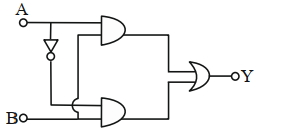
The truth table for this gvien circuit is:
To get the maximum flight, a ball must be thrown as
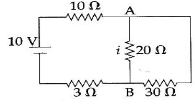
In the electrical circuit shown in the figure, the current $i$ through the side $AB$ is
A car, starting from rest, accelerates at the rate $f$ through a distance $S$, then continues at constant speed for time $t$ and then decelerates at the rate $\frac{f}{2}$ to come to rest. If the total distance traversed is $15S$, then
A spaceship of mass $2 \times 10^4\,kg$ is launched into a circular orbit close to the earth surface. The additional velocity to be imparted to the spaceship in the orbit to overcome the gravitational pull will be $......$ (if $g =10\,m / s ^2$ and radius of earth $=6400\,km$ )
A ball is thrown from the location $\left(x_0, y_0\right)=(0,0)$ of a horizontal playground with an initial speed $v_0$ at an angle $\theta_0$ from the $+x$-direction. The ball is to be hit by a stone, which is thrown at the same time from the location $\left(x_1, y_1\right)=(L, 0)$. The stone is thrown at an angle $\left(180-\theta_1\right)$ from the $+x$-direction with a suitable initial speed. For a fixed $v_0$, when $\left(\theta_0, \theta_1\right)=\left(45^{\circ}, 45^{\circ}\right)$, the stone hits the ball after time $T_1$, and when $\left(\theta_0, \theta_1\right)=\left(60^{\circ}, 30^{\circ}\right)$, it hits the ball after time $T_2$. In such a case, $\left(T_1 / T_2\right)^2$ is. . . . .
The total number of $\alpha$ and $\beta$ particles emitted in the nuclear reaction ${ }_{92}^{238} \mathrm{U} \rightarrow{ }_{82}^{214} \mathrm{~Pb}$ is
Consider a thin uniform square sheet made of a rigid material. If its side is $‘a’$ mass $m$ and moment of inertia $I$ about one of its diagonals, then
For $100\%$ modulation $(AM)$, the useful part of the total power radiated is
A sample contains $10^{-2}\, kg$ each of two substances A and $B$ with half lives $4 \,s$ and $8 \,s$ respectively. The ratio of then atomic weights is $1: 2$ The ratio of the amounts of $A$ and $B$ after $16 \,s$ is $\frac{x}{100}$. the value of $x$ is........