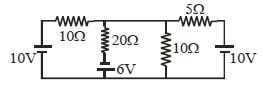
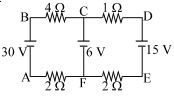
The value of current through $20\,\Omega $ resistor is .................. $A$
Medium
Download our app for free and get started
Let the potential of common point is $\mathrm{O}$ and potential of all other points are as shown in figure
$\frac{x-10}{10}+\frac{x+6}{20}+\frac{x}{10}+\frac{x-10}{5}=0$
$\Rightarrow \mathrm{x}=6 \mathrm{\,V} \quad \therefore 1_{20\, \Omega}=\frac{6+6}{20}=0.6 \mathrm{\,A}$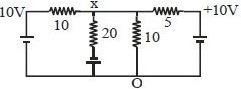

Download our appand get started for free
Experience the future of education. Simply download our apps or reach out to us for more information. Let's shape the future of learning together!No signup needed.*
Similar Questions
- 1Which of the following graph represents the variation of resistivity ( $\rho$ ) with temperature $(T)$ for copper $?$View Solution
- 2View SolutionIn potentiometer a balance point is obtained, when
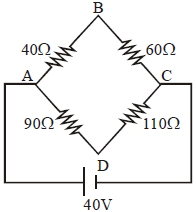
- 3Four resistances $40 \ \Omega, 60\ \Omega, 90\ \Omega$ and $110\ \Omega$ make the arms of a quadrilateral $A,B,C,D$. Across $AC$ is a battery of emf $40\, V$ and internal resistance negligible. The potential difference across $BD$ is $V$ is......View Solution
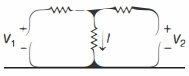
- 4Two batteries $V_1$ and $V_2$ are connected to three resistors as shown below. If $V_1=2 \,V$ and $V_2=0 \,V$, then the current $I=3 \,mA$. If $V_1=0 \,V$ and $V_2=4 \,V$, then the current $I=4 \,mA$. Now, if $V_1=10 \,V$ and $V_2=10 \,V$, then the current $I$ will be ............ $\,mA$View Solution
- 5In hydrogen atom, the electron makes $6.6 \times {10^{15}}$ revolutions per second around the nucleus in an orbit of radius $0.5 \times {10^{ - 10}}\,m$. It is equivalent to a current nearlyView Solution
- 6$n$ identical bulbs, each designed to draw a power $p$ from a certain voltage supply, are joined in series across that supply. The total power which they will draw isView Solution
- 7View SolutionThe figure shows a network of four resistances and three batteries Choose the correct alternative
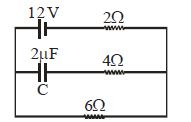
- 8Find the maximum charge on the capacitor $C$ in the following circuit ............ $\mu C$View Solution
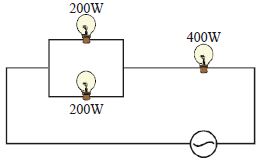
- 9Three electric bulbs of $200\,W,\,\,200\,W$ and $400\,W$ are shown in figure. The resultant power of the combination is ................ $W$View Solution
- 10A resistance wire connected in the left gap of a meter bridge balances a $10\, \Omega$ resistance in the right gap at a point which divides the bridge wire in the ratio $3: 2 .$ If the length of the resistance wire is $1.5 m ,$ then the length of $1\, \Omega$ of the resistance wire is $....... \times 10^{-2}\;m$View Solution