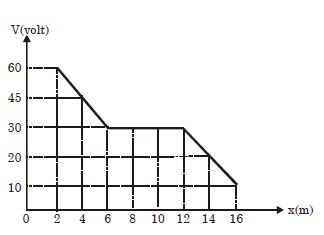
The variation of potential with distance $x$ from a fixed point is as shown in figure. The electric field at $x =13\,m$ is......$volt/meter$
Medium


Download our appand get started for free
Experience the future of education. Simply download our apps or reach out to us for more information. Let's shape the future of learning together!No signup needed.*
Similar Questions
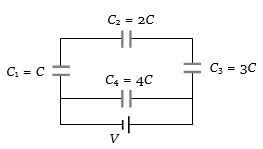
- 1A network of four capacitors of capacity equal to $C_1 = C, C_2 = 2C, C_3 = 3C$ and $C_4 = 4C$ are conducted in a battery as shown in the figure. The ratio of the charges on $C_2$ and $C_4$ isView Solution
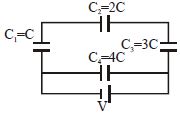
- 2A network of four capacitors of capacity equal to ${C_1} = C,\,\,{C_2} = 2C,\,{C_3} = 3C$ and ${C_4} = 4C$ are conducted in a battery as shown in the figure. The ratio of the charges on ${C_2}$ and ${C_4}$ isView Solution
- 3View SolutionA parallel plate air capacitor is charged and then isolated. When a dielectric material is inserted between the plates of the capacitor, then which of the following does not change
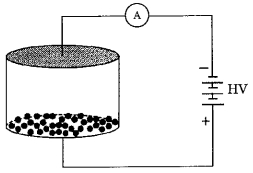
- 4Consider an evacuated cylindrical chamber of height $h$ having rigid conducting plates at the ends and an insulating curved surface as shown in the figure. A number of spherical balls made of a light weight and soft material and coated with a conducting material are placed on the bottom plate. The balls have a radius $r \ll h$. Now a high voltage source ($HV$) is connected across the conducting plates such that the bottom plate is at $+V_0$ and the top plate at $-V_0$. Due to their conducting surface, the balls will get charged, will become equipotential with the plate and are repelled by it. The balls will eventually collide with the top plate, where the coefficient of restitution can be taken to be zero due to the soft nature of the material of the balls. The electric field in the chamber can be considered to be that of a parallel plate capacitor. Assume that there are no collisions between the balls and the interaction between them is negligible. (Ignore gravity)View Solution
(image)
($1$) Which one of the following statements is correct?
($A$) The balls will stick to the top plate and remain there
($B$) The balls will bounce back to the bottom plate carrying the same charge they went up with
($C$) The balls will bounce back to the bottom plate carrying the opposite charge they went up with
($D$) The balls will execute simple harmonic motion between the two plates
($2$) The average current in the steady state registered by the ammeter in the circuit will be
($A$) zero
($B$) proportional to the potential $V_0$
($C$) proportional to $V_0^{1 / 2}$
($D$) proportional to $V_0^2$
Give the answer quetion ($1$) and ($2$)
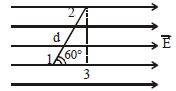
- 5The electric field $\vec E$ between two points is constant in both magnitude and direction. Consider a path of length d at an angle $\theta = 60^o$ with respect to field lines shown in figure. The potential difference between points $1$ and $2$ isView Solution
- 6If the dielectric constant and dielectric strength be denoted by $k$ and $x$ respectively, then a material suitable for use as a dielectric in a capacitor must haveView Solution
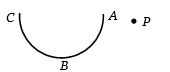
- 7In the following diagram the work done in moving a point charge from point $P$ to point $A$, $B$ and $C$ is respectively as $W_A$, $W_B$ and $W_C$ , thenView Solution
- 8The electrostatic potential inside a charged spherical ball is given by : $V = b -ar^2$, where $r$ is the distance from the centre ; $a$ and $b$ are constants. Then, the charge density inside the ball is :View Solution
- 9The diameter of each plate of an air capacitor is $4\,cm$. To make the capacity of this plate capacitor equal to that of $20\,cm$ diameter sphere, the distance between the plates will beView Solution
- 10The figure shows a family of parallel equipotential surfaces and four paths along which an electron is made to move from one surface to another as shown in the figurView Solution
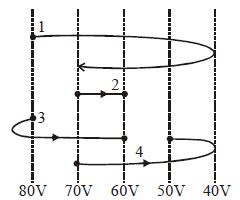
$(I)$ What is the direction of the electric field ?
$(II)$ Rank the paths according to magnitude of work done, greatest first