The diameter of each plate of an air capacitor is $4\,cm$. To make the capacity of this plate capacitor equal to that of $20\,cm$ diameter sphere, the distance between the plates will be
Medium
Download our app for free and get started
(b) Capacity of spherical conductor of $20\, cm$ diameter ${C_1} = 4\pi {\varepsilon _0}r = 4\pi {\varepsilon _0} \times 10$
Capacity of parallel plate air capacitor
${C_2} = \frac{{{\varepsilon _0}A}}{d} = \frac{{{\varepsilon _0}[\pi {{(2)}^2}]}}{d} = \frac{{{\varepsilon _0} \times 4\pi }}{d}$
Hence ${C_1} = {C_2}$ $==>$ $40\pi {\varepsilon _0} = \frac{{4\pi {\varepsilon _0}}}{d}$ $==>$ $d = {10^{ - 3}}\,m$
Capacity of parallel plate air capacitor
${C_2} = \frac{{{\varepsilon _0}A}}{d} = \frac{{{\varepsilon _0}[\pi {{(2)}^2}]}}{d} = \frac{{{\varepsilon _0} \times 4\pi }}{d}$
Hence ${C_1} = {C_2}$ $==>$ $40\pi {\varepsilon _0} = \frac{{4\pi {\varepsilon _0}}}{d}$ $==>$ $d = {10^{ - 3}}\,m$

Download our appand get started for free
Experience the future of education. Simply download our apps or reach out to us for more information. Let's shape the future of learning together!No signup needed.*
Similar Questions
- 1A uniformly charged solid sphere of radius $R$ has potential $V_0$ (measured with respect to $\infty$) on its surface. For this sphere the equipotential surfaces with potentials $\frac{{3{V_0}}}{2},\;\frac{{5{V_0}}}{4},\;\frac{{3{V_0}}}{4}$ and $\frac{{{V_0}}}{4}$ have rasius $R_1,R_2,R_3$ and $R_4$ respectively. ThenView Solution
- 2The area of each plate of a parallel plate capacitor is $20\,cm^2$ and separation between the plates is $2\,mm$. If dielectric strength of air is $3 \times 10^6\,V/m,$ the maximum possible value of emf of the battery, which can be connected across the plates of this capacitor and the corresponding charge on the plates isView Solution
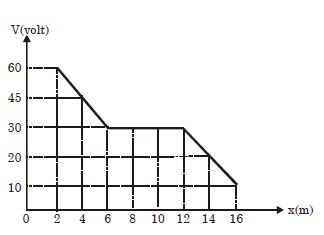
- 3The variation of potential with distance $x$ from a fixed point is as shown in figure. The electric field at $x =13\,m$ is......$volt/meter$View Solution
- 4An electron with kinetic energy $K _{1}$ enters between parallel plates of a capacitor at an angle $'\alpha'$ with the plates. It leaves the plates at angle $' \beta '$ with kinetic energy $K _{2}$. Then the ratio of kinetic energies $K _{1}: K _{2}$ will be ....... .View Solution
- 5An electric dipole of moment $\vec p$ is lying along a uniform electric field $\vec E.$ The work done in rotating the dipole by $90^o $ isView Solution
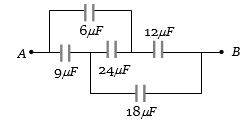
- 6In the connections shown in the adjoining figure, the equivalent capacity between $A$ and $B$ will be......$\mu F$View Solution
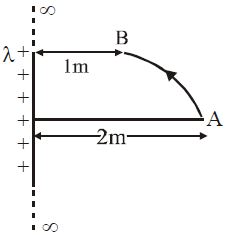
- 7Figure shows a positively charged infinite wire. $A$ particle of charge $2C$ moves from point $A$ to $B$ with constant speed. (Given linear charge density on wire is $\lambda = 4 \pi \varepsilon_0$)View Solution
- 8A spherical conductor of radius $2m$ is charged to a potential of $120\, V$. It is now placed inside another hollow spherical conductor of radius $6m$. Calculate the potential to which the bigger sphere would be raised......$V$View Solution
- 9A charge of $10 \,\mu C$ is placed at the origin of $x-y$ coordinate system. The potential difference between two points $(0, a)$ and $(a, 0)$ in volt will beView Solution
- 10An uncharged parallel plate capacitor having a dielectric of constant $K$ is connected to a similar air cored parallel capacitor charged to a potential $V$. The two capacitors share charges and the common potential is $V$. The dielectric constant $K$ isView Solution