MCQ
The velocity of simple pendulum is maximum at
  • A
    Extremes
  • B
    Half displacement
  • Mean position
  • D
    Every where

Answer

Correct option: C.
Mean position
c
(c) The velocity of bob is zero at extreme position whereas

The velocity of bob is maximum at mean position

$K E=\frac{1}{2} m v^{2}$

So $K E$ is maximum at mean position because velocity is maximum at mean position

Need a full question paper?

Generate a complete, print-ready paper with questions like this in minutes — across 16+ boards, with answer keys.
Start Generating Free

Similar questions

A circular disc $X$ of radius $R$ is made from an iron plate of thickness $t,$ and another plate $Y$ of radius $4R$ is made from an iron plate of thickness $\frac{\text{t}}{4}$ The ratio between moment of inertia $\frac{\text{I}_{\text{y}}}{\text{I}_{\text{x}}}$ is:
For a surface molecule:
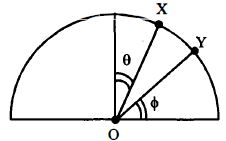
A particle is released on a vertical smooth semicircular track from point $X$ so that $OX$ makes angle $\theta $ from the vertical ( see figure). The normal reaction of the track on the particle vanishes at point $Y$ where $OY$ makes angle $\phi $ with the horizontal. Then
A resonance air column of length $20 cm$ resonates with a tuning fork of frequency $250 Hz$. The speed of sound in air is .... $m/s$
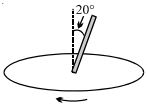
$A$ uniform rod is fixed to a rotating turntable so that its lower end is on the axis of the turntable and it makes an angle of $20^o$ to the vertical. (The rod is thus rotating with uniform angular velocity about a vertical axis passing through one end.) If the turntable is rotating clockwise as seen from above. Is there a torque acting on it, and if so in what direction?
The speed of sound in oxygen $\left( O _{2}\right)$ at a certain temperature is $460 \;ms ^{-1}$. The speed of sound in helium $(He)$ at the same temperature will be (asume both gases to be ideal)
A wire is suspended from the ceiling and stretched under the action of a weight F suspended from its other end. The force exerted by the ceiling on it is equal and opposite to the weight.
  1. Tensile stress at any cross section $A$ of the wire is $F/ A.$
  2. Tensile stress at any cross section is zero.
  3. Tensile stress at any cross section $A$ of the wire is $2F/ A.$
  4. Tension at any cross section $A$ of the wire is $F.$
A body executing simple harmonic motion has a maximum acceleration equal to $ 24\,metres/se{c^2} $ and maximum velocity equal to $ 16\;metres/sec $. The amplitude of the simple harmonic motion is
A projectile crosses two walls of equal height $H$ symmetrically as shown The angle of projection of the projectile is
A gaseous mixture consists of $16g$ of helium and $16g$ of oxygen. The ratio $\text{CP/ CV}$ of the mixture is: