MCQ
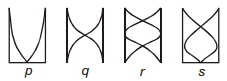
The vibrations of four air columns under identical conditions are represented in the figure below. The ratio of frequencies $n_p: n_q: n_r: n_s$ will be
  • A
    $12: 6: 3: 4$
  • $1: 2: 4: 3$
  • C
    $4: 2: 3: 1$
  • D
    $6: 2: 3: 4$

Answer

Correct option: B.
$1: 2: 4: 3$
b
(b)

$P, S$, will be $1^{\text {st }}$ and $2^{\text {nd }}$ harmonics of closed tube.

$P=\frac{v}{4 l}, S=\frac{v}{4 l}$

$Q, R$ are the $1^{\text {st }}$ and $2^{\text {nd }}$ harmonics of open pipe.

$Q=\frac{v}{2 l}, R=\frac{v}{l}$

$\therefore P: Q: R: S=1: 2: 4: 3$

Need a full question paper?

Generate a complete, print-ready paper with questions like this in minutes — across 16+ boards, with answer keys.
Start Generating Free

Similar questions

An earth satellite $X$ is revolving around earth in an orbit whose radius is one-fourth of the radius of orbit of a communication satellite. Time period of revolution of $X$ is ..........
Which of the following law states that “good absorbers of heat are good emitters”
The power of sound from the speaker of a radio is $20$ milli watt by turning the knob of the  volume control the power of the sound is increased to $400$ milli watt. The power  increase in decibles as compared to the original power is ..... $dB$
A bar of iron is $10\ cm$ at $20^\circ C.$ At $19^\circ C,$ it will be: $(\alpha$ of iron $=11\times10^{-6}\ ^\circ\text{C})$
A stone of mass $0.25\; kg$ tied to the end of a string is whirled round in a circle of radius $1.5 \;m$ with a speed of $40\; rev./min$ in a hortzontal plane. What is the tenston in the string? What is the maximum speed in $m/s $ with which the stone can be whirled around if the string can withstand a maximum tension of $200\; N ?$
If $R$ and $H$ represent the horizontal range and the maximum height achieved by a projectile then which of the relation exists?
If $\rho $ is the density of the material of a wire and $\sigma  $ is breaking stress, the greatest length of the wire that can hang freely without breaking is
A particle of mass $m$ at rest is acted upon by a force $F$ for a time $t$. Its Kinetic energy after an interval $t$ is
A force $F$ acting on an object varies with distance $x$ as shown in the figure. The work done by the force in moving the object from $x = 0$ and $x = 20m$ is:
A heavy object has $.......$ gravitational potential energy than a lighter one.