A uniform square plate S(side c) and a uniform rectangular plate R(sides b, a) have identical areas and masses: 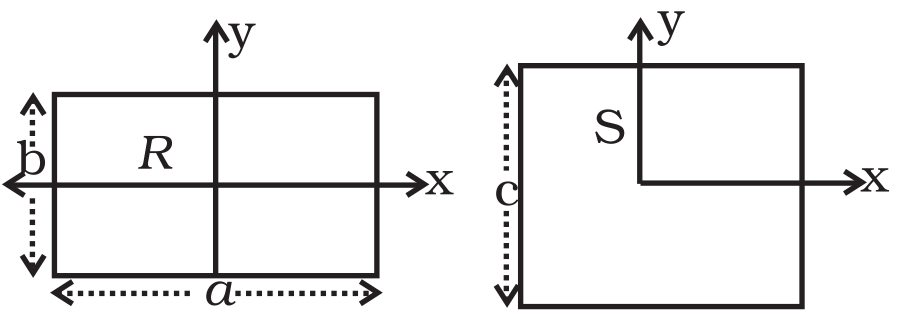
Show that:
Show that:
- $\frac{\text{I}_\text{xR}}{\text{I}_\text{xS}}<1$
- $\frac{\text{I}_\text{ys}}{\text{I}_\text{ys}}>1$
- $\frac{\text{I}_{2\text{R}}}{\text{I}_{2\text{s}}}>1$
Download our app for free and get started
According to the problem, Area of square = Area of rectangular plate $\Rightarrow c^2 = a \times b \Rightarrow c^2 = ab$
$\Rightarrow\ \frac{\text{I}_\text{XR}}{\text{I}_\text{XS}}=\Big(\frac{\text{b}}{\text{c}}\Big)^2<1$
$\Rightarrow{\text{I}_\text{XR}}<{\text{I}_\text{XS}}$
Now, $\text{I}_\text{zR}-\text{I}_\text{zS}=\frac{1}{12}\text{M}\big[\text{a}^2+\text{b}^2-2\text{c}^2\big]$
$\Rightarrow\ \text{I}_\text{zR}-\text{I}_\text{zS}=\frac{1}{12}\text{M}\big(\text{a}^2+\text{b}^2-2\text{ab}\big)$
$\Rightarrow\ \text{I}_\text{zR}-\text{I}_\text{zS}=\frac{1}{12}\text{M}\big(\text{a}-\text{b}\big)^2>0$
$\Rightarrow\ \frac{\text{I}_\text{zR}}{\text{I}_\text{zS}}>1$
- $\frac{\text{I}_\text{XR}}{\text{I}_\text{XS}}=\frac{\text{b}^2}{\text{c}^2}$
$\Rightarrow\ \frac{\text{I}_\text{XR}}{\text{I}_\text{XS}}=\Big(\frac{\text{b}}{\text{c}}\Big)^2<1$
$\Rightarrow{\text{I}_\text{XR}}<{\text{I}_\text{XS}}$
- $\frac{\text{I}_\text{YR}}{\text{I}_\text{RS}}=\frac{\text{a}^2}{\text{c}^2}$ (It is clear that a > c)
- $\text{I}_\text{zR}=\frac{1}{12}\text{M}(\text{a}^2+\text{b}^2)$
Now, $\text{I}_\text{zR}-\text{I}_\text{zS}=\frac{1}{12}\text{M}\big[\text{a}^2+\text{b}^2-2\text{c}^2\big]$
$\Rightarrow\ \text{I}_\text{zR}-\text{I}_\text{zS}=\frac{1}{12}\text{M}\big(\text{a}^2+\text{b}^2-2\text{ab}\big)$
$\Rightarrow\ \text{I}_\text{zR}-\text{I}_\text{zS}=\frac{1}{12}\text{M}\big(\text{a}-\text{b}\big)^2>0$
$\Rightarrow\ \frac{\text{I}_\text{zR}}{\text{I}_\text{zS}}>1$

Download our appand get started for free
Experience the future of education. Simply download our apps or reach out to us for more information. Let's shape the future of learning together!No signup needed.*
Similar Questions
- 1View SolutionExplain why friction is necessary to make the disc in roll in the direction indicated.
- Give the direction of frictional force at B, and the sense of frictional torque, before perfect rolling begins.
- What is the force of friction after perfect rolling begins?
- 2A meter stick held vertically, with one end on the ground, is then allowed to fall. What is the value of the radial and tangential acceleration of the top end of the stick when the stick has turned through on angle $\theta?$ What is the speed with which the top end of the stick hits the ground? Assume that the end of the stick in. contact with the ground does not slip.View Solution
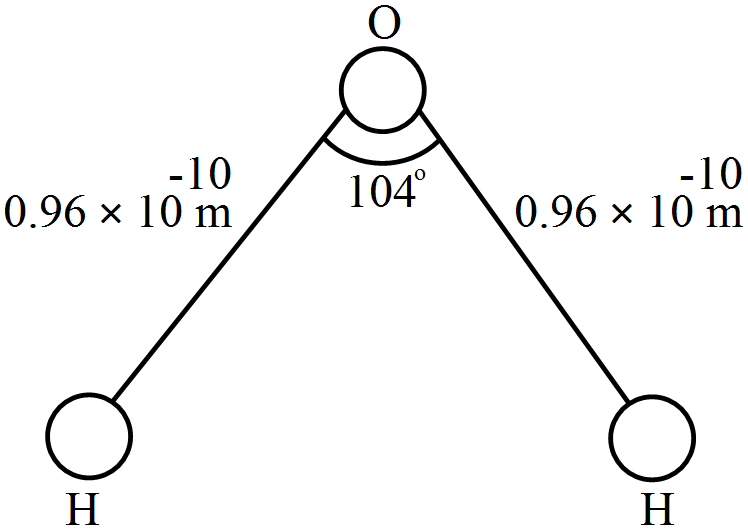
- 3View SolutionThe structure of a water molecule is shown in figure. Find the distance of the centre of mass of the molecule from the centre of the oxygen atom.
- 4Separation of Motion of a system of particles into motion of the centre of mass and motion about the centre of mass: Show $\text{K}=\text{K}'+\frac{1}{2}\text{M}\text{V}^2$ where K' is the total kinetic energy of the system of particles, K′ is the total kinetic energy of the system when the particle velocities are taken with respect to the centre of mass and $\frac{\text{MV}^2}{2}$ is the kinetic energy of the translation of the system as a whole (i.e. of the centre of mass motion of the system). The result has been used in $\sec7.14$View Solution
- 5Separation of Motion of a system of particles into motion of the centre of mass and motion about the centre of mass: Show $\text{K}=\text{K}'+\frac{1}{2}\text{M}\text{V}^2$ where K' is the total kinetic energy of the system of particles, K′ is the total kinetic energy of the system when the particle velocities are taken with respect to the centre of mass and $\frac{\text{MV}^2}{2}$ is the kinetic energy of the translation of the system as a whole (i.e. of the centre of mass motion of the system). The result has been used in $\sec7.14$View Solution
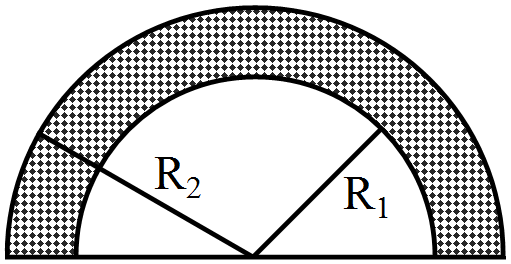
- 6Find the centre of mass of a uniform plate having semicircular inner and outer boundaries of radii $R_1$ and $R_2$.View Solution
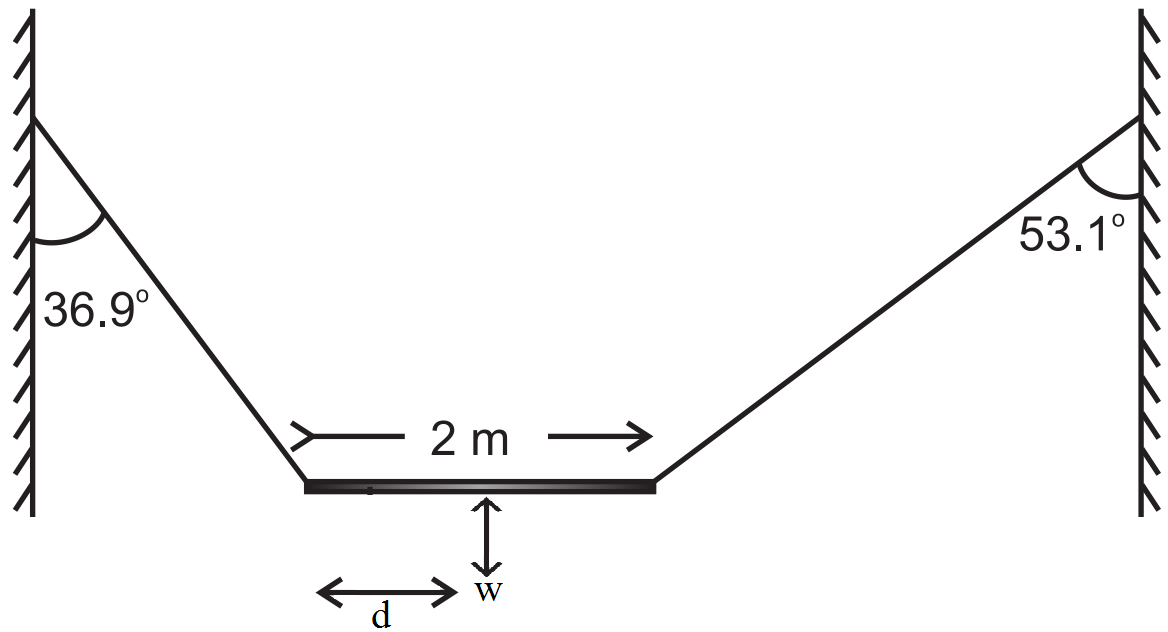
- 7A non-uniform bar of weight W is suspended at rest by two strings of negligible weight as shown in. The angles made by the strings with the vertical are $36.9°$ and $53.1°$ respectively. The bar is $2m$ long. Calculate the distance d of the centre of gravity of the bar from its left end.View Solution
- 8Prove that the velocity v of translation of a rolling body (like a ring, disc, cylinder or sphere) at the bottom of an inclined plane of height h is given by:$\text{v}^2=\frac{2\text{gh}}{\big(1+\frac{\text{K}^2}{\text{R}^2}\big)}$View Solution
Note K is the radius of gyration of the body about its symmetry axis, and R is the radius of the body. The body starts from rest at the top of the plane. - 9View SolutionA uniform rod of length L lies on a smooth horizontal table. A particle moving on the table strikes the rod perpendicularly at an end and stops. Find the distance travelled by the centre of the rod by the time it turns through a right angle. Show that if the mass of the rod is four times that of the particle, the collision is elastic.
- 10A uniform sphere of mass m and radius R is placed on a rough horizontal surface. The sphere is struck horizontally at a height h from the floor. Match the following:View Solution
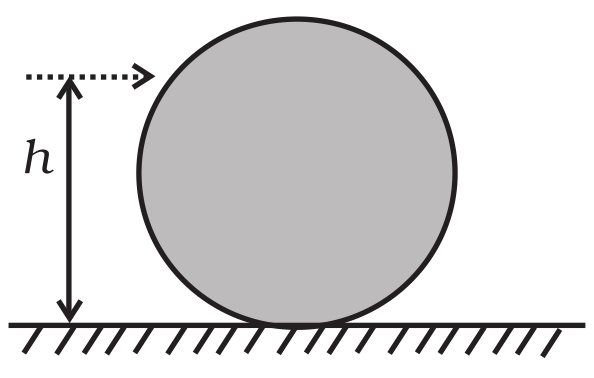
a. $\text{h}=\frac{\text{R}}{2}$ i. Sphere rolls without slipping with a constant velocity and no loss of energy. b. $\text{h}=\text{R}$ ii. Sphere spins clockwise, loses energy by friction. c. $\text{h}=\frac{3\text{R}}{2}$ iii. Sphere spins anti-clockwise, loses energy by friction. d. $\text{h}=\frac{7\text{R}}{5}$ iv. Sphere has only a translational motion, looses energy by friction.