Thirteen resistances each of resistance $R\, ohm$ are connected in the circuit as shown in the figure below. The effective resistance between $A$ and $B$ is
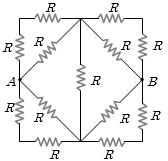
Diffcult

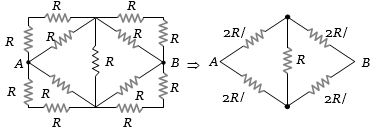

Download our appand get started for free
Experience the future of education. Simply download our apps or reach out to us for more information. Let's shape the future of learning together!No signup needed.*
Similar Questions
- 1Wheatstone bridge principle is used to measure the specific resistance $\left(S_1\right)$ of given wire, having length $L$, radius $r$. If $X$ is the resistance of wire, then specific resistance is: $S_1=X\left(\frac{\pi r^2}{L}\right)$. If the length of the wire gets doubled then the value of specific resistance will be :View Solution
- 2A wire of resistance $R$ is divided in $10$ equal parts. These parts are connected in parallel, the equivalent resistance of such connection will beView Solution
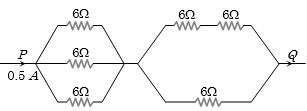
- 3Resistances of $6\, ohm$ each are connected in the manner shown in adjoining figure. With the current $0.5\,ampere$ as shown in figure, the potential difference ${V_P} - {V_Q}$ is .............. $V$View Solution
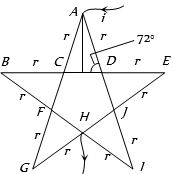
- 4In the following star circuit diagram (figure), the equivalent resistance between the points $A$ and $H$ will be ..............$r$View Solution
- 5Two resistances $r_1$ and $r_2\left(r_1 < r_2\right)$ are joined in parallel. The equivalent resistance $R$ is such thatView Solution
- 6A material '$B$' has twice the specific resistance of '$A$'. A circular wire made of '$B$' has twice the diameter ofa wire made of '$A$'. then for the two wires to have the same resistance, the ratio $\frac{{{l_B}}}{{{l_A}}}$ of their respective lengths must beView Solution
- 7View SolutionCorrect set up to verify Ohm's law is
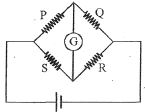
- 8Resistances are arranged in a cyclic order to form a balanced wheatstone bridge as shown in figure. Ratio of power consumed in the branches $P + Q$ and $R + S$ isView Solution
- 9View SolutionThe maximum current that flows through a fuse wire before it blows out varies with its radius as
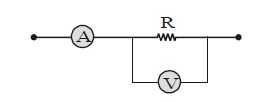
- 10In the circuit shown the readings of ammeter and voltmeter are $4\,\, A$ and $20\,\, V$ respectively. The meters are non ideal, then $R$ isView Solution