A uniform rope lies on a horizontal table so that a part of it hangs over the edge. The rope begins to slide down when the length of the hanging part is $25\%$ of the entire length. The coefficient of friction between the rope and the table is
Medium


Download our appand get started for free
Experience the future of education. Simply download our apps or reach out to us for more information. Let's shape the future of learning together!No signup needed.*
Similar Questions
- 1The upper half of an inclined plane of inclination $\theta$ is perfectly smooth while lower half is rough. A block starting from rest at the top of the plane will again come to rest at the bottom, if the coefficient of friction between the block and lower half of the plane is given byView Solution
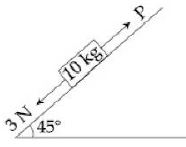
- 2A block of mass $10\, kg$ is kept on a rough inclined plane as shown in the figure. A force of $3\, N$ is applied on the block. The coefficient of static friction between the plane and the block is $0.6$. What should be the minimum value of force $P$, such that the block does not move downward? (take $g = 10\, ms^{-2}$) ........ $N$View Solution
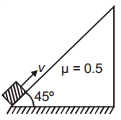
- 3A block of mass $1 \,kg$ is projected from the lowest point up along the inclined plane. If $g=10 \,ms ^{-2}$, the retardation experienced by the block is ............. $ms ^ {-2}$View Solution
- 4A uniform wooden stick of mass $1.6 \mathrm{~kg}$ and length $l$ rests in an inclined manner on a smooth, vertical wall of height $h( < l)$ such that a small portion of the stick extends beyond the wall. The reaction force of the wall on the stick is perpendicular to the stick. The stick makes an angle of $30^{\circ}$ with the wall and the bottom of the stick is on a rough focr. The reaction of the wall on the stick is equal in magnitude to the reaction of the floor on the st $ck$. The ratio $h / l$ and the frictional force $f$ at the bottom of the stick are $\left(g=10 \mathrm{~m} \mathrm{~s}^{-2}\right)$View Solution
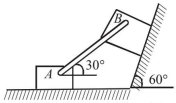
- 5In figure, two blocks are separated by a uniform strut attached to each block with frictionless pins. Block $A$ weighs $400\,N$, block $B$ weighs $300\,N$, and the strut $A B$ weigh $200\,N$. If $\mu=0.25$ under $B$, determine the minimum coefficient of friction under $A$ to prevent motion.View Solution
- 6A child weighing $25$ kg slides down a rope hanging from the branch of a tall tree. If the force of friction acting against him is $2\, N$, ........ $m/s^2$ is the acceleration of the child (Take $g = 9.8\,m/{s^2})$View Solution
- 7The maximum speed of a car on a road-turn of radius $30\, m$, if the coefficient of friction between the tyres and the road is $0.4$, will be .......... $m/sec$View Solution
- 8$A$ block of mass $M$ is placed on $a$ horizontal surface and it is tied with an inextensible string to $a$ block of mass, as shown in figure. A block of mass $m_0$ is also placed on $M$ The minimum value of $\mu$ between the block $M$ and $m_0$ (taking horizontal surface frictionless) for which all the three blocks move together, isView Solution

- 9View SolutionWhich one of the following statements is incorrect?
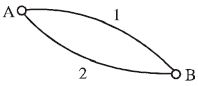
- 10A small body slips, subject to the force of friction, from point $A$ to point $B$ along two curved surfaces of equal radius, first along route $1,$ then along route $2$. Friction does not depend on the speed and the coefficient of friction on both routes is the same. In which case will the body’s speed at $B$ be greater?View Solution