MCQ
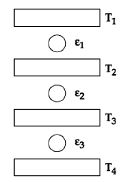
Three Carnot engines operate in series between a heat source at a temperature $T_1$ and a heat sink at temperature $T_4$ (see figure). There are two other reservoirs at temperature $T_2$ and $T_3$, as shown, with $T_1 > T_2 > T_3 > T_4$. The three engines are equally efficient if
  • A
    ${T_2} = {\left( {{T_1}{T_4}} \right)^{1/2}};\,{T_3} = {\left( {T_1^2{T_4}} \right)^{1/3}}$
  • ${T_2} = {\left( {T_1^2{T_4}} \right)^{1/3}};\,{T_3} = {\left( {{T_1}T_4^2} \right)^{1/3}}$
  • C
    ${T_2} = {\left( {{T_1}T_4^2} \right)^{1/3}};\,{T_3} = {\left( {T_1^2{T_4}} \right)^{1/3}}$
  • D
    ${T_2} = {\left( {T_1^3{T_4}} \right)^{1/4}};\,{T_3} = {\left( {{T_1}T_4^3} \right)^{1/4}}$
Answer

Correct option: B.
${T_2} = {\left( {T_1^2{T_4}} \right)^{1/3}};\,{T_3} = {\left( {{T_1}T_4^2} \right)^{1/3}}$
b
$n_{1}=n_{2}=n_{3}$

$\Rightarrow \quad 1-\frac{T_{2}}{T_{1}}=1-\frac{T_{3}}{T_{2}}=1-\frac{T_{4}}{T_{3}}$

$\Rightarrow \quad \frac{T_{2}}{T_{1}}=\frac{T_{3}}{T_{2}}=\frac{T_{4}}{T_{3}}$

$\Rightarrow \quad \mathrm{T}_{2} \mathrm{T}_{3}=\mathrm{T}_{1} \mathrm{T}_{4}$ and $\frac{\mathrm{T}_{3}^{2}}{\mathrm{T}_{2}}=\mathrm{T}_{4}$

Solve for $\mathrm{T}_{2}$ and $\mathrm{T}_{3}$

Need a full question paper?

Generate a complete, print-ready paper with questions like this in minutes — across 16+ boards, with answer keys.

Start Generating Free

Similar questions

If the temperature increases, then what happens to the frequency of the sound produced by the organ pipe
One end of a copper rod of length $1.0\;m$ and area of cross-section ${10^{ - 3}}$ is immersed in boiling water and the other end in ice. If the coefficient of thermal conductivity of copper is $92\;cal/m{\rm{ - }}s{{\rm{ - }}^o}C$ and the latent heat of ice is $8 \times {10^4}cal/kg$, then the amount of ice which will melt in one minute is
For a particle executing $\text{SHM}$ along $x-$axis force is given by:
If two liquids of same masses but densities ${\rho _1}$ and ${\rho _2}$ respectively are mixed, then density of mixture is given by
A rocket is launched normal to the surface of earth, away from the Sun, along the line joining the Sun and the Earth. The Sun is $3 \times 10^5$ times heavier than the Earth and is at a distance $2.5 \times 10^4$ times larger than the radius of the Earth. The escape velocity from Earth's gravitational field is $\mathrm{ve}_{\mathrm{e}}=11.2 \mathrm{~km} \mathrm{~s} \mathrm{~s}^{-1}$. The minimum initial $\left(\mathrm{v}_{\mathrm{s}}\right)$ required for the rocket to be able to leave the Sun-earth system is closest to

(Ignore the rotation and revolution of the Earth and the presence of any other planet)

The heat capacity of a body depends on:
  1. The heat given.
  2. The temperature raised.
  3. The mass of the body.
  4. The material of the body.
A block of mass $10\, kg$ is placed on a rough horizontal surface having coefficient of friction $\,\mu  = 0.5$. If a horizontal force of $100\, N$ is acting on it, then acceleration of the block will be ....... $m/s^2$
Consider the situation of the previous problem. Let the water push the left wall by a force $F_1$ and the right wall by a force $F_2$
A stick of length $L$ and mass $M$ lies on a frictionless horizontal surface on which it is free to move in any ways. A ball of mass $m$ moving with speed $v$ collides elastically with the stick as shown in the figure. If after the collision the ball comes to rest, then what should be the mass of the ball ?
In simple harmonic motion :