Two metal spheres of capacitance ${C_1}$ and ${C_2}$ carry some charges. They are put in contact and then separated. The final charges ${Q_1}$ and ${Q_2}$ on them will satisfy
Easy


Download our appand get started for free
Experience the future of education. Simply download our apps or reach out to us for more information. Let's shape the future of learning together!No signup needed.*
Similar Questions
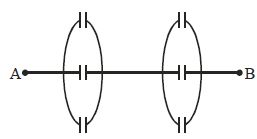
- 1All the six capacitors shown in the circuit are identical. Each can withstand maximum $200\, volt$ between its terminals. The maximum voltage that can be applied safely between $A$ and $B$ is.....$V$View Solution
- 2In Millikan's oil drop experiment an oil drop carrying a charge $Q$ is held stationary by a potential difference $2400\,V$ between the plates. To keep a drop of half the radius stationary the potential difference had to be made $600\,V$. What is the charge on the second dropView Solution
- 3View SolutionTwo identical conductors of copper and aluminium are placed in an identical electric fields. The magnitude of induced charge in the aluminium will be
- 4An electric charge ${10^{ - 3}}\,\mu \,C$ is placed at the origin $(0, 0)$ of $X -Y$ co-ordinate system. Two points $A$ and $B$ are situated at $\left( {\sqrt {2\,} \,,\,\,\sqrt 2 } \right)$ and $(2, 0)$ respectively. The potential difference between the points $A$ and $B$ will be......$volt$View Solution
- 5A capacitor of capacitance $6\,\mu \,F$ is charged upto $100$ $volt$. The energy stored in the capacitor is........$Joule$View Solution
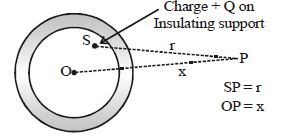
- 6The adjacent diagram shows a charge $+Q$ held on an insulating support $S$ and enclosed by a hollow spherical conductor. $O$ represents the centre of the spherical conductor. and $P$ is a point such that $OP = x $ and $SP = r$ . The electric field at point $P$ will beView Solution
- 7Seven capacitors, each of the capacitance $2\,\mu F$, are to be connected in a configuration to obtain an effective capacitance of $\left( {\frac{6}{{13}}} \right)\,\mu F$. Which of the combinations, shown in figures below, will achieve the desired value ?View Solution
- 8An electric field $\vec E\, = (25 \hat i + 30 \hat j)\,NC^{-1}$ exists in a region of space. If the potential at the origin is taken to be zero then the potential at $x\, = 2\, m, y\, = 2\, m$ is......$volt$View Solution
- 9At a distance $l$ from a uniformly charged long wire, a charged particle is thrown radially outward with a velocity $u$ in the direction perpendicular to the wire. When the particle reaches a distance $2 l$ from the wire, its speed is found to be $\sqrt{2} u$. The magnitude of the velocity, when it is a distance $4 l$ away from the wire is (ignore gravity)View Solution
- 10A $5.0\, \mu F$ capacitor is charged to a potential difference $800\, V$ and discharged through a conductor. The energy(in $J$) given to a conductor during the discharge isView Solution