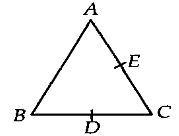
Three charges, each $+q,$ are placed at the comers of an isosceles triangle $ABC$ of sides $BC$ and $AC, 2a.$ $D$ and $E$ are the mid-points of $BC$ and $CA.$ The work done in taking a charge $Q$ from $D$ to $E$ is
AIPMT 2011, Medium
Download our app for free and get started
Here, $A C=B C=2 a$
$D$ and $E$ are the midpoints of $B C$ and $AC$.
$\therefore A E=E C=a$ and $B D=D C=a$
$\operatorname{In} \Delta A D C,(A D)^{2}=(A C)^{2}-(D C)^{2}$
$=(2 a)^{2}-(a)^{2}=4 a^{2}-a^{2}=3 a^{2}$
$A D=a \sqrt{3}$
Similarly, potential at point $D$ due to the given charge configuration is
$V_{D}=\frac{1}{4 \pi \varepsilon_{0}}\left[\frac{q}{B D}+\frac{q}{D C}+\frac{q}{A D}\right]$
$=\frac{q}{4 \pi \varepsilon_{0}}\left[\frac{1}{a}+\frac{1}{a}+\frac{1}{\sqrt{3} a}\right]=\frac{q}{4 \pi \varepsilon_{0} a}\left[2+\frac{1}{\sqrt{3}}\right].........(i)$
Potential at point $E$ due to the given charge configuration is $V_{E}=\frac{1}{4 \pi \varepsilon_{0}}\left[\frac{q}{A E}+\frac{q}{E C}+\frac{q}{B E}\right]$
$=\frac{q}{4 \pi \varepsilon_{0}}\left[\frac{1}{a}+\frac{1}{a}+\frac{1}{a \sqrt{3}}\right]=\frac{q}{4 \pi \varepsilon_{0} a}\left[2+\frac{1}{\sqrt{3}}\right].........(ii)$
From the $(i)$ and $(ii)$, it is clear that
$V_{D}=V_{E}$
The work done in taking a charge $Q$ from $D$ to $E$ is
$W = Q({V_E} - {V_D}) = O$ $(\because \,{V_D} = {V_E})$

Download our appand get started for free
Experience the future of education. Simply download our apps or reach out to us for more information. Let's shape the future of learning together!No signup needed.*
Similar Questions
- 1When a positive $q$ charge is taken from lower potential to a higher potential point, then its potential energy willView Solution
- 2A thin-walled, spherical conducting shell $S$ of radius $R$ is given charge $Q$. The same amount of charge is also placed at its centre $C. $ Which of the following statements are correct ?View Solution
- 3Find the potential difference $V_a -V_b$ between the points $a$ and $b$ shown in each part of the figure.View Solution
- 4$125$ identical drops each charged to the same potential of $50\;volts$ are combined to form a single drop. The potential of the new drop will be......$V$View Solution
- 5A capacitor is discharging through a resistor $R$. Consider in time $t _{1}$, the energy stored in the capacitor reduces to half of its initial value and in time $t_{2}$, the charge stored reduces to one eighth of its initial value. The ratio $t_{1} / t_{2}$ will be ................View Solution
- 6A $30\,\mu F$ capacitor is charged by a constant current of $30\, mA$. If the capacitor is initially uncharged, how long does it take for the potential difference to reach $400\, V$.....$s$View Solution
- 7Minimum number of $2\,\mu F$ and $250\, V$ capacitors used to make a combination of $12\,\mu F$ and $500\,V$ areView Solution
- 8A parallel plate capacitor has $1\,\mu F$ capacitance. One of its two plates is given $+2\,\mu C$ charge and the other plate, $+4\,\mu C$ charge. The potential difference developed across the capacitor is......$V$View Solution
- 9An oil drop having charge $2e$ is kept stationary between two parallel horizontal plates $2.0\, cm$ apart when a potential difference of $12000\, volts$ is applied between them. If the density of oil is $900 \,kg/m^3$, the radius of the drop will beView Solution
- 10Five capacitors together with their capacitances are shown in the adjoining figure. The potential difference between the points $A$ and $B$ is $60\, volt.$ The equivalent capacitance between the point $A$ and $B$ and charge on capacitor $5\,\mu F$ will be respectively :-View Solution