$125$ identical drops each charged to the same potential of $50\;volts$ are combined to form a single drop. The potential of the new drop will be......$V$
Medium


Download our appand get started for free
Experience the future of education. Simply download our apps or reach out to us for more information. Let's shape the future of learning together!No signup needed.*
Similar Questions
- 1Which one statement is correct ? A parallel plate air condenser is connected with a battery. Its charge, potential, electric field and energy are ${Q_o},\;{V_o},\;{E_o}$ and ${U_o}$ respectively. In order to fill the complete space between the plates a dielectric slab is inserted, the battery is still connected. Now the corresponding values $Q,\;V,\;E$ and $U$ are in relation with the initially stated asView Solution
- 2A parallel plate capacitor has plates of area $A$ separated by distance $d$ between them. It is filled with a dielectric which has a dielectric constant that varies as $\mathrm{k}(\mathrm{x})=\mathrm{K}(1+\alpha \mathrm{x})$ where $\mathrm{x}$ is the distance measured from one of the plates. If $(\alpha \text {d)}<<1,$ the total capacitance of the system is best given by the expressionView Solution
- 3Two parallel plates have equal and opposite charge. When the space between them is evacuated, the electric field between the plates is $2 \times {10^5}\,V/m$. When the space is filled with dielectric, the electric field becomes $1 \times {10^5}\,V/m$. The dielectric constant of the dielectric materialView Solution
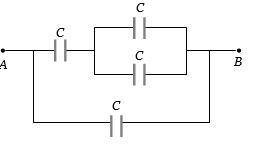
- 4Four equal capacitors, each of capacity $C$, are arranged as shown. The effective capacitance between $A$ and $B$ isView Solution
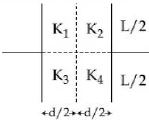
- 5A parallel palate capacitor with square plates is filled with four dielectrics of dielectric constants $K_1, K_2, K_3, K_4$ arranged as shown in the figure. The effective dielectric constant $K$ will beView Solution
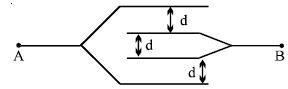
- 6Four metallic plates arearranged as shown in the figure. If the distance between each plate then capacitance of the given system between points $A$ and $B$ is (Given $d < < A$)View Solution
- 7View SolutionWhen a dielectric material is introduced between the plates of a charges condenser, then electric field between the plates
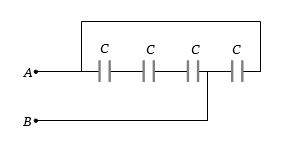
- 8The equivalent capacitance between $A$ and $B$ isView Solution
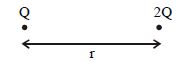
- 9Mass of charge $Q$ is $m$ and mass of charge $2Q$ is $4\,m$ . If both are released from rest, then what will be $K.E.$ of $Q$ at infinite separationView Solution
- 10A capacitor of capacitance $C$ is initially charged to a potential difference of $V$ $volt$. Now it is connected to a battery of $2V$ with opposite polarity. The ratio of heat generated to the final energy stored in the capacitor will beView Solution