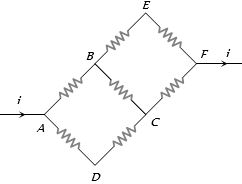
Three copper wires of lengths and cross sectional areas are $(l,\,A),\,(2l,\,A/2)$ and $(l/2,\, 2A)$ . Resistance is minimum in
AIIMS 2013,AIPMT 1997, Easy


Download our appand get started for free
Experience the future of education. Simply download our apps or reach out to us for more information. Let's shape the future of learning together!No signup needed.*
Similar Questions
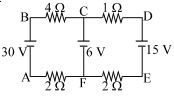
- 1The figure shows a network of four resistances and three batteries The electrical power dissipated as heat is .............. $W$View Solution
- 2Two cells of same emf but different internal resistances $I_{1}$ and $I_{2}$ are connected in series with a resistance $R$. The value of resistance $R$, for which the potential difference across second cell is zero, isView Solution
- 3Three bulbs of $40\,W$, $60\,W$ and $100\,W$ are arranged in series with $220\,V$. Which bulb has minimum resistance............... $W$View Solution
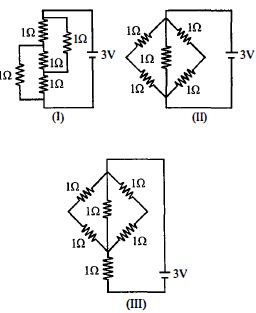
- 4The figure shows three circuits $I, II$ and $III$ which are connected to a $3\,V$ battery. If the powers dissipated by the configurations $I, II$ and $III$ are $P_1 , P_2$ and $P_3$ respectively, thenView Solution
- 5In a potentiometer circuit there is a cell of $e.m.f.$ $2\, volt$, a resistance of $5\, ohm$ and a wire of uniform thickness of length $1000\, cm$ and resistance $15\, ohm$. The potential gradient in the wire isView Solution
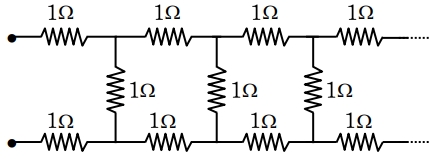
- 6View SolutionThe equivalent resistance of the infinite network given below is :
- 7In the experiment of calibration of voltmeter, a standard cell of $e.m.f\,\,1.1\,volt$ is balanced against $440\,cm$ of potential wire. The potential difference across the ends of resistance is found to balance against $220\,cm$ of the wire. The corresponding reading of voltmeter is $0.5\,volt.$ The error in the reading of volmeter will be .................. $volt$View Solution
- 8A wire of resistance $20 \Omega$ is divided into $10$ equal parts. A combination of two parts are connected in parallel and so on. Now resulting pairs of parallel combination are connected in series. The equivalent resistance of final combination is_______.0$\Omega$.View Solution
- 9The current density in a cylindrical wire of radius $4 \; mm$ is $4 \times 10^{6} \; Am ^{-2}$. The current through the outer portion of the wire between radial distance $\frac{R}{2}$ and $R$ is $\dots \; \pi A .$View Solution
- 10In the adjoining circuit diagram each resistance is of $10$ $\Omega$. The current in the arm $AD$ will beView Solution