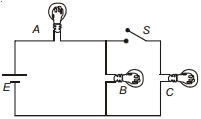
Three identical bulbs are connected as shown in figure. When switch $S$ is closed, the power consumed in bulb $B$ is $P$. What will be the power consumed by the same bulb when switch $S$ is opened?
Medium
Download our app for free and get started
(a)
$P=\left(\frac{E}{2 R}\right)^2 R$
$P=\frac{E^2}{4 R}$
When $K$ is closed
$i=\frac{2 E}{3 R}$
$P^{\prime}=\frac{E^2}{9 R^2} \cdot R$
$P^{\prime}=\frac{E^2}{9 R}$
$\frac{P}{P^{\prime}}=\frac{9}{4}$
$P^{\prime}=\frac{4 P}{9}$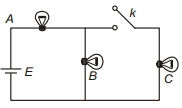

Download our appand get started for free
Experience the future of education. Simply download our apps or reach out to us for more information. Let's shape the future of learning together!No signup needed.*
Similar Questions
- 1In the diagram resistance between any two junctions is $R$. Equivalent resistance across terminals $A$ and $B$ isView Solution

- 2The e.m.f. of a cell is $E\, volts$ and internal resistance is $r$ $ohm$. The resistance in external circuit is also $r$ $ohm$. The p.d. across the cell will beView Solution
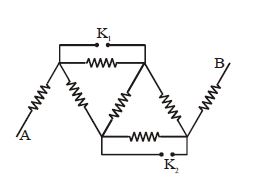
- 3All wires have same resistance and equivalent resistance between $A$ and $B$ is $R$. Now keys are closed, then the equivalent resistance will becomeView Solution
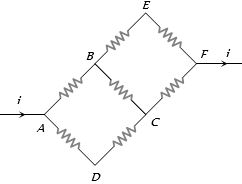
- 4In the adjoining circuit diagram each resistance is of $10$ $\Omega$. The current in the arm $AD$ will beView Solution
- 5The equivalent resistance across $AB$ would be ............ $\Omega$View Solution
- 6Which of the following graph represents the variation of resistivity ( $\rho$ ) with temperature $(T)$ for copper $?$View Solution
- 7Two wires that are made up of two different materials whose specific resistance are in the ratio $2 : 3$, length $3 : 4$ and area $4 : 5$. The ratio of their resistances isView Solution
- 8View SolutionOhm's law is true
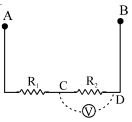
- 9Resistances $R_1$ and $R_2$ each $60\,\Omega$ are connected in series as shown in figure. The Potential difference between $A$ and $B$ is kept $120$ volt. Then what ............. $V$ will be the reading of voltmeter connected between the point $C$ and $D$ if resistance of voltmeter is $120\,\Omega .$View Solution
- 10The lowest resistance which can be obtained by connecting $10$ resistors each of $1/10$ $ohm$ isView Solution