A hollow metal sphere of radius $5\,\, cm$ is charged so that the potential on its surface is $10\,\, V$. The potential at the centre of the sphere is.....$V$
Easy


Download our appand get started for free
Experience the future of education. Simply download our apps or reach out to us for more information. Let's shape the future of learning together!No signup needed.*
Similar Questions
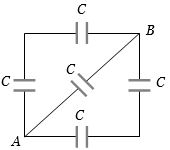
- 1In the figure shown, the effective capacitance between the points $A$ and $B$, if each has capacitance $C$, isView Solution
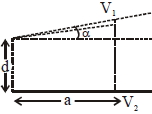
- 2A capacitor is made of two square plates each of side $a$ making a very small angle $\alpha$ between them, as shown in figure. The capacitance will be close toView Solution
- 3The figure shows a family of parallel equipotential surfaces and four paths along which an electron is made to move from one surface to another as shown in the figurView Solution
$(I)$ What is the direction of the electric field ?
$(II)$ Rank the paths according to magnitude of work done, greatest first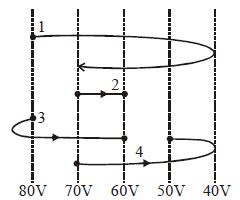
- 4View SolutionAn uncharged capacitor is connected to a battery. On charging the capacitor
- 5If some charge is given to a solid metallic sphere, the field inside remains zero and by Gauss's law all the charge resides on the surface. Now, suppose that Coulomb's force between two charges varies as $1 / r^{3}$. Then, for a charged solid metallic sphereView Solution
- 6Two capacitors connected in parallel having the capacities ${C_1}$ and ${C_2}$ are given $'q'$ charge, which is distributed among them. The ratio of the charge on ${C_1}$ and ${C_2}$ will beView Solution
- 7A capacitor of capacitance $6\,\mu \,F$ is charged upto $100$ $volt$. The energy stored in the capacitor is........$Joule$View Solution
- 8There exists an electric field of magnitude $E$ in $x$-direction. If the work done in moving a charge of $0.2 \,C$ through a distance of $2 \,m$ along a line making an angle $60^{\circ}$ with $x$-axis is $4 \,J$, then the value of $E$ is ........ $N / C$View Solution
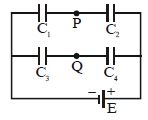
- 9The potential difference between the points $P$ and $Q$ in the adjoining circuit will be :-View Solution
- 10The insulated spheres of radii ${R_1}$ and ${R_2}$ having charges ${Q_1}$and ${Q_2}$ respectively are connected to each other. There isView Solution