Three infinitely long linear charges of charge density $\lambda $ , $\lambda $ and $-2\lambda $ are placed in space. A point in space is specified by its perpendicular distance $r_1 , r_2 $ and $ r_3$ respectively from the linear charges. For the points which are equipotential
Diffcult
Download our app for free and get started
$2{\rm{k}}\lambda \ln \left( {\frac{{\rm{a}}}{{{{\rm{r}}_1}}}} \right) + 2{\rm{k}}\lambda \ln \left( {\frac{{\rm{a}}}{{{{\rm{r}}_2}}}} \right) + 4{\rm{k}}\lambda \ln \left( {\frac{{\rm{a}}}{{{{\rm{r}}_3}}}} \right) = {\rm{c}}$
$=\frac{\mathrm{r}_{3}^{2}}{\mathrm{r}_{1} \mathrm{r}_{2}}=$ const.

Download our appand get started for free
Experience the future of education. Simply download our apps or reach out to us for more information. Let's shape the future of learning together!No signup needed.*
Similar Questions
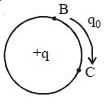
- 1A circle of radius $R$ is drawn with charge $+ q$ at the centre. A charge $q_0$ is brought from point $B$ to $C$, then work done isView Solution
- 2Two spherical conductors $A$ and $B$ of radius $a$ and $b (b > a)$ are placed in air concentrically $B$ is given charge $+ Q$ coulomb and $A$ is grounded. The equivalent capacitance of these isView Solution
- 3A capacitor is connected to a $10\,V$ battery. The charge on the plates is $10\,\mu C$ when medium between plates is air. The charge on the plates become $100\,\mu C$ when space between plates is filled with oil. The dielectric constant of oil isView Solution
- 4Two small equal point charges of magnitude $q$ are suspended from a common point on the ceiling by insulating mass less strings of equal lengths. They come to equilibrium with each string making angle $\theta $ from the vertical. If the mass of each charge is $m,$ then the electrostatic potential at the centre of line joining them will be $\left( {\frac{1}{{4\pi { \in _0}}} = k} \right).$View Solution
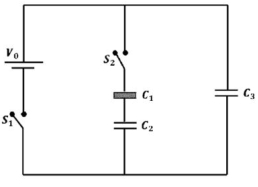
- 5. Three identical capacitors $C _1, C _2$ and $C _3$ have a capacitance of $1.0 \mu F$ each and they are uncharged initially. They are connected in a circuit as shown in the figure and $C _1$ is then filled completely with a dielectric material of relative permittivity $\varepsilon_{ r }$. The cell electromotive force (emf) $V_0=8 V$. First the switch $S_1$ is closed while the switch $S_2$ is kept open. When the capacitor $C_3$ is fully charged, $S_1$ is opened and $S_2$ is closed simultaneously. When all the capacitors reach equilibrium, the charge on $C _3$ is found to be $5 \mu C$. The value of $\varepsilon_{ r }=$. . . . .View Solution
- 6View SolutionIf a charge is shifted from a low potential region to high potential region, the electric potential energy
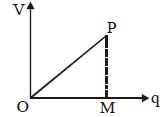
- 7Charge $'q'$ on a capacitor varies with voltage $'V'$ as shown. The area of $\Delta OPM$ representsView Solution
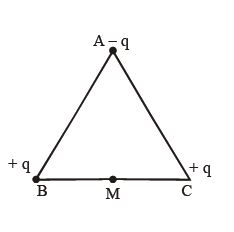
- 8Charges $-q,\, q,\,q$ are placed at the vertices $A$, $B$, $C$ respectively of an equilateral triangle of side $'a'$ as shown in the figure. If charge $-q$ is released keeping remaining two charges fixed, then the kinetic energy of charge $(-q)$ at the instant when it passes through the mid point $M$ of side $BC$ isView Solution
- 9A bullet of mass $2\, gm$ is having a charge of $2\,\mu C$. Through what potential difference must it be accelerated, starting from rest, to acquire a speed of $10\,m/s$View Solution
- 10View SolutionAfter charging a capacitor the battery is removed. Now by placing a dielectric slab between the plates :-