Two spherical conductors $A$ and $B$ of radius $a$ and $b (b > a)$ are placed in air concentrically $B$ is given charge $+ Q$ coulomb and $A$ is grounded. The equivalent capacitance of these is
Medium


Download our appand get started for free
Experience the future of education. Simply download our apps or reach out to us for more information. Let's shape the future of learning together!No signup needed.*
Similar Questions
- 1Let $V$ and $E$ are potential and electric field intensity at a point thenView Solution
- 2Assertion : Electric potential and electric potential energy are different quantities.View Solution
Reason : For a system of positive test charge and point charge electric potential energy $=$ electric potential.
- 3The capacitance of a parallel plate capacitor with air as medium is $6\, \mu F$. With the introduction of a dielectric medium, the capacitance becomes $30\, \mu F$. The permittivity of the medium is..........$C ^{2} N ^{-1} m ^{-2}$View Solution
$\left(\varepsilon_{0}=8.85 \times 10^{-12} C ^{2} N ^{-1} m ^{-2}\right)$
- 4After the switch shown in figure $A$ is closed, there is current $i$ through resistance $R$. Figure $B$ indicates current variation curves $a, b, c$ and $d$ for four sets of values of $R$ and capacitance $C$:View Solution
$(i)$ $R_0$ and $C_0$, $(ii)$ $2R_0$ and $C_0$,
$(iii)$ $R_0$ and $2C_0$, $(iv)$ $2R_0$ and $2C_0$.
Which set goes with which curve?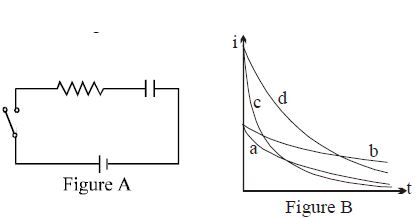
- 5View SolutionThe capacity of parallel plate condenser depends on
- 6A capacitor with capacitance $5\,\mu F$ is charged to $5\,\mu C.$ If the plates are pulled apart to reduce the capacitance to $2\,\mu F,$ how much work is done?View Solution
- 7Two capacitors of $10\,\mu \,F$ and $20\,\mu \,F$ are connected in series with a $30\,V$ battery. The charge on the capacitors will be, respectivelyView Solution
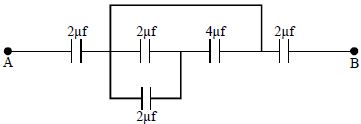
- 8Find the equivalent capacitance between $A$ and $B$.......$\mu f$View Solution
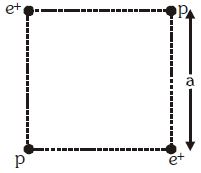
- 9Two positrons $(e^+)$ and two protons $(p)$ are kept on four corners of a square of side $a$ as shown in figure. The mass of proton is much larger than the mass of positron. Let $q$ denotes the charge on the proton as well as the positron then the kinetic energies of one of the positrons and one of the protons respectively after a very long time will be-View Solution
- 10View SolutionA non uniformly shaped conductor is charged then at it's sharpest point