Three particles, each having a charge of $10\,\mu C$ are placed at the corners of an equilateral triangle of side $10\,cm$. The electrostatic potential energy of the system is.....$J$ (Given $\frac{1}{{4\pi {\varepsilon _0}}} = 9 \times {10^9}\,N - {m^2}/{C^2}$)
Medium
Download our app for free and get started
(c) For pair of charge $U = \frac{1}{{4\pi {\varepsilon _0}}}.\frac{{{q_1}{q_2}}}{r}$
${U_{System}} = \frac{1}{{4\pi {\varepsilon _0}}}\left[ {\frac{{10 \times {{10}^{ - 6}} \times 10 \times {{10}^{ - 6}}}}{{10/100}}} \right.$
$\left. { + \frac{{10 \times {{10}^{ - 6}} \times 10 \times {{10}^{ - 6}}}}{{10/100}} + \frac{{10 \times {{10}^{ - 6}} \times 10 \times {{10}^{ - 6}}}}{{10/100}}} \right]$
$ = 3 \times 9 \times {10^9} \times \frac{{100 \times {{10}^{ - 12}} \times 100}}{{10}} = 27\,J$
${U_{System}} = \frac{1}{{4\pi {\varepsilon _0}}}\left[ {\frac{{10 \times {{10}^{ - 6}} \times 10 \times {{10}^{ - 6}}}}{{10/100}}} \right.$
$\left. { + \frac{{10 \times {{10}^{ - 6}} \times 10 \times {{10}^{ - 6}}}}{{10/100}} + \frac{{10 \times {{10}^{ - 6}} \times 10 \times {{10}^{ - 6}}}}{{10/100}}} \right]$
$ = 3 \times 9 \times {10^9} \times \frac{{100 \times {{10}^{ - 12}} \times 100}}{{10}} = 27\,J$

Download our appand get started for free
Experience the future of education. Simply download our apps or reach out to us for more information. Let's shape the future of learning together!No signup needed.*
Similar Questions
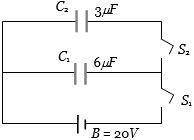
- 1In the circuit shown here ${C_1} = 6\,\mu F,\;{C_2} = 3\,\mu F$ and battery $B = 20\,V$. The switch ${S_1}$ is first closed. It is then opened and afterwards ${S_2}$ is closed. What is the charge finally on ${C_2}$.......$\mu C$View Solution
- 2A hollow metallic sphere of radius $R$ is given a charge $Q$. Then the potential at the centre isView Solution
- 3Electric potential at a point $P$ due to a point charge of $5 \times 10^{-9}\; C$ is $50 \;V$. The distance of $P$ from the point charge is ......... $cm$View Solution
(Assume, $\frac{1}{4 \pi \varepsilon_0}=9 \times 10^{+9}\; Nm ^2 C ^{-2}$)
- 4An electric charge $10^{-3}$ $\mu C$ is placed at the origin $(0, 0) $ of $X - Y$ co-ordinate system. Two points $A$ and $B$ are situated at $\left( {\sqrt 2 ,\sqrt 2 } \right)$ and $(2,0)$ respectively. The potential difference between the points $A$ and $B$ will be.......$V$View Solution
- 5Two positively charged particles $X$ and $Y$ are initially far away from each other and at rest. $X$ begins to move towards $Y$ with some initial velocity. The total momentum and energy of the system are $p$ and $E$.View Solution
- 6Electric potential at any point is $V = -5x + 3y + \sqrt {15} z$, then the magnitude of the electric field isView Solution
- 7A charge $ + q$ is fixed at each of the points $x = {x_0},\,x = 3{x_0},\,x = 5{x_0}$..... $\infty$, on the $x - $axis and a charge $ - q$ is fixed at each of the points $x = 2{x_0},\,x = 4{x_0},x = 6{x_0}$,..... $\infty$. Here ${x_0}$ is a positive constant. Take the electric potential at a point due to a charge $Q$ at a distance $r$ from it to be $Q/(4\pi {\varepsilon _0}r)$. Then, the potential at the origin due to the above system of charges isView Solution
- 8The radius of a metallic sphere if its capacitance is $1/9\,F$, isView Solution
- 9The distance between the two plates of a parallel plate capacitor is doubled and the area of each plate is halved. If $C$ is its initial capacitance, its final capacitance is equal toView Solution
- 10Two mutually perpendicular infinitely long straight conductors carrying uniformly distributed charges of linear densities $\lambda_{1}$ and $\lambda_{2}$ are positioned at a distance $r$ from each other. Force between the conductors depends on $r$ asView Solution